Andy Burnham Consumer Protections Target Subscription Traps and Misleading Discounts


Prime Minister Andy Burnham has announced new consumer protections aimed at ending subscription traps and tackling misleading discounts, with the first major subscription changes due to take effect in January 2027.
For UK small businesses, the announcement matters for two different reasons.
Subscription businesses face confirmed changes around information, renewals, cancellation and cooling-off rights, while retailers should prepare for a separate consultation on strengthening the law around fake discounts and deceptive pricing.
→ January 2027: New subscription rules are scheduled to come into force, including easier cancellation and clearer renewal information.
→ Autumn 2026: The government plans to consult on whether fake “was” prices, invented discounts and misleading RRPs should become automatically banned practices.
What Has Andy Burnham Announced?

Burnham’s consumer protection package starts with two measures intended to reduce what the government describes as everyday financial frustrations for households.
The first targets subscription traps — arrangements where consumers may find it easy to join a service but difficult to leave, or where contracts renew without customers fully appreciating what they will pay next.
The second focuses on misleading retail discounts. The government wants to make it easier to take action when businesses create a false impression of savings through questionable previous prices, invented discounts or misleading recommended retail prices.
According to the official government announcement, both measures form part of a wider series of “everyday fixes” aimed at easing cost-of-living pressures.
However, businesses should distinguish carefully between the two policies. The subscription reforms have a January 2027 implementation timetable, whereas the additional rules on misleading discounts are still subject to consultation.
New Subscription Rules Will Start in January 2027
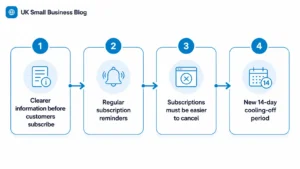
The government says the new subscription regime will require businesses to provide consumers with clearer information and make it easier to leave recurring contracts.
Clearer Information Before Customers Subscribe
Customers will need clearer up-front information about the subscription they are entering.
For businesses, this makes the information displayed during signup particularly important.
Charges, recurring payments, renewal arrangements and important contractual conditions should not be buried in complicated wording or difficult-to-find pages.
Regular Subscription Reminders
Businesses will also need to provide regular reminders.
That means firms operating recurring subscription models should review how they notify customers about continuing contracts and upcoming renewals.
Businesses that already provide clear renewal notices may have less work to do, but those relying on minimal communication should start reviewing their systems before January 2027.
Subscriptions Must Be Easier to Cancel
A central part of the announcement is the principle that subscriptions should become much easier to exit.
Burnham said the government wants it to be as easy for customers to leave a subscription as it is to join one.
For digital businesses, this could make the design of online cancellation journeys particularly important.
Firms should review whether customers can cancel through their account without unnecessary obstacles, repeated retention screens or unclear instructions.
Cancellation records may also become increasingly important where customer payments are later challenged. Our guide to merchant chargeback disputes explains why businesses should retain reliable records of consent, renewals and cancellations.
New 14-day Cooling-off Period
The government has also announced a 14-day cooling-off period allowing consumers to cancel after a trial or long-term subscription contract renews.
Businesses using free trials, introductory subscriptions or longer-term recurring agreements should therefore examine how renewals are processed and how customers will exercise this right.
Further official implementation detail will matter, so businesses should check final guidance before changing contractual processes.
How Much Are Unwanted Subscriptions Costing Consumers?

The scale of the subscription market helps explain the government’s intervention.
Official figures accompanying the announcement estimate that:
- there are around 155 million active subscriptions in the UK;
- consumers spend approximately £1.6 billion a year on subscriptions they do not want; and
- ending an unwanted subscription could save an average of around £14 a month.
For subscription businesses, the commercial impact could go beyond compliance.
Companies that currently benefit from customers forgetting to cancel may see retention patterns change. Businesses that depend on genuine customer value and voluntary renewals could, however, benefit from stronger trust and clearer competition.
Membership-based businesses may also want to consider how prominently annual charges and increases are communicated. Our coverage of Costco membership costs provides a recent example of how membership pricing can affect customer decisions.
Will Every Subscription Business Face Major Changes?
Not necessarily.
The government specifically says businesses that already give customers sufficient notice before renewals and make contracts easy to leave should see relatively little change.
That is significant for smaller firms concerned about another major compliance burden.
A business already operating a straightforward system — clear signup information, visible renewal terms, timely reminders and simple cancellation — may be closer to the new requirements than one relying on complex retention processes.
The government argues clearer rules should also create a more level playing field by preventing businesses using difficult cancellation processes from gaining an advantage over competitors that treat customers more transparently.
Certain charitable memberships associated with cultural and heritage organisations will be excluded from the new subscription rules.
Government Targets Misleading Discounts and Fake Prices
The second part of Burnham’s consumer protection announcement focuses on promotional pricing.
The government is concerned about retailers creating an exaggerated impression of value by manipulating the price against which a discount is presented.
Practices being examined include:
- fake “was” prices;
- invented discounts;
- misleading recommended retail prices;
- temporarily increasing a price before advertising a reduction; and
- presenting a normal selling price as though it represents a special saving.
For legitimate retailers, the issue is not that discounting itself is being targeted. Businesses can still use sales and promotional pricing, but claims about savings need to reflect reality.
Retailers interested in how major businesses use genuine promotions and price reductions can also see our coverage of Iceland pricing changes.
Are Misleading Discounts Already Being Banned?
 The new proposed measures should not be described as though they have already become law.
A consultation is expected in autumn 2026 to consider whether practices such as fake “was” prices, invented discounts and misleading RRPs should be added to the list of practices automatically treated as unfair under the Digital Markets, Competition and Consumers Act 2024.
Existing UK consumer law already prohibits unfair commercial practices, including misleading conduct in relevant circumstances. The CMA unfair trading guidance explains businesses’ existing responsibilities under the DMCCA.
What the government is considering is a clearer automatic prohibition for specified pricing tactics.
That distinction matters. The consultation is a proposal about strengthening and simplifying enforcement; it is not evidence that every measure described in the announcement is already in force.
What Should Retailers Check Before Running Promotions?
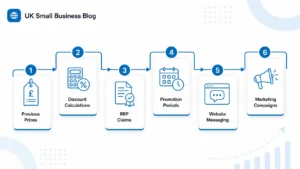
Retailers do not need to wait for the consultation before reviewing questionable pricing practices.
A sensible promotional pricing audit should examine:
- Previous prices — Can the business prove that the claimed earlier price was genuine?
- Discount calculations — Does the advertised percentage saving match the actual prices?
- RRP claims — Is there a reasonable basis for presenting the recommended retail price?
- Promotion periods — Has the product genuinely been reduced, or is the “sale” price effectively its normal selling price?
- Website messaging — Are countdowns, banners and savings claims accurate?
- Marketing campaigns — Do emails, adverts and social posts make the same truthful pricing claims as the product page?
Businesses should retain records showing how significant promotional claims were calculated.
What Do the Changes Mean for UK Small Businesses?
For some firms, the measures could create additional work.
Subscription businesses may need to update websites, billing systems, renewal emails and cancellation processes. Retailers could need stronger controls around promotional pricing and evidence supporting savings claims.
There are potential benefits as well.
Businesses already operating transparently may have less to change, while competitors using confusing subscriptions or questionable discounts could face tighter restrictions.
Clearer rules can also reduce uncertainty. A small retailer should not have to compete with another business making a £100 product appear to be a £200 product simply so it can advertise a dramatic “50% off” promotion.
The same principle applies to subscriptions: genuine customer retention is more sustainable when people stay because they want the service, rather than because leaving is deliberately difficult.
What Are Consumer Groups Saying?

Consumer organisations have broadly welcomed the announcement.
Which? said stronger rules could make it easier to tackle misleading pricing practices that regulators have previously found difficult to challenge.
Citizens Advice highlighted the wider problem of accidental subscriptions, referring to previous research suggesting more than 13 million people had accidentally taken out a subscription within a year.
The Money and Mental Health Policy Institute also welcomed the proposals, while stressing that people experiencing mental health problems can find misleading discounts and complicated subscription processes especially difficult to navigate.
What Happens Next?
There are two dates businesses should watch.
9 August 2026 — The government announced the consumer protection measures.
Autumn 2026 — Consultation is expected on adding specified misleading pricing practices to the DMCCA banned-practices list.
January 2027 — The new subscription rules are scheduled to take effect.
Businesses should monitor further government and regulatory guidance as January approaches, particularly around the detailed operation of cancellation, reminders and cooling-off periods.
What Should Small Businesses Do Now?
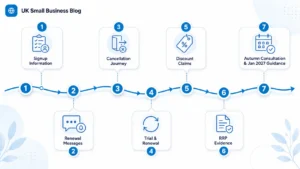
Businesses do not need to redesign every system immediately, but they should identify potential problems early.
A practical starting point is to:
- audit subscription signup information;
- review automatic renewal messages;
- test the customer cancellation journey;
- check trial and renewal processes;
- review “was/now” and percentage discount claims;
- confirm evidence supporting RRPs and previous prices; and
- monitor the autumn consultation and January 2027 guidance.
Businesses already following transparent practices may find the transition relatively straightforward. Those relying on friction, vague renewal terms or questionable discount presentation have more reason to act early.
FAQs
When do the new UK subscription rules start?
The government says the new subscription rules will come into force in January 2027. Businesses using recurring subscription contracts should review their processes before that date.
What is a subscription trap?
A subscription trap occurs when customers find it difficult to cancel a recurring service or continue paying after a renewal they did not properly anticipate or want.
Will businesses have to make subscriptions easier to cancel?
Yes. The government says the new rules will require a much easier exit from subscription contracts alongside clearer information and regular reminders.
Are fake “was” prices now automatically illegal?
The August announcement does not itself make the proposed practices automatically banned. An autumn 2026 consultation will consider adding fake “was” prices, invented discounts and misleading RRPs to the DMCCA list of practices automatically regarded as unfair.
What is the new 14-day cooling-off period?
The government says consumers will receive a new 14-day period in which they can cancel after a trial or long-term subscription contract renews. Businesses should watch for detailed implementation guidance.
Which businesses could be affected?
Subscription providers, ecommerce businesses, retailers and other consumer-facing firms could be affected. Certain charitable memberships for cultural and heritage organisations are expected to be excluded from the new subscription rules.

Jermaine writes informative business content related to entrepreneurship, finance, innovation, operations, and emerging opportunities for growing businesses in the UK.

Does Gross Misconduct Always Lead to Dismissal?
No. Gross misconduct does not always lead to dismissal. It can be serious enough to justify dismissal without notice, including for a first offence, but dismissal is not…
Andy Burnham Whitehall Job Cuts: What Is Changing In 2026?
The Andy Burnham Whitehall job cuts story has become part of a much wider debate about how the UK Government should operate and where political power, public money…
Insights for the Modern
UK Small Business.
Join 15,000+ owners receiving tactical analysis on finance, marketing, and technology. No clutter.
Zero spam. Unsubscribe in one click.