HMRC Quantexa 10 Year Contract: £175 Million AI Deal and What It Means for UK Businesses


The HMRC Quantexa 10 year contract is a major £175 million technology agreement designed to improve how HM Revenue and Customs identifies tax fraud, connects taxpayer records and resolves administrative errors.
Announced by Quantexa on 14 May 2026, the partnership will use advanced data analytics, entity resolution and artificial intelligence to help HMRC modernise its systems.
The agreement is described as a 10-year partnership, although the procurement provides for an initial eight-year contract with an option to extend for another two years.
The announcement became particularly significant after HMRC published its latest tax gap statistics on 23 June 2026. These revealed that an estimated £59.2 billion in tax went unpaid during 2024/25, equivalent to 6.4% of theoretical UK tax liabilities.
Small businesses accounted for 62% of that estimated shortfall, making improved tax compliance an important issue for company directors, sole traders and accountants.
However, the contract does not introduce new tax laws or mean that artificial intelligence can automatically impose penalties.
What Is the HMRC Quantexa 10 Year Contract?
The HMRC Quantexa contract is a long-term technology partnership intended to create a more connected and reliable foundation for tax administration.
Quantexa is a British-founded data analytics company specialising in Decision Intelligence, a technology that identifies relationships between people, organisations, accounts and transactions.
Rather than examining individual records in isolation, the platform helps investigators understand how information from different systems relates to the same taxpayer or business.
According to Quantexa’s official contract announcement, the programme aims to modernise HMRC’s data infrastructure, improve operational efficiency and support responsible AI deployment.
The agreement also provides a foundation for identifying possible tax risks more effectively.
HMRC Quantexa Contract Overview
| Contract Detail | Confirmed Information |
| Government department | HM Revenue and Customs |
| Technology provider | Quantexa |
| Announced value | £175 million |
| Initial contract period | Eight years |
| Extension option | Up to two additional years |
| Public announcement | 14 May 2026 |
| Main technology | Entity resolution and Decision Intelligence |
| Primary objectives | Data modernisation, fraud detection and improved customer services |
| Data governance | HMRC retains responsibility for taxpayer data |
The £175 million figure represents the stated contract value, not an amount already paid to Quantexa.
Some publications describe the agreement as potentially worth £175 million because future expenditure and the extension period depend on contractual arrangements.
International coverage has also described the deal as approximately $233 million or $234 million. These are currency conversions of the same agreement, not separate contracts.
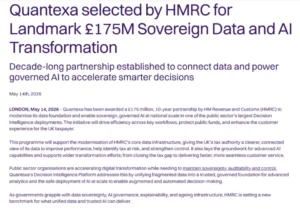
Quantexa’s official announcement confirming the £175 million partnership with HMRC.
Why Is HMRC Investing in AI-Powered Fraud Detection?
HMRC faces increasing pressure to identify unpaid taxes while improving services for millions of taxpayers.
Traditional investigations often require officers to examine separate records manually, particularly when financial activity involves multiple companies, directors or transactions.
Connected data technology can help reveal relationships that would otherwise take considerably longer to investigate.
However, the main reason this investment matters is the scale of the UK’s estimated tax gap.
How Large Is the UK Tax Gap in 2026?
HMRC’s provisional figures for 2024/25 reveal the following:
| Tax Gap Measure | 2023/24 | 2024/25 |
| Estimated tax gap | £52.8 billion | £59.2 billion |
| Percentage of theoretical liabilities | 6.0% | 6.4% |
| Estimated tax collected | 94.0% | 93.6% |
| Small-business share | 62% | 62% |
The 2023/24 figure was revised upwards from an earlier estimate of £46.8 billion.
That distinction matters because articles still using £46.8 billion as the latest tax gap are relying on outdated statistics.
The current figures are available in HMRC’s official 2024/25 tax gap announcement.
The government has also announced measures intended to raise an additional £10 billion annually by 2029/30 through efforts to close the tax gap.
This is a wider policy ambition, not a guaranteed financial return from the Quantexa contract.
Why Do Small Businesses Account for 62% of the Tax Gap?
HMRC estimates that small-business non-compliance accounted for approximately £36.7 billion in unpaid taxes during 2024/25.
For tax administration purposes, HMRC generally defines small businesses as those with turnover below £10 million and typically fewer than 20 employees.
This category is therefore substantially broader than companies employing only a handful of people.
The estimated small-business share increased from around 40% in 2017/18 to approximately 62% in the latest figures.
Importantly, that increase cannot automatically be attributed to worsening business behaviour. Changes in data quality, compliance investigations and estimation methods have influenced the historical figures.
A higher share of the tax gap also does not mean 62% of small businesses are deliberately evading tax.
The percentage describes the estimated distribution of unpaid tax across taxpayer groups.
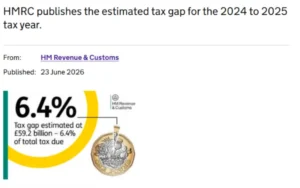
HMRC’s 2024/25 tax gap figures showing the £59.2 billion estimate and the 62% small-business contribution.
How Much of the Tax Gap Comes From Corporation Tax?
Corporation Tax is one of the largest components of the estimated tax gap.
HMRC estimates that Corporation Tax accounts for approximately 35% of the total, equivalent to around £21 billion in 2024/25.
Of this, approximately £17.3 billion is attributed to small businesses.
The figures suggest that accurate Corporation Tax reporting deserves particular attention from company directors and professional advisers.
HMRC’s research also found that 55% of small businesses in its relevant 2022/23 compliance analysis submitted incorrect Corporation Tax returns resulting in additional tax liabilities.
This does not establish that 55% of all UK small companies knowingly submitted incorrect returns.
KPMG’s analysis of the latest statistics identifies two important areas of concern: underreported business income or excessive expense claims, and errors involving transactions between companies and their owners.
For limited companies, these issues make the correct treatment of dividends, directors’ loan accounts, business expenditure and taxable profits particularly important.
How Reliable Are HMRC’s Tax Gap Estimates?
The statistics are estimates rather than an exact measurement of unpaid tax.
TaxWatch researcher Mike Lewis highlighted that the small-business Corporation Tax estimate relies on a random audit sample of just 337 businesses’ tax returns.
Such a sample can inform statistical modelling, but it also introduces uncertainty when estimates are extrapolated across millions of businesses.
HMRC’s 2026 publication acknowledges this problem. The share of the overall tax gap classified as having high uncertainty increased to 35%, largely because the small-business Corporation Tax component was moved into that category.
The figures therefore support stronger compliance monitoring, but they should not be presented as proof that every estimated pound is recoverable.
The Chartered Institute of Taxation has also questioned how achievable the government’s wider tax-gap reduction target will be.
Its director of public policy, Ellen Milner, described the government’s £10 billion target as feeling “very optimistic”.
This professional assessment highlights an important distinction: detecting potential non-compliance is not the same as establishing liability or successfully collecting unpaid tax.
Did HMRC Work With Quantexa Before May 2026?
Yes. The 2026 announcement expanded an existing technology relationship.
HMRC had already entered into an agreement with Quantexa in September 2024, publicly reported in January 2025.
That earlier two-year contract was valued at approximately £2.9 million including VAT.
It involved replacing an internally developed Enterprise Matching Tool with a more advanced entity-resolution service.
The earlier project was associated with HMRC’s Unique Customer Record initiative, which aims to improve consistency between taxpayer information held across separate systems.
This history changes how the 2026 contract should be understood.
Rather than selecting an entirely unfamiliar provider, HMRC expanded its use of technology already being introduced into its data infrastructure.
How Has Quantexa’s Government Work Developed?
| Period | Development |
| January 2023 | Quantexa secured a Public Sector Fraud Authority analytics contract worth approximately £3.4 million |
| September 2024 | HMRC entered into an earlier entity-resolution agreement |
| January 2025 | The earlier HMRC contract was publicly reported |
| May 2026 | Quantexa announced the £175 million HMRC partnership |
| October 2026 | Quantexa announced a separate Insolvency Service contract |
The earlier agreements demonstrate experience in government data analytics, but they do not by themselves establish that the new project will deliver its intended financial or operational benefits.
How Will Quantexa’s Technology Identify Tax Fraud?
Quantexa’s platform combines entity resolution, contextual analysis and network analytics.
Entity resolution identifies records that refer to the same person or organisation, even when those records contain inconsistent names, addresses or identifiers.
Network analytics then examines relationships between the entities.
For example, investigators may find that several apparently independent companies share directors, addresses or other financial connections.
These relationships do not automatically indicate wrongdoing.
However, they can provide evidence that helps investigators decide whether further checks are necessary.
What Types of Tax Fraud Could the Technology Help Detect?
Potential applications include:
- VAT fraud: Identifying suspicious chains of transactions between connected companies.
- Payroll fraud: Examining relationships involving employers, workers and payroll records.
- Shell companies: Identifying organisations that may conceal beneficial ownership or financial activity.
- False business records: Finding inconsistencies between company information and tax declarations.
- Organised financial crime: Connecting apparently separate transactions or businesses associated with wider networks.
The technology is particularly relevant where investigations require officers to understand complex corporate structures.
Its effectiveness will depend on the quality of the underlying data, investigative procedures and the safeguards applied to automated risk assessments.
Does Quantexa Replace HMRC’s Existing Connect System?
HMRC has used its Connect compliance analytics system since 2010.
Connect brings together information from multiple sources to identify inconsistencies and potential tax risks.
Professional services firm Crowe identifies relevant information sources as including banks, credit card providers, Companies House, Land Registry and publicly available social media information.
Crowe also reports that HMRC’s capabilities expanded in January 2026 to include information from cryptoasset service providers.
This increased access to financial information is also relevant to businesses accepting cryptocurrency or individuals reporting digital asset transactions.
Our coverage of HMRC crypto tax warning letters explains how third-party information can prompt taxpayers to check undeclared income or gains.
How Are Connect and Quantexa Different?
| Technology | Main Role |
| HMRC Connect | Analyse data to identify compliance risks |
| Quantexa Entity Resolution | Match records and identify relationships between entities |
| Microsoft Copilot | Support staff with administrative and productivity tasks |
Quantexa replaced an earlier HMRC enterprise matching tool, but that should not be confused with replacing Connect itself.
There is no confirmed public announcement establishing that Quantexa’s entire platform has replaced Connect.
The technologies may support complementary functions within HMRC’s modernisation programme, while separate work is also underway to reduce reliance on parts of the existing Connect infrastructure.
Can Quantexa Help Resolve Incorrect Tax Payment References?
One practical application concerns payments that HMRC receives but cannot correctly match to a taxpayer’s account.
A small business may pay Corporation Tax, VAT or PAYE using an incorrect reference number.
Although the money has reached HMRC, the payment may not be allocated correctly.
This can create administrative complications, including apparent outstanding balances and unnecessary correspondence.
Better customer-record matching could help HMRC identify and resolve some of these discrepancies.
However, taxpayers should not assume the new technology automatically corrects every incorrectly referenced payment.
Businesses should continue checking their HMRC accounts after making payments and retain transaction confirmations.
Where an established tax debt remains unresolved, the consequences can become more serious. Our article on HMRC’s Direct Recovery of Debts explains the separate enforcement arrangements that may apply to qualifying unpaid liabilities.
Will Microsoft AI Replace HMRC Employees?
Microsoft’s involvement is separate from the Quantexa procurement.
HMRC has been expanding the use of Microsoft 365 Copilot to support employees with administrative work.
Its 2025/26 annual report confirms that approximately 28,000 Copilot licences were issued to staff.
HMRC has also examined the potential benefits of expanding deployment to as many as 50,000 employees.
A July 2026 evaluation found that participants reported productivity savings equivalent to approximately 2–3% of their working week.
The evaluation estimated that deploying up to 50,000 licences could generate around £50 million annually in net productivity benefits through additional staff capacity.
These are projected productivity benefits, not proven cash savings or additional taxes recovered.
How Is HMRC Using Microsoft Copilot?
Common applications include document drafting, summarising meetings, searching internal guidance and supporting technical tasks.
The programme also has limitations.
HMRC’s evaluation found that 46% of non-users cited security and data-privacy concerns as their main reason for not using Copilot.
Quantexa’s technology and Microsoft Copilot should not be treated as interchangeable systems. One focuses primarily on connecting and analysing records, while the other supports workplace productivity.
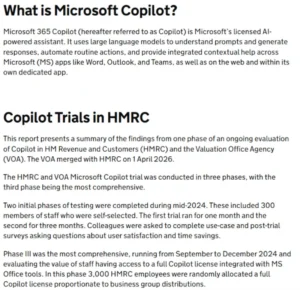
HMRC’s official evaluation of Microsoft Copilot showing reported productivity improvements and implementation challenges.
How Will AI Improve HMRC Customer Service?
Customer service is another important reason for HMRC’s investment.
The department has faced criticism over lengthy response times, unresolved cases and the difficulty taxpayers experience when correcting administrative problems.
Its latest annual report provides more precise information than earlier reporting.
| Customer Service Measure | 2023/24 | 2024/25 | 2025/26 |
| New complaints | 92,206 | 93,589 | 87,353 |
| Average initial complaint response | 35.7 days | 26.7 days | 40 days |
Complaints increased in 2024/25 but declined in 2025/26.
The average initial complaint response time nevertheless worsened to 40 days.
This demonstrates why complaint volumes alone cannot measure the quality of customer service.
Quantexa’s connected records may eventually help staff locate information more efficiently and avoid repeating verification procedures.
However, the announced partnership does not guarantee immediate reductions in waiting times.
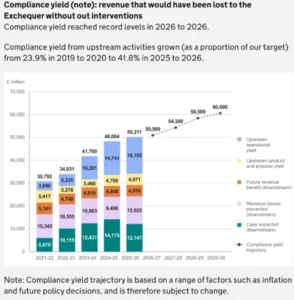
HMRC’s 2025/26 annual report showing complaint volumes and average response times.
Could Quantexa Strengthen UK Digital Sovereignty?
Digital sovereignty has become an increasingly important issue in public-sector technology procurement.
It concerns the ability of government organisations to maintain control over sensitive information, critical systems and technology-related decisions.
Quantexa’s UK origins have made the HMRC agreement part of a wider debate about the role of British technology companies in government infrastructure.
Quantexa founder and chief executive Vishal Marria described the partnership as:
“This is a blueprint for how the UK government deploys AI at scale.”
His statement appeared in the company’s official May 2026 announcement.
The company emphasises governed AI, auditable decision-making and public-sector control.
However, selecting a British-founded supplier does not automatically guarantee stronger security or eliminate risks associated with cloud platforms, software dependencies and subcontractors.
The practical safeguards matter more than the nationality of the technology provider.
How Does Quantexa Compare With Palantir?
The comparison with US technology company Palantir is particularly relevant.
Palantir has secured major British government contracts involving advanced data analytics, defence and public services.
Its NHS Federated Data Platform agreement, awarded to a consortium led by Palantir in 2023, has a potential value of approximately £330 million over seven years.
An October 2026 investigation by The Nerve estimated that the British state had spent or committed to spend more than £990 million through Palantir-related contracts since 2014.
That total combines expenditure and contractual commitments, including future amounts that might not ultimately be paid.
The HMRC Quantexa procurement and the NHS Palantir contract serve different purposes and should not be treated as directly equivalent bids.
Nevertheless, both demonstrate the growing importance of data analytics in public administration.
The central questions remain whether procurement delivers value for money, preserves public control and provides sufficient transparency.
What Is Quantexa’s New Insolvency Service Contract?
An important development occurred on 22 October 2026, when Quantexa announced a separate three-year partnership with the Insolvency Service.
The agreement involves using connected data to investigate economic crime, including suspected money laundering, company phoenixing and historical COVID-19 loan fraud.
Phoenixing becomes abusive when individuals deliberately abandon companies to avoid liabilities before continuing substantially similar activities through new businesses.
The Insolvency Service programme is separate from HMRC’s £175 million contract.
However, both involve technology designed to identify relationships between companies, individuals, addresses and financial activity.
Quantexa’s announcement also confirms that Insolvency Service investigators will remain responsible for enforcement decisions.
For legitimate businesses, stronger detection of organised fraud could help improve competition by making it more difficult for dishonest operators to avoid obligations.
What Concerns Exist About Privacy and Algorithmic Accountability?
The use of advanced analytics in tax administration creates important questions about accuracy, privacy and procedural fairness.
HMRC remains responsible for how taxpayer information is handled within its systems.
Technology suppliers must operate within the relevant contractual, security and data-protection arrangements.
Vishal Marria has publicly emphasised the importance of governed and auditable AI.
However, assurances about responsible technology need to be supported by operational safeguards.
Important areas for scrutiny include:
- Whether personal data is used only for appropriate purposes.
- How inaccurate records are identified and corrected.
- Whether investigators can understand why a taxpayer was flagged.
- How automated recommendations are reviewed by qualified staff.
- Whether taxpayers can challenge incorrect decisions.
- How HMRC measures false positives and unnecessary investigations.
A data-matching alert is not evidence of deliberate wrongdoing on its own.
Accountability becomes particularly important when incorrect information could influence penalties, tax assessments or enforcement action.
In March 2026, the House of Commons Public Accounts Committee criticised the wider government’s underdeveloped use of data analytics to tackle fraud and error.
Its report highlighted weaknesses in coordination, planning and the ability to demonstrate financial benefits.
The committee also recognised that HMRC and the Department for Work and Pensions had more established analytics capabilities than many other departments.
This context means HMRC’s new investment should be judged not simply by its technology, but by measurable results and transparent oversight.
What Does the Quantexa Contract Mean for UK Businesses and Accountants?
For compliant businesses, the most immediate implication is the importance of consistent financial information.
Better data matching may make discrepancies easier for HMRC to identify, whether they arise from deliberate non-compliance or ordinary administrative errors.
Accountants may therefore need to place greater emphasis on reviewing information across tax returns, accounting records, payroll systems and Companies House filings.
This does not mean every inconsistency will trigger an investigation.
However, businesses should be prepared to explain unusual transactions and demonstrate that figures reported to HMRC are accurate.
For employers, HMRC payroll compliance checks already demonstrate the importance of maintaining records that support PAYE submissions, employee payments and workplace obligations.
For new businesses, accurate registration details are equally important. The requirements for registering a business with HMRC depend on its structure and taxable activities.
Maintaining those records consistently can reduce the effort required to resolve future compliance questions.
How Should Small Businesses Prepare for More Data-Driven HMRC Checks?
Small businesses do not need specialist AI software simply because HMRC has signed the Quantexa agreement.
The most useful preparation involves improving existing financial controls.
Small-Business HMRC Compliance Checklist
| Action | Why It Matters |
| Use correct HMRC payment references | Reduces payment allocation problems |
| Reconcile accounting records | Helps identify differences before filing |
| Review Corporation Tax calculations | Reduces the risk of underreported liabilities |
| Check VAT submissions | Helps identify omissions and unsupported claims |
| Maintain accurate PAYE records | Supports payroll compliance |
| Review directors’ transactions | Improves reporting of company-owner payments |
| Keep supporting documents | Makes enquiries easier to answer |
| Confirm accountant authorisation | Ensures HMRC can communicate with the correct representative |
Businesses should also retain relevant documentation in accordance with the applicable tax record-keeping requirements.
For limited companies, particular attention should be given to the relationship between statutory accounts, tax computations and Company Tax Returns.
Sole traders should ensure that business income, expenses and taxable profits can be reconciled with their financial records.
Where discrepancies are discovered, correcting them promptly is generally preferable to allowing unresolved problems to accumulate.
What Should You Do If HMRC Opens a Tax Enquiry?
Receiving an HMRC compliance letter does not automatically mean a business has committed fraud.
HMRC can investigate returns to check whether the correct amount of tax has been reported and paid.
Businesses should first confirm that the correspondence is genuine.
The next step is to identify the tax period, information requested and response deadline.
If an accountant or tax adviser represents the business, the enquiry should be brought to their attention promptly.
Owners should then collect the relevant supporting documentation, including invoices, bank statements, tax computations and correspondence.
Where HMRC’s figures appear incorrect, the business should provide an evidence-based explanation rather than assuming the assessment is accurate.
HMRC’s established procedures allow taxpayers to challenge certain decisions and penalties, request reviews or appeal to an independent tribunal.
Many formal appeals have a 30-day deadline, although the exact procedure depends on the decision and legislation involved.
Businesses should follow the instructions accompanying their correspondence.
Most importantly, an AI-generated risk assessment should not be confused with a final legal determination.
What Could the HMRC Quantexa Partnership Achieve Over the Next Decade?
The partnership could become an important part of HMRC’s wider digital transformation programme.
Potential benefits include more reliable taxpayer records, faster identification of complex fraud networks and reduced administrative duplication.
However, its success will depend on implementation rather than announcement value.
Useful performance measures would include the accuracy of record matching, fewer incorrectly allocated tax payments, reduced investigation times, improved customer satisfaction and demonstrable financial benefits.
The department should also monitor whether improved analytics results in unnecessary enquiries against compliant taxpayers.
An effective compliance system should make it easier to identify genuine risks without placing disproportionate burdens on businesses that maintain accurate records.
The long-term objective should therefore be better-informed decisions, rather than simply more automated investigations.
Frequently Asked Questions
How Much Is the HMRC Quantexa Contract Worth?
The agreement has a stated value of £175 million, with an initial eight-year term and an option to extend for two additional years. The figure does not establish how much has already been spent.
Is the $233 Million Quantexa Deal Different?
No. The dollar figure is an approximate currency conversion of the same £175 million agreement.
Does Quantexa Replace HMRC Connect?
There is no confirmed announcement that Quantexa has completely replaced Connect. Quantexa previously replaced a separate enterprise matching tool, and its technology supports the wider modernisation of HMRC’s data capabilities.
Will HMRC Use AI to Automatically Fine Small Businesses?
The agreement does not introduce automatic penalties or new tax offences. HMRC must continue to follow the applicable legal procedures, including taxpayer safeguards and rights to challenge decisions.
Why Are Small Businesses Important to HMRC’s AI Strategy?
Small businesses accounted for approximately 62% of the estimated UK tax gap in 2024/25. Better record matching and compliance analysis may help HMRC investigate discrepancies more effectively.
Can Quantexa Help Correct HMRC Payment Errors?
Improved entity resolution may help HMRC identify payments associated with incorrect references or inconsistent customer records. However, automatic correction of every payment problem has not been guaranteed.
How Should Businesses Prepare for AI-Powered HMRC Investigations?
Businesses should maintain accurate bookkeeping, reconcile tax returns, review payroll and VAT submissions, preserve financial records and seek professional advice when an enquiry raises complex issues.

Jennifer contributes business-focused articles covering modern business trends, digital growth, entrepreneurship, and practical insights designed to support startups and SMEs.

Does Gross Misconduct Always Lead to Dismissal?
No. Gross misconduct does not always lead to dismissal. It can be serious enough to justify dismissal without notice, including for a first offence, but dismissal is not…

Andy Burnham Whitehall Job Cuts: What Is Changing In 2026?
The Andy Burnham Whitehall job cuts story has become part of a much wider debate about how the UK Government should operate and where political power, public money…
Insights for the Modern
UK Small Business.
Join 15,000+ owners receiving tactical analysis on finance, marketing, and technology. No clutter.
Zero spam. Unsubscribe in one click.