Can PIP Be Stopped Without Notification?

Yes, a Personal Independence Payment (PIP) payment can appear to stop before a claimant receives or notices a letter.
However, where the Department for Work and Pensions (DWP) makes a formal decision to reduce or end an award, the claimant should normally receive written notification explaining what has changed and their challenge rights.
A missing PIP payment does not automatically mean the award has permanently ended.
The payment might instead have been delayed, suspended while the DWP checks something, reduced to recover an overpayment, affected by hospital or care-home rules, or stopped following a review or other entitlement decision.
For claimants in England and Wales, the PIP enquiry line is 0800 121 4433, Monday to Friday, 9am to 5pm.
PIP Stopped, Suspended, Reduced or Delayed: What Is the Difference?
| Situation | What it means | What to check |
| Delayed payment | The expected payment has not reached the account | Payment date, bank details and bank-holiday changes |
| Suspended payment | Payment is temporarily withheld while the DWP investigates or obtains information | Why it was suspended and what evidence is required |
| Reduced payment | Some PIP is still being paid, but the amount has fallen | Review decision, component change or overpayment recovery |
| Award ended | Entitlement has formally ended or a fixed award has expired | Decision notice, effective date and appeal rights |
This distinction is important because the solution is different in each case.
What Changes Must Be Reported to the DWP?
PIP claimants should tell the DWP promptly about relevant changes rather than waiting for the next scheduled review.
Changes that should be reported include:
- Daily living or mobility needs: If significantly more or less help is needed.
- Condition duration: If a health professional says the condition is likely to last for a longer or shorter period than previously reported.
- Hospital or hospice admission: Including relevant dates.
- Nursing or care home admission: Including changes in how the placement is funded.
- Residential school or college: Where applicable.
- Prison or detention: Including periods in legal custody.
- Travel abroad: When planning to be outside the country for more than four weeks.
- Immigration status: Where the claimant is not a British or Irish citizen.
- Personal details: Name, address, telephone number, bank account or doctor.
- Representative details: If the person formally acting on the claimant’s behalf changes.
- End-of-life circumstances: Where a medical professional says the claimant may have 12 months or less to live.
A new diagnosis by itself does not automatically change PIP. PIP is primarily based on how a condition affects daily living and mobility. A new diagnosis becomes particularly important where it changes those needs or the expected duration of the condition.
Likewise, simply changing an informal carer does not necessarily change PIP, although a change in the person officially acting on the claimant’s behalf should be reported.
Why Can PIP Suddenly Stop?

The PIP Award Has Reached Its End Date
Some PIP awards are fixed-term rather than ongoing.
If the award reaches its end without another entitlement being established, payments can stop. Claimants should therefore check the most recent award letter for both the review date and the award end date.
A review does not automatically mean PIP will be withdrawn. It can result in the award being:
- Maintained;
- Increased;
- Reduced; or
- Ended.
Anyone already waiting for a reassessment can check how long a PIP review decision can take and what normally happens during the review process.
PIP Review Rule Changes in 2026
There have been important changes to PIP award durations during 2026.
Since April 2026, most new PIP awards for people aged 25 or over are generally made for four years, with a review after three years.
Where a later review is successful, a subsequent award will generally last six years, with the next review taking place after five years.
The new approach was extended to the existing PIP caseload from 16 June 2026.
Award periods can still differ where individual circumstances justify another approach.
There are also ongoing awards for people whose needs are considered unlikely to change substantially. These have no fixed end date and are generally subject to a lighter-touch review at the 10-year point.
Anyone concerned by wider headlines about reform should distinguish changes to review periods from claims that PIP has disappeared entirely.
The current position on whether PIP is being scrapped explains the difference between rules already in force and proposed future reforms.
A Review Form or Requested Evidence Was Not Returned
PIP can also be affected where the DWP asks for information and does not receive it.
This might involve:
- A PIP review form;
- Supporting evidence;
- Additional information requested by the DWP; or
- Attendance at an assessment.
If a claimant could not respond because the paperwork never arrived, they were seriously ill, there was a postal problem or another significant issue prevented them from responding, they should contact the DWP as soon as possible and explain what happened.
Do not assume that missing a deadline means nothing can be done.
PIP Suspended During a Fraud Investigation
A significant reason for PIP payments being suspended is a suspected benefit fraud investigation.
Government guidance confirms that a benefit may be stopped while suspected fraud is investigated. If this happens, the claimant should be sent a letter.
This is different from the DWP deciding that fraud has actually occurred.
An investigation may examine whether information supplied about a claimant’s circumstances is accurate.
It can involve evidence relating to health-related needs, household circumstances, documents, previous declarations or other information lawfully obtained by investigators.
The existence of an investigation does not itself establish wrongdoing.
Someone trying to understand why their case is being examined may also find it useful to understand what can trigger a DWP investigation.
If an investigation finishes without a finding that removes entitlement, money withheld during the relevant period may become payable.
Can the DWP Look at Social Media During a Fraud Investigation?
Information available online can potentially become relevant to a fraud investigation.
The DWP has publicly confirmed that it monitors social media platforms in relation to benefit fraud activity, and investigators can consider information obtained through lawful investigative processes.
That does not mean one Facebook photograph, Instagram post or short video automatically proves a PIP claim is incorrect.
PIP conditions can fluctuate, and a photograph provides limited information about whether an activity can be carried out safely, repeatedly, to an acceptable standard and within a reasonable time.
The important question is whether reliable evidence contradicts information material to the claimant’s entitlement.
PIP Reduced Because of an Overpayment
Another frequently overlooked explanation for a lower PIP payment is benefit overpayment recovery.
The DWP can recover money where it decides that a claimant has been overpaid.
The debt could relate to:
- PIP itself; or
- Another recoverable benefit overpayment.
Instead of the PIP award itself having been reduced following a disability assessment, part of the payment may be deducted to repay the debt.
If the deductions are causing serious financial difficulty, the claimant can contact DWP Debt Management on 0800 916 0647.
Debt Management can discuss repayment arrangements and what the claimant can reasonably afford.
This is an important distinction: an overpayment deduction does not necessarily mean the claimant’s underlying PIP entitlement has been reduced.
What Happens to PIP in Hospital?
Hospital stays have specific payment rules.
For an adult receiving treatment as an NHS inpatient, both the daily living and mobility components can stop after a total of 28 days.
The 28 days do not always have to be one uninterrupted hospital stay.
Separate hospital stays can be linked where there are no more than 28 days between them, meaning previous days can count towards the total.
This is important for people who are repeatedly admitted and discharged.
Privately funded hospital patients can be treated differently.
There was not a new April 2026 rule introducing the 28-day suspension of the mobility component. Both PIP components being affected after the relevant NHS hospital period predates 2026.
Claimants should report hospital admissions promptly so the DWP can calculate the correct payment period.
What Happens to PIP in a Care Home?
Care-home rules depend heavily on who is paying the fees and what type of placement is involved.
Self-Funded Care Home
Where the claimant pays the full cost of the care-home placement themselves, both the daily living and mobility components can normally continue.
Local Authority-Funded Care
Where public or local-authority funding meets the relevant care-home costs, the daily living component normally stops after 28 days.
The mobility component can generally continue in an ordinary residential care-home setting.
NHS Continuing Healthcare
NHS Continuing Healthcare can create a more complicated position.
Where NHS Continuing Healthcare fully funds a nursing-home or hospital-equivalent placement, both PIP components can potentially be affected after the relevant 28-day period.
Where NHS Continuing Healthcare funds a residential care-home placement rather than a nursing-home placement, the daily living component may stop while mobility can continue.
NHS-funded nursing care is also not automatically identical to full NHS Continuing Healthcare.
Anyone whose care funding changes should therefore tell the DWP rather than assuming that all care-home placements are treated in the same way.
How Long Can You Go Abroad and Still Receive PIP?
The rule is more generous than simply four weeks.
A temporary absence abroad can normally allow PIP to continue for up to:
- 13 weeks for a temporary absence; or
- 26 weeks where the absence is connected with qualifying medical treatment.
However, claimants are expected to tell the benefit office if they plan to go abroad for more than four weeks.
The four-week figure is therefore primarily an important reporting point, rather than a general rule saying PIP automatically stops after four weeks.
A longer or permanent move abroad can produce a different result.
Does PIP Stop If You Go to Prison?
PIP does not necessarily disappear immediately on the first day someone enters custody.
Current rules state that PIP payments stop when a claimant has been in custody for more than 28 days in a 12-month period.
Payments can normally restart following release if the relevant conditions continue to be met, but the DWP needs to know about the detention and release.
Linked periods of custody can therefore matter.
What Notification Should the DWP Give?
Where the DWP makes a decision carrying a right of appeal, Regulation 51 of the Universal Credit, Personal Independence Payment, Jobseeker’s Allowance and Employment and Support Allowance (Decisions and Appeals) Regulations 2013 requires written notification of the decision and information about appeal rights.
But there is an important practical difference between:
The DWP did not issue notification
and
The DWP issued a letter, but the claimant did not receive it before noticing the missing payment.
Possible problems include:
- Postal delays;
- An old address;
- Lost mail;
- Administrative delays; or
- The claimant not having access to their correspondence.
This is why an unexpected payment failure should be investigated rather than immediately treated as a permanent termination.
What Should You Do If Your PIP Does Not Arrive?
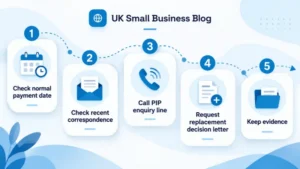
1. Check the Normal Payment Date
PIP is usually paid every four weeks.
A weekend or bank holiday may move the payment to an earlier working day.
Check the previous payments before assuming the award has stopped.
2. Check Recent Correspondence
Look for:
- Award-review letters;
- Assessment appointments;
- Requests for evidence;
- Review forms;
- Overpayment notices;
- Fraud or compliance correspondence;
- Award end dates; and
- Formal decision notices.
3. Call the PIP Enquiry Line
Call 0800 121 4433 and ask precise questions.
For example:
- Is my PIP claim still active?
- Has my payment been suspended?
- Has my award been reduced or ended?
- Has an overpayment deduction been applied?
- What date did the change take effect?
- What was the reason?
- When was the decision letter sent?
- Which address was used?
- Is there anything I need to provide before payments can restart?
Record the date and time of the call and what was said.
4. Request a Replacement Decision Letter
If the DWP says it made a decision but the claimant never received it, ask for another copy.
The letter is important because it should identify:
- The decision;
- Its effective date;
- The reason for the change; and
- How to challenge it.
5. Keep Evidence
Retain copies of:
- PIP forms;
- Assessment reports;
- Hospital records;
- Care-home funding letters;
- Medical evidence;
- DWP correspondence;
- Proof of postage; and
- Notes from telephone calls.
This can become particularly important during Mandatory Reconsideration or an appeal.
Can a PIP Decision Be Challenged?
Yes.
Where the DWP has formally reduced or ended PIP and the claimant believes the decision is incorrect, the normal first step is a Mandatory Reconsideration.
A request should usually be made within one month of the decision date.
A late request may still be considered where there is a good reason for the delay. Not receiving the original decision letter can therefore be highly relevant.
If Mandatory Reconsideration does not resolve the dispute, the next stage is normally an appeal to the independent Social Security and Child Support Tribunal.
How Often Do PIP Appeals Succeed?
Recent official statistics provide useful context, although the figures should not be interpreted as guaranteeing the outcome of an individual appeal.
Ministry of Justice tribunal statistics for April to June 2026 show that 67% of PIP cases decided at a tribunal hearing were overturned in favour of the claimant.
Separate DWP statistics covering PIP award reviews between April 2021 and March 2026 show that 79% of award-review decisions that reached and were cleared at a tribunal hearing were overturned.
The denominators are important.
These figures do not mean that 67% or 79% of every PIP decision is overturned. They describe cases that progressed to a tribunal hearing.
They do, however, demonstrate why a claimant who believes a decision is incorrect should not necessarily assume the initial DWP decision is the end of the process.
Can PIP Be Reinstated and Backdated?
Potentially.
If the issue was a temporary suspension and the reason for the suspension is resolved, payments may restart.
If the DWP formally ended or reduced the award, reinstatement may require:
- Mandatory Reconsideration;
- A revised DWP decision; or
- A successful tribunal appeal.
Where a decision is changed in the claimant’s favour, arrears may become payable for the period in which PIP should have been received.
The exact amount and period depend on the circumstances and effective date of the revised decision.
What Happens to a Motability Car If Enhanced Mobility PIP Stops?
Losing the enhanced mobility component can affect eligibility for the Motability Scheme.
A claimant using a Motability vehicle should contact Motability promptly after receiving a decision affecting their qualifying mobility allowance.
Depending on the circumstances, customers can have up to eight weeks after qualifying allowance payments end to return a car or Wheelchair Accessible Vehicle.
There are also special transitional-support arrangements for some people affected by an unsuccessful DLA-to-PIP reassessment.
However, the financial Transitional Support Package is not available to every person who loses enhanced-rate mobility PIP. Eligibility can depend on factors including the type of reassessment and when the person originally joined the Scheme.
Anyone challenging the PIP decision through Mandatory Reconsideration or appeal should also tell Motability rather than assuming the vehicle arrangements will automatically remain unchanged.
Can Losing PIP Affect Universal Credit or Other Support?
PIP and Universal Credit health entitlement are separate systems.
Losing PIP does not automatically mean someone also loses Limited Capability for Work or Limited Capability for Work and Work-Related Activity.
Likewise, having LCWRA does not guarantee entitlement to PIP.
The two benefits use different assessment criteria.
The distinction is explained further in the rules covering LCW and LCWRA payments.
However, ending PIP can affect other forms of support that depend on receiving a qualifying disability benefit, including certain concessions, premiums or Motability eligibility.
Each linked entitlement should therefore be checked separately.
What Happens to PIP After State Pension Age?
Reaching State Pension age does not automatically end an existing PIP award.
Someone already receiving PIP can potentially continue receiving it after reaching State Pension age, subject to the normal entitlement rules.
The position is different for a new claim.
A person over State Pension age cannot usually make a completely new PIP claim and will generally need to consider Attendance Allowance instead.
There is an exception where someone received PIP or Adult Disability Payment during the previous 12 months and meets the applicable conditions.
This distinction matters because Attendance Allowance does not include a mobility component.
When Should Independent Benefits Advice Be Considered?
Specialist help can be particularly valuable where:
- No decision notice was received;
- PIP has been suspended during a fraud investigation;
- The DWP is seeking a large overpayment;
- A Mandatory Reconsideration deadline has passed;
- A Motability vehicle is affected;
- Several benefits have changed at once;
- There are linked hospital stays;
- NHS Continuing Healthcare is funding a care placement;
- The claimant is approaching or over State Pension age; or
- A tribunal appeal is being considered.
The first priority should always be identifying exactly what the DWP has done.
A delayed payment, suspension, overpayment deduction and formal entitlement decision can look similar in a bank account but require very different responses.
FAQs
Can PIP be stopped without a letter?
A payment can appear to stop before the letter arrives, but the DWP should normally provide written notification when it makes a formal appealable decision affecting entitlement.
Government guidance also says a claimant should receive a letter if benefit is stopped during a suspected fraud investigation.
Can PIP be stopped during a fraud investigation?
Yes. The DWP can suspend payment while suspected benefit fraud is investigated. A suspension is not itself proof that fraud occurred.
Will the DWP pay back PIP if a fraud investigation finds nothing wrong?
Where entitlement remains and money was withheld during the investigation, the claimant may be entitled to the PIP they should have received during the suspension period.
Can the DWP check Facebook or other social media for PIP?
Publicly available or otherwise lawfully obtained information can potentially form part of an investigation. However, an isolated social-media post does not automatically prove that someone’s PIP claim is incorrect.
Can the DWP take money from PIP for an overpayment?
Yes. PIP can be reduced to recover certain benefit overpayments, including overpayments relating to another benefit. DWP Debt Management can be contacted on 0800 916 0647 if deductions are causing financial difficulty.
Does PIP stop after 28 days in hospital?
For an adult receiving NHS inpatient treatment, both the daily living and mobility components can stop after the relevant total reaches 28 days. Linked hospital stays can count towards this period.
Does PIP stop after 28 days in a care home?
It depends on how the care is funded. Self-funded residents can normally continue receiving PIP. Publicly funded placements can affect the daily living component after 28 days, while mobility treatment varies according to the funding and type of placement.

Jennifer contributes business-focused articles covering modern business trends, digital growth, entrepreneurship, and practical insights designed to support startups and SMEs.

DWP Energy Bill Letters Dispatched: Six Million Households Could Get £150 Discount
Millions of UK households are being urged to watch their post as the Department for Work and Pensions (DWP) prepares to distribute letters concerning a £150 reduction in…

Kemi Badenoch Inheritance Tax Policy: What the 2026 Plan Could Mean
The Kemi Badenoch inheritance tax policy would make one of the biggest changes to the way family homes are treated for UK inheritance tax in decades if a…
Insights for the Modern
UK Small Business.
Join 15,000+ owners receiving tactical analysis on finance, marketing, and technology. No clutter.
Zero spam. Unsubscribe in one click.