How Long Does Gross Misconduct Stay on Your Record in the UK?

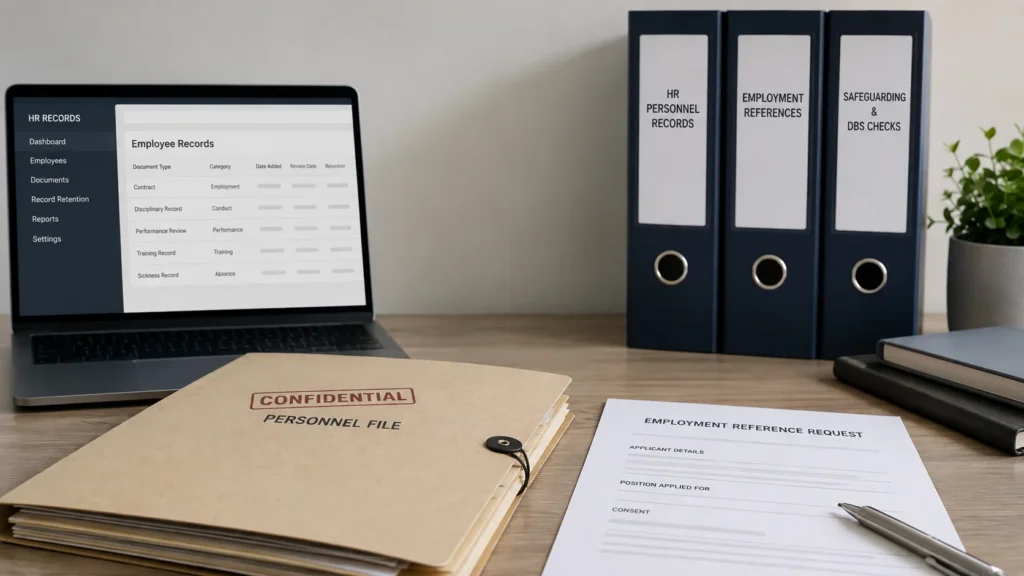
Gross misconduct does not stay on a single public employment record for a fixed number of years. In most cases, the details remain in the former employer’s confidential personnel files for as long as the organisation can justify keeping them.
There is no UK law stating that every gross misconduct dismissal must be deleted after five, six or seven years. The practical effect depends on the employer’s retention policy, what is said in future references, whether the conduct involved a criminal offence and whether safeguarding or professional rules apply.
How Long Does a Gross Misconduct Dismissal Remain on Your Employment Record?
There is no universal retention period for gross misconduct records in the UK.
The UK General Data Protection Regulation does not prescribe specific time limits for different categories of personal information. Instead, an employer must decide how long it needs the record for its stated purpose and must not keep it for longer than necessary. The Information Commissioner’s Office guidance on storage limitation recommends establishing and documenting appropriate retention periods.
An employer may decide that it still needs gross misconduct records to:
- answer questions about the disciplinary process;
- handle an internal appeal;
- defend a legal claim;
- meet regulatory or safeguarding obligations;
- respond consistently to reference requests;
- investigate connected allegations; or
- demonstrate that it followed a fair procedure.
However, seriousness alone does not give an employer an unlimited right to keep all disciplinary documents permanently. The organisation should periodically review whether the information is still necessary, relevant, accurate and proportionate.
What Does “On Your Record” Actually Mean?
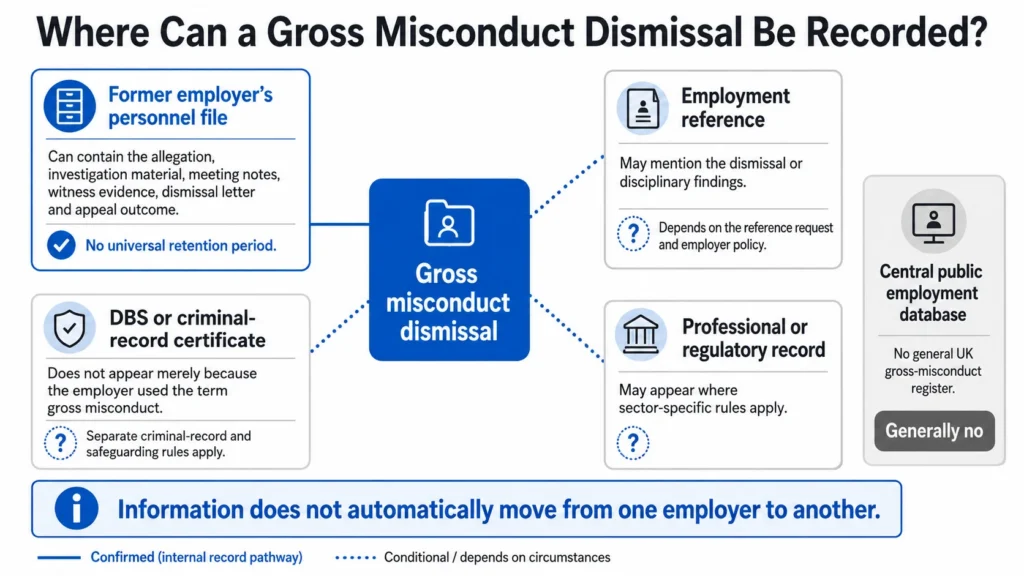
People often use the phrase “employment record” to describe several different systems. They should be considered separately.
| Type of record | Could gross misconduct appear? | Is there a fixed retention period? |
| Former employer’s personnel file | Yes | No universal period |
| Employment reference | Possibly | Depends on the reference request and policy |
| DBS or criminal-record certificate | Not merely because an employer used the term “gross misconduct” | Criminal-record and safeguarding rules apply |
| Professional or regulatory record | Possibly | Sector-specific rules may apply |
| Central public employment database | Generally no | There is no general UK gross misconduct register |
The most common record is the former employer’s internal file. It may contain the allegation, investigation material, meeting notes, witness evidence, the dismissal letter and any appeal outcome.
That information does not automatically move from one employer to another.
Employment Record Checker
Select the type of record you are concerned about to see what information may appear, who could access it and what you can do next.
Please select a record type.
What May Appear?
Who Can Access It?
What Should You Do Next?
This checker provides general UK information and is not a substitute for legal advice. Additional rules may apply in regulated or safeguarding roles.
Is Gross Misconduct Placed on a Permanent Employment Record?
There is no general, centralised UK employment record that follows every worker throughout their career.
A gross misconduct dismissal will usually be recorded by the employer that investigated and decided the case. The information may remain in its HR system, archived files, emails, investigation reports or legal records until the employer’s applicable retention period ends.
The employer should keep a written record of disciplinary cases, including cases in which no action was ultimately taken. However, Acas guidance on disciplinary records says those records must be confidential and kept only for as long as necessary.
This means two employers could adopt different defensible retention periods. A regulated financial business, care provider or school may have reasons to retain certain information longer than a small retailer dealing with an ordinary internal conduct matter.
Neither employer should simply keep every personnel file forever without reviewing why it is still needed.
Is an Expired Disciplinary Warning the Same as a Deleted Record?
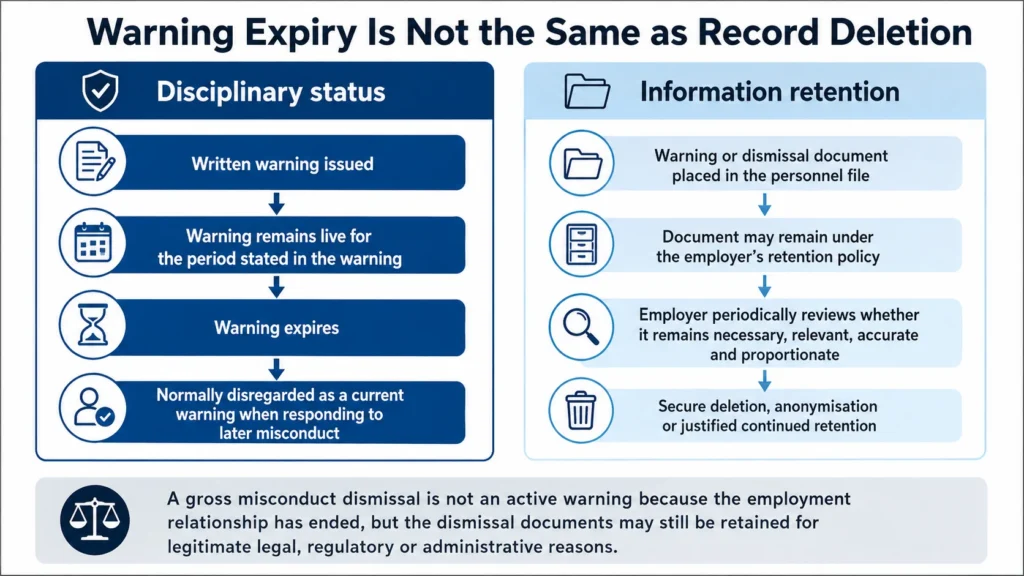
No. This is an important distinction.
A written warning normally states how long it will remain “live” for disciplinary purposes. Once that period ends, the employer would not usually treat it as a current warning when deciding how to respond to later misconduct.
However, the underlying document may remain in the personnel file for a further period under the employer’s retention policy.
Acas provides a warning-letter template that distinguishes between information being placed on a personnel file and the warning later being disregarded for disciplinary purposes. Its disciplinary guidance also says a warning should specify how long it will stay in place.
A gross misconduct dismissal is different from an active warning because the employment relationship has already ended. Nevertheless, the dismissal documents may continue to be retained for legitimate legal, regulatory or administrative reasons.
What Counts as Gross Misconduct?
Gross misconduct is conduct considered so serious, or with such serious effects, that it may justify dismissal without notice or notice pay.
Examples can include:
- theft or fraud;
- physical violence;
- gross negligence;
- serious insubordination;
- serious harassment;
- major health and safety breaches;
- deliberate misuse of confidential information; or
- other conduct identified in the employer’s disciplinary rules.
The exact definition may vary according to the organisation and the nature of its work.
Gross misconduct does not allow an employer to skip fairness altogether. The official GOV.UK guidance on conduct dismissals says an employer should investigate the incident and give the employee an opportunity to respond before deciding to dismiss. Acas similarly states that an investigation and fair disciplinary procedure are still required before dismissal without notice.
An employer may therefore dismiss someone immediately after completing the procedure, but it should not normally dismiss them immediately after first hearing an untested allegation.
Can Gross Misconduct Appear in an Employment Reference?

Yes, it can, but it will not appear in every reference.
An employer does not usually have to provide a reference unless there is a contractual agreement or a relevant regulatory requirement. When a reference is provided, it must be fair and accurate.
According to the GOV.UK guidance on employment references, a reference can be brief, covering information such as the person’s job title and employment dates. It can also include performance information and the fact that the person was dismissed, provided the information is fair and can be supported.
Many organisations operate a policy of giving only a factual reference. A typical factual reference may confirm:
- the employee’s name;
- their position;
- the dates of employment; and
- sometimes their salary or reason for leaving.
A factual-reference policy reduces risk, but it does not guarantee that every employer will omit a gross misconduct dismissal.
Acas says references must not be misleading and that statements about a person’s performance or employment must be fair and accurate. Opinions should have evidence behind them.
Can an Employer Disclose Gross Misconduct Years Later?
Potentially, yes.
The passage of time does not automatically make an accurate statement false. However, the employer should consider whether the information remains relevant to the reference being requested and whether including it would create a fair and accurate impression.
For example, stating that an employee was dismissed following a completed gross misconduct procedure may be very different from saying the person “committed theft” when the employer only investigated an allegation and never established that theft occurred.
Employers should distinguish carefully between:
- an allegation;
- an investigation;
- a finding;
- an appeal;
- a dismissal; and
- any later decision that overturned or changed the outcome.
Omitting the fact that an allegation was rejected or a dismissal was overturned could make the record or reference misleading.
Can a Former Employer Give a Bad Reference?
A former employer may give an unfavourable reference when it is truthful, fair, relevant and supported by evidence.
It should not exaggerate what happened, present disputed allegations as proven facts or omit information that materially changes the meaning.
A worker may be able to challenge a reference if it is inaccurate or misleading. GOV.UK states that a person considering a damages claim would generally need to show both that the reference was misleading or inaccurate and that they suffered a loss, such as a withdrawn job offer.
The employer should retain enough reliable documentation to support any significant negative statement it chooses to make.
Does Gross Misconduct Appear on a DBS Check?
An ordinary workplace finding of gross misconduct does not automatically appear on a DBS certificate.
DBS checks concern criminal-record and, for eligible roles, safeguarding information. An internal HR decision does not become a criminal conviction simply because the employer described the behaviour as gross misconduct.
A dismissal may have separate DBS implications when the conduct also resulted in:
- a criminal conviction or caution;
- relevant police information;
- a finding that the person harmed or placed a child or vulnerable adult at risk; or
- a referral for consideration under the barring system.
Employers can request different levels of criminal-record checks depending on the role. More detailed checks are restricted to positions that are legally eligible, including certain work involving children, vulnerable adults and healthcare.
When Could an Employer Have to Refer Someone to DBS?
A separate safeguarding duty can arise where an employer removes a person from regulated activity because the person harmed, or might have harmed, a child or vulnerable adult.
GOV.UK states that employers must make a referral in certain circumstances, including where they dismissed someone because the person harmed somebody or might have harmed somebody. An obligation can also arise when the employer was planning to dismiss the person but they resigned first.
A DBS referral is not the same as an ordinary employment reference, and referral does not by itself mean that the person will be barred. DBS has a separate assessment and decision-making process.
What About Northern Ireland?
In Northern Ireland, criminal-record checks are administered through AccessNI rather than the DBS checking service used in England and Wales.
An AccessNI check concerns criminal-history information and, at enhanced levels, potentially relevant police and barring information. It does not ordinarily list an internal workplace dismissal simply because the employer classified it as gross misconduct.
Northern Ireland also has a separate employment-law system. Employees and employers there should consult the Labour Relations Agency or current Northern Ireland guidance.
Do You Have to Disclose Gross Misconduct to a New Employer?
There is no single disclosure rule applying to every job application.
The safest approach is to read the wording of each application question closely.
An application might ask:
- Have you ever been dismissed?
- Have you been subject to disciplinary action?
- Why did your last employment end?
- Are you currently under investigation?
- Have you been referred to a regulator or safeguarding body?
- Is there anything that could affect your suitability for this role?
You should not describe a dismissal as a voluntary resignation when a direct question requires the true reason your employment ended.
However, a question asking about criminal convictions is not automatically asking about an internal employment dismissal. Equally, a question asking whether you have ever been dismissed cannot be answered solely by pointing to a clear DBS certificate.
Regulated professions, security-sensitive roles, financial services, healthcare, education and safeguarding work may involve more extensive disclosure or reference requirements. Applicants should check the rules applying to the particular profession and position.
How Should You Explain Gross Misconduct in an Interview?

A dismissal does not automatically prevent you from finding another job. Your explanation can influence how a prospective employer assesses the situation.
A useful answer should:
- State what happened briefly. Avoid a long account of every disagreement.
- Be accurate. Do not contradict information the new employer is likely to receive.
- Separate allegations from findings. Explain clearly when you dispute the outcome.
- Accept appropriate responsibility. Acknowledging a genuine mistake can be more credible than blaming everyone else.
- Explain what changed. Mention relevant training, new procedures, treatment, qualifications or professional development.
- Bring the answer back to the new role. Explain why the issue is unlikely to recur.
For example:
“My employment ended following a disciplinary finding concerning the handling of confidential information. I accepted that I had not followed the required process, although I did not agree with every part of the decision. Since then, I have completed data-protection training and introduced a written checking process in my work.”
That example is only a model. The explanation should reflect the actual facts and should not imply acceptance of conduct the person genuinely disputes.
Can You Ask a Former Employer to Delete the Record?
You can ask, but the employer does not always have to agree.
The right to erasure, sometimes called the right to be forgotten, applies in certain circumstances. It may apply when the organisation no longer needs the information for the original purpose, used it unlawfully or has no overriding reason to retain it.
The right is not absolute. An employer may be entitled to retain information when it is needed to:
- comply with a legal duty;
- establish, exercise or defend a legal claim;
- meet a regulatory obligation; or
- carry out another lawful and proportionate purpose.
The ICO’s guidance on the right to erasure explains these conditions and exceptions. It also says an organisation should normally respond to an erasure request within one calendar month, although an extension may be permitted in some circumstances.
A useful written request could ask the employer to confirm:
- what disciplinary information it still holds;
- the purpose for which it is retained;
- the applicable retention period;
- when the next review or deletion is due;
- who can access it;
- whether it has been disclosed to anyone else; and
- why continued retention is necessary.
Can You Obtain a Copy of Your Disciplinary Record?
You can make a subject access request asking whether an organisation is using or storing your personal information and requesting copies of that information.
This may include personal data contained in:
- dismissal letters;
- meeting notes;
- HR records;
- investigation reports;
- relevant emails; and
- internal correspondence about you.
The right of access does not guarantee an unredacted copy of every document. Information about other people, legally privileged material and information covered by another exemption may be withheld or redacted.
The current ICO subject access guidance says organisations usually have one month to respond. The ICO notes that some of its guidance is being reviewed following the Data (Use and Access) Act, so businesses and individuals should check the current position when making or handling a request.
A subject access request provides access to information. It does not automatically erase the record or overturn the disciplinary decision.
Can You Correct an Inaccurate Gross Misconduct Record?
You can challenge inaccurate personal data and ask for it to be corrected.
Your request should identify:
- the exact statement you believe is wrong;
- why it is inaccurate or incomplete;
- the correct information;
- evidence supporting the correction; and
- the outcome you want recorded.
The ICO’s guidance on correcting personal data explains that the right to rectification covers inaccurate or incomplete information.
There is an important limitation. A genuine record of an opinion does not necessarily become inaccurate simply because you disagree with it. The employer may be entitled to record that a manager reached a particular conclusion.
The record should nevertheless make the context clear. If an appeal overturned the dismissal, or if a finding was based on demonstrably incorrect information, the file should not continue to present the original conclusion as the final or unqualified outcome. ICO guidance notes that where an opinion was based on inaccurate information, this should be recorded so the file is not misleading.
What Should You Do Immediately After a Gross Misconduct Dismissal?
Take the following steps promptly.
1. Obtain the Written Decision
The letter should identify the finding, the reason for dismissal, the termination date and the appeal procedure.
Check whether the letter accurately distinguishes between allegations that were upheld and those that were rejected.
2. Read the Appeal Rules
An appeal can challenge:
- procedural unfairness;
- insufficient evidence;
- new evidence;
- inconsistency;
- an excessive sanction; or
- a factual error in the decision.
Acas states that an employer should offer a right of appeal so the employee can challenge an outcome they believe was too severe, wrong or unfair.
3. Ask About the Reference Policy
Find out whether the employer normally provides:
- a basic factual reference;
- a detailed reference;
- a regulated reference; or
- no reference unless legally required.
Where a settlement agreement is being negotiated, the parties may agree reference wording as part of the agreement.
4. Request the Retention Information
Ask HR or the data-protection contact how long the investigation and dismissal records will be kept and under which policy.
5. Preserve Your Evidence
Keep copies of your contract, staff handbook, invitation letters, evidence, meeting notes, dismissal decision, appeal and relevant correspondence.
6. Check Legal Deadlines Immediately
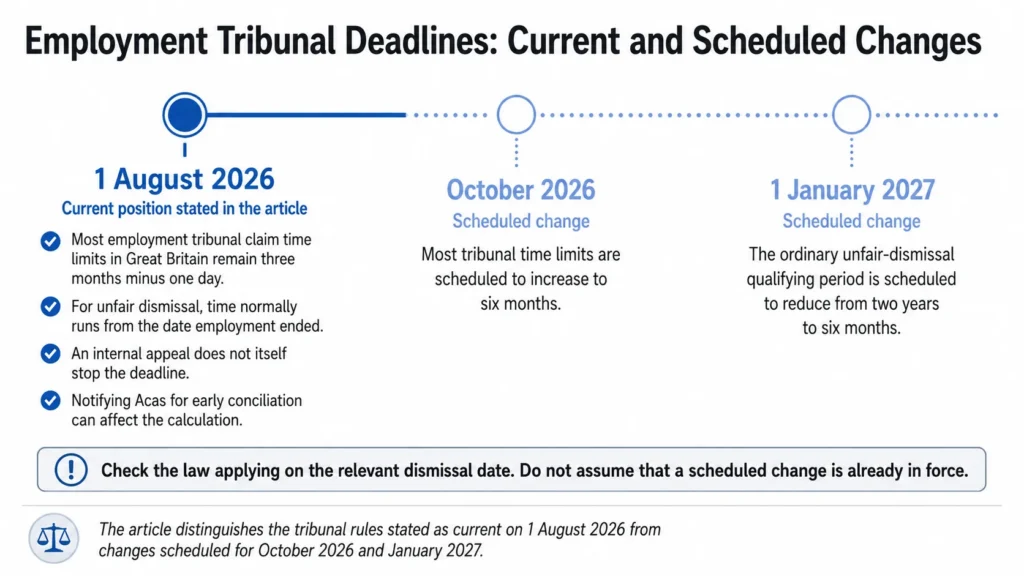
At 1 August 2026, the time limit for most employment tribunal claims in Great Britain remains three months minus one day. For an unfair dismissal claim, time normally runs from the date employment ended. Notifying Acas for early conciliation can affect the calculation, but an internal appeal does not by itself stop the deadline.
Under the Employment Rights Act 2025 implementation timetable, most tribunal time limits are scheduled to increase to six months in October 2026. The ordinary unfair-dismissal qualifying period is scheduled to reduce from two years to six months on 1 January 2027. Employees should check the law applying on the relevant dismissal date rather than assuming the later rules already apply.
What Should Small Employers Do With Gross Misconduct Records?
Small employers should avoid using an arbitrary retention period copied from another organisation.
A defensible retention schedule should identify:
| Record-management question | What the employer should document |
| What is being retained? | Investigation, outcome, appeal, correspondence or evidence |
| Why is it needed? | Legal claim, regulatory duty, consistency, safeguarding or another purpose |
| When does retention begin? | Creation date, case closure date or termination date |
| When will it be reviewed? | A documented review date |
| Who may access it? | Authorised HR, management, legal or compliance personnel |
| What happens at the end? | Secure deletion, anonymisation or justified extension |
Keep the Final Outcome Clear
The file should show whether:
- the allegation was upheld;
- no action was taken;
- a warning was issued;
- dismissal occurred;
- the employee appealed; and
- the original decision was upheld, reduced or overturned.
Keeping an allegation without its final outcome can create an inaccurate and unfair impression.
Limit Access
Disciplinary records should not be available to everyone with general access to an employee-management system.
Access should be restricted to people who genuinely need the information. Acas says disciplinary outcomes should remain confidential, while investigation reports should be stored securely and disposed of when they are no longer required.
Separate Warning Duration From Data Retention
A warning may stop being active before the document is deleted. Policies and letters should explain both concepts to avoid confusion.
Use a Consistent Reference Process
Reference requests should be handled by authorised people under a written policy.
Managers should not give informal telephone references containing unverified opinions or incomplete accounts of disciplinary cases.
Review Safeguarding Obligations Separately
An employer should not assume that deleting an HR record removes a separate legal duty to make or preserve a safeguarding referral. DBS and professional-regulator duties should be assessed independently.
Conclusion
Gross misconduct does not stay on one universal UK record for a set number of years.
A former employer may retain the disciplinary and dismissal information for as long as it has a legitimate and documented need, but UK data-protection principles prevent indefinite retention without justification. The information might be included in a future reference if it is fair, accurate and relevant, although many employers provide only factual references.
Gross misconduct will not appear on a DBS or AccessNI certificate merely because an employer used that label. Separate consequences may arise when the conduct involved a criminal offence, safeguarding risk, regulatory breach or barring referral.
Employees should obtain the written outcome, check the appeal and tribunal deadlines, ask about the employer’s reference and retention policies, and challenge any inaccurate or misleading information promptly.
Frequently Asked Questions
Is Gross Misconduct Kept on Your Record Forever?
Not necessarily. There is no universal permanent record or statutory retention period. The former employer must decide how long the information is necessary for and should review or delete it when it no longer has a justified purpose.
How Many Years Do Employers Keep Gross Misconduct Records?
The period varies. UK GDPR does not prescribe five, six or seven years for every case. The employer should use a documented retention period based on its purpose, legal exposure, industry and regulatory responsibilities.
Can a Former Employer Tell a New Employer About Gross Misconduct?
Yes, a reference may mention the dismissal or relevant disciplinary findings. Any information provided should be fair, accurate, relevant and supported by evidence.
Does Gross Misconduct Show on a DBS Check?
Not automatically. An internal disciplinary finding is not itself a criminal record. DBS implications may arise separately if the conduct resulted in criminal-record information or an eligible safeguarding referral.
Can You Get Another Job After Gross Misconduct?
Yes. The outcome may make some applications more difficult, particularly in regulated or safeguarding roles, but it does not create a universal ban on employment. An accurate, concise explanation and a positive subsequent work history can help.
Do You Have to Declare Gross Misconduct When Applying for Work?
You should answer direct questions truthfully. Whether you must volunteer the information when it is not requested depends on the role, contract, regulatory rules and vetting requirements.
Can You Make an Employer Delete a Gross Misconduct Record?
You can request erasure, but the right is not absolute. The employer may refuse when continued retention is necessary for a legal obligation, regulatory purpose or the establishment, exercise or defence of legal claims.
Can You Challenge a False Gross Misconduct Reference?
Yes. Start by asking the former employer to correct it and provide evidence showing why it is inaccurate or misleading. Where the reference causes a job offer to be withdrawn or another measurable loss, seek employment-law advice promptly.

Jennifer contributes business-focused articles covering modern business trends, digital growth, entrepreneurship, and practical insights designed to support startups and SMEs.

Best Rubbish Removal Companies in London: 6 Services to Know
London residents often need rubbish cleared quickly after moving home, renovating a property, replacing furniture or completing a garden project. Businesses also regularly require unwanted office furniture, packaging…

Mark Brennan M&S WRC Decision: Why His Dismissal Was Unfair?
The Mark Brennan M&S WRC decision found that a long-serving sales adviser was unfairly dismissed after his staff discount credentials were used 73 times in six weeks. Mark…
Insights for the Modern
UK Small Business.
Join 15,000+ owners receiving tactical analysis on finance, marketing, and technology. No clutter.
Zero spam. Unsubscribe in one click.