Royal Mail Dog Warning: What UK Households and Businesses Need to Know

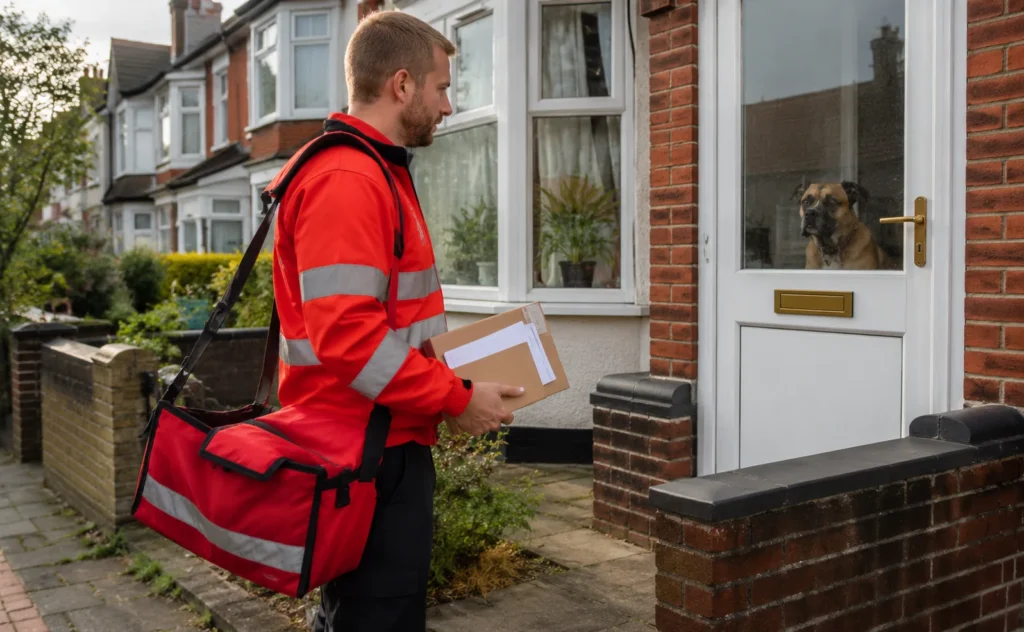
The Royal Mail dog warning asks households and businesses to keep dogs securely away from postal workers during deliveries. The warning remains important in 2026: Royal Mail recorded 2,019 dog attacks on staff during 2025/26, equivalent to around 38 attacks every week across the UK.
Although the total was 8% lower than the 2,197 attacks recorded in 2024/25, Royal Mail says dog attacks continue to cause serious injuries, psychological harm and lengthy staff absences. There were 61 significant injuries during 2025/26, while dog attacks resulted in 3,442 days of staff absence. One absence was still ongoing after more than 300 days.
Royal Mail’s message is therefore straightforward: even a normally friendly dog should be secured before the front door is opened or a postal worker enters a garden, driveway or other delivery area.
What Is the Royal Mail Dog Warning?
The Royal Mail dog warning is an ongoing safety campaign encouraging customers to prevent dogs from approaching postal workers.
Royal Mail says even affectionate dogs can behave territorially when someone approaches their home. The risk is particularly high when a customer opens the door, when a dog is loose in a front garden or when the animal can reach fingers through a letterbox.
The company’s official dog awareness advice recommends keeping dogs secure and out of the way before the post person arrives.
For home-based businesses, offices, workshops and other premises where dogs are present, this is also a business-continuity issue. An unsafe delivery point can affect letters, parcels, customer returns, supplier documents and other business post.
Businesses expecting weekend post should also consider when dogs have access to delivery areas because Royal Mail Saturday deliveries form part of the normal delivery week for many services.
How Many Royal Mail Workers Were Attacked by Dogs in 2025/26?
Royal Mail reported 2,019 dog attacks on its staff during 2025/26.
That was an 8% reduction from the 2,197 attacks recorded during 2024/25, but it still represents an average of approximately 38 incidents every week.
The latest figures show:
| Royal Mail dog attack statistic | 2025/26 |
| Total reported attacks | 2,019 |
| Average attacks per week | 38 |
| Significant injuries | 61 |
| Significant injuries in 2024/25 | 74 |
| Reduction in significant injuries | 17% |
| Staff absence caused by attacks | 3,442 days |
| Longest ongoing absence | More than 300 days |
Royal Mail Health & Safety Director Lizz Lloyd welcomed the reduction but stressed that attacks still cause painful injuries and lasting distress, saying that “Every attack is one too many.”
The scale of the risk also has to be viewed against Britain’s growing dog population. UK Pet Food’s 2026 population research estimates that there are around 15.5 million pet dogs in the UK, with dogs present in approximately 41% of households.
Is Your Area a Royal Mail Dog Attack Hotspot?
Royal Mail publishes postcode-level dog attack figures each year.
For 2025/26, Sheffield’s S postcode area ranked first with 61 attacks. Doncaster and Guildford were joint second with 53 each, while Newcastle and Portsmouth were joint third with 50 each.
Because several locations share ranking positions, Royal Mail’s top-10 ranking contains more than ten individual postcode areas.
| Rank | Postcode | Area | 2025/26 attacks | Year-on-year change |
| 1 | S | Sheffield | 61 | -8% |
| 2= | DN | Doncaster | 53 | +26% |
| 2= | GU | Guildford | 53 | -2% |
| 3= | NE | Newcastle | 50 | +11% |
| 3= | PO | Portsmouth | 50 | -17% |
| 4 | NG | Nottingham | 48 | -2% |
| 5 | SA | Swansea | 44 | +76% |
| 6 | BT | Belfast | 37 | -18% |
| 7 | ME | Medway/Rochester | 36 | +38% |
| 8= | TN | Kent, Sussex and Surrey | 35 | -38% |
| 8= | YO | York | 35 | +25% |
| 9 | LE | Leicester | 34 | +31% |
| 10 | ST | Stoke-on-Trent/Staffordshire | 31 | -23% |
There are several notable trends behind these figures. Sheffield has appeared on every Royal Mail high-risk list since postcode-specific reporting began and has now topped the ranking five times. Portsmouth has appeared among the high-risk locations for nine consecutive years and ten times overall, while Belfast has appeared on every hotspot list since Royal Mail began releasing postcode-specific figures in 2013.
Swansea recorded one of the sharpest increases, rising from 25 incidents to 44, while Leicester entered the high-risk ranking for the first time with 34 attacks.
A postcode appearing in the table does not mean every dog or property in that area is dangerous. The figures show where Royal Mail employees reported the greatest numbers of attacks during the reporting period.
Where Do Most Dog Attacks on Postal Workers Happen?
The majority do not happen randomly in the street. Royal Mail’s latest figures show that most occur at or immediately around customers’ properties.
| Location of attack | Number | Share |
| Front door | 1,048 | 52% |
| Garden, drive or yard | 511 | 25% |
| Through the letterbox | 324 | 16% |
| Street or road | 135 | 7% |
The front door is therefore the single biggest risk point. Royal Mail recorded 1,048 front-door incidents, an increase from 1,005 the previous year.
This explains why simply telling a postal worker that a dog is friendly is not enough. Opening a door can create an opportunity for the animal to push past its owner, particularly if a child answers the door or the dog is already excited by the arrival of post.
Can a Dog Owner Be Prosecuted for a Letterbox Attack?
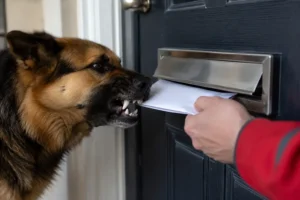
Yes, depending on the circumstances and the jurisdiction.
For England and Wales, the Dangerous Dogs Act 1991 applies to dogs that are dangerously out of control on private as well as public property. Changes introduced in 2014 were specifically intended to give greater protection to people such as postal workers who legitimately enter private property as part of their jobs.
Letterbox attacks are particularly important because the householder exemption for trespassers does not normally protect an owner when a postal worker is legitimately putting post through a letterbox.
Crown Prosecution Service guidance cites Royal Mail Group Ltd v Watson [2021] EWHC 2098 (Admin). The High Court concluded that a letterbox represents an invitation for mail to be posted through it and that the postal worker in the case was therefore not a trespasser merely because fingers briefly entered through the opening.
Royal Mail’s own dog-awareness page refers to the principle when explaining its letterbox-attack figures, although its page describes it as a 2020 High Court ruling. The CPS case citation provides the clearer legal reference.
Scotland also has specific dog-control legislation covering dogs that are out of control on private property, including situations involving postal workers. Northern Ireland operates under its own dog-control framework, so the precise offence and penalty can depend on where an incident occurs.
What Can Happen If a Dog Bites a Postman or Postwoman?
A dog attack can result in considerably more than a Royal Mail warning letter.
Depending on the circumstances, there may be a police investigation, action under dangerous-dog legislation, restrictions on future deliveries, civil compensation issues and potentially court proceedings.
In England and Wales, CPS guidance says an offence under section 3 of the Dangerous Dogs Act can arise where a dog is dangerously out of control. An aggravated offence may apply where a person is injured. Courts can also consider compensation, dog-control conditions, disqualification and, in qualifying cases, destruction orders.
The safest approach is therefore to prevent contact between the dog and the postal worker rather than relying on a warning sign or assuming that a previously friendly dog will behave in the same way every time.
Can Royal Mail Stop Delivering Because of a Dog?
Deliveries can be suspended where staff cannot safely access an address.
CWU and Royal Mail safety material tells postal workers not to enter properties where dogs are running loose and to report dog hazards and near misses. The February 2026 half-term safety material also states that returned mail can be marked when an unsafe situation prevents a delivery attempt.
For a home business, a suspension can be especially disruptive if the property regularly receives customer returns, contracts, stock, correspondence or time-sensitive business post.
The practical solution is to create a delivery arrangement in which the postal worker never needs to rely on the dog remaining calm.
What Should a Postal Worker Do After a Dog Bite?
An injured postal worker should deal with both the medical risk and the workplace incident.
| Step | Recommended action |
| 1 | Move to a safe location away from the dog. |
| 2 | Clean a broken-skin bite with soap and warm water and cover it with a clean dressing. |
| 3 | Seek medical help where appropriate, particularly for deep wounds, heavy bleeding, bites to the hand, face, feet or head, or signs of infection. |
| 4 | Report the incident to the Royal Mail manager and make sure the workplace reporting process is followed. |
| 5 | Record useful evidence where it can be done safely, including the circumstances, address, witnesses and relevant photographs. |
| 6 | Report the attack to police where required and retain the crime number. |
| 7 | Royal Mail/CWU workers should check whether the Royal Mail Group Dog Attack Compensation Scheme or union legal assistance applies. |
The NHS warns that animal bites can become infected and medical staff may need to assess the need for antibiotics and protection against infections such as tetanus or rabies depending on the circumstances.
CWU guidance tells affected workers to report attacks to their manager, record injuries through Royal Mail’s reporting systems, report attacks to police and obtain a crime number, and report incidents to the relevant local authority dog warden or officer.
Does Royal Mail Have a Dog Attack Compensation Scheme?
Yes. The Royal Mail Group Dog Attack Compensation Scheme is intended to help qualifying Royal Mail and Parcelforce employees who are off sick following a dog attack.
CWU’s June 2025 reminder says the scheme can compensate for the difference between full-rate sick pay and the worker’s average weekly earnings during the 13 weeks before the incident.
Under the conditions published by CWU, a worker normally needs at least one week’s sick absence to qualify, payments can cover a maximum of 13 weeks of average earnings and applications should be made within one month of the attack.
The scheme is separate from any personal-injury compensation that might subsequently be recovered through legal proceedings. Workers should therefore seek advice promptly rather than assuming ordinary sick pay is the only financial support available.
The CWU has also reported that more than 30,000 postal workers have been attacked by dogs over the past decade, with approximately 1,000 workers having a finger or part of a finger bitten off in letterbox incidents.
A Real Postal Worker Case: Katy’s Story
The human impact can be seen in the experience of Katy, a Royal Mail postal worker in Bristol.
Royal Mail says Katy was attacked in January 2026 while working on a route she had known for more than two years. The dog was familiar to her and had not previously displayed aggressive behaviour.
The dog approached rapidly in a shared driveway and bit her below the knee. Royal Mail says she suffered five puncture wounds, including deep wounds requiring stitches, as well as tendon damage.
Katy was unable to walk without assistance for around three weeks, could not drive for roughly three months and remained away from work for three months. The wounds later became infected, and she also described significant psychological effects following the attack.
The case reinforces a central part of Royal Mail’s warning: a dog does not have to have a history of aggression to create a risk.
Royal Mail also features Kirsteen Hobson, a postwoman based at Oban Delivery Office, whose dog attack resulted in serious facial injuries.
How Can Dog Owners Make Royal Mail Deliveries Safer?
Royal Mail’s current advice goes beyond simply putting up a warning sign.
| Risk | Safer approach |
| Dog runs to the front door | Put the dog in another room or secure area before opening it. |
| Dog pushes past children | Children should not answer the door while the dog is loose. |
| Dog becomes excited by deliveries | Give the dog food or a toy while the post is being delivered. |
| Dog remains excited afterwards | Wait around 10 minutes after delivery before allowing the dog back into the hallway. |
| Dog attacks letters through the door | Fit a wire letter receptacle or letter cage. |
| Dog cannot be separated from the delivery route | Install a secure external mailbox at the property’s boundary. |
| Dog has garden access | Secure gates and prevent access between rear and front gardens. |
| Parcel needs signing for | Put the dog away before opening the door rather than trying to restrain it while accepting the parcel. |
Royal Mail specifically recommends giving a dog food or a toy during delivery and waiting approximately ten minutes after the mail arrives before returning the animal to the hallway so the situation remains calm.
What Is a Royal Mail Posting Peg?
A Posting Peg is a piece of postal-work equipment designed to help workers push letters through a letterbox without putting their fingers through the opening.
The CWU and Royal Mail repeatedly tell delivery workers to use a Posting Peg because dogs can bite or grab fingers from the other side of a door.
A revised prototype was trialled after postal workers asked for a longer, more flexible design capable of holding more mail. The equipment is primarily intended to reduce finger-through-letterbox incidents.
During Dog Awareness Week, postal workers have also been reminded not to assume that a dog will not bite simply because the owner says it is friendly.
What Do Royal Mail’s Yellow Dots and “D” Markings Mean?
Royal Mail and CWU use internal hazard reminders to help postmen and postwomen identify addresses where there is a known dog risk.
A yellow dot can be placed on the delivery preparation frame where a significant dog hazard has been identified. Royal Mail’s February 2026 safety material says these markers should correspond with the property’s recorded Offsite Risk Assessment information.
Workers can also put a “D” on letters and parcels to remind themselves that a known dog hazard exists when they reach that address during the delivery round.
These are internal safety measures rather than labels intended to publicly identify or shame a customer. Their purpose is to help postal workers recognise a recorded risk before approaching the property.
What Is the Blue Cross Protecting Your Postie Webinar?
Royal Mail works with Blue Cross to provide a free online Protecting Your Postie webinar for dog owners.
The programme is particularly aimed at owners where concerns have arisen about a dog’s behaviour but an attack has not yet occurred.
The Zoom session takes around one hour and covers canine behaviour around deliveries, the possible consequences of incidents, practical ways of managing the dog’s behaviour and sources of further support.
Blue Cross listed three 2026 sessions: 12 May, 16 July and 17 November 2026. As of 11 September 2026, the November session is the remaining future date and is scheduled for 7pm.
Dog owners can find registration information through the official Blue Cross Protecting Your Postie page.
Why Does Royal Mail Run a Half-Term Dog Safety Campaign?
Dog awareness is not limited to the main summer Dog Awareness Week.
Royal Mail also ran a specific half-term dog-awareness campaign in February 2026 after recording an increase in incidents during the previous school holiday.
CWU material dated 30 January 2026 said Royal Mail would issue a half-term message during the week beginning 9 February 2026, focusing particularly on keeping fingers safe around letterboxes and taking additional precautions when a dog can be heard behind a door.
The campaign noted that the previous February half-term had seen a spike in postal workers being injured after putting fingers through letterboxes. The briefing reinforced Posting Peg use and told workers to create distance from the doorstep and ask customers to secure dogs before an item is handed over.
School holidays can create different delivery conditions because children may be at home and may answer doors while dogs are nearby. Royal Mail’s wider advice therefore specifically warns against allowing children to open the door when a dog is unsecured.
What Should Home-Based Businesses With Dogs Do?
Businesses operating from residential properties may receive considerably more parcels, collections and signed-for items than an ordinary household.
A reliable routine should therefore separate the dog from the delivery point before the postal worker reaches the door.
A secure internal room, dog gate, closed garden access, letter cage or boundary mailbox can reduce the chance of unexpected contact. Employees and family members should also follow the same routine so safety does not depend on which person answers the door.
A warning sign may provide useful information, but it does not replace physical control of the dog.
Is the Royal Mail Dog Warning Only About Aggressive Breeds?
No.
Royal Mail’s warning applies to dogs generally rather than to one specific breed. Its advice states that even lovable dogs may behave unpredictably because dogs can become territorial around their home and family.
The 2026 case involving Katy is particularly relevant because the dog involved was already known to her and had previously appeared friendly.
Owners should therefore base delivery precautions on the possibility of unexpected behaviour rather than assuming that a particular dog is safe because of its breed, size or previous behaviour.
FAQs About the Royal Mail Dog Warning
How Many Royal Mail Workers Were Attacked by Dogs in 2025/26?
Royal Mail recorded 2,019 dog attacks, an 8% reduction from the previous year’s 2,197 incidents. That is approximately 38 attacks per week.
Which UK Postcode Has the Most Royal Mail Dog Attacks?
The S postcode area covering Sheffield ranked highest in 2025/26, with 61 reported attacks. It topped the list for a second consecutive year.
Where Do Most Attacks on Postmen and Postwomen Happen?
The front door accounts for the largest share, with 52% of incidents. Another 25% happen in gardens, drives or yards, 16% through letterboxes and 7% in streets or roads.
Can an Owner Be Prosecuted if a Dog Bites a Postman Through the Letterbox?
Potentially, yes. In England and Wales, CPS guidance confirms that the householder trespasser exemption does not generally apply to postal workers legitimately putting post through a letterbox.
Can Royal Mail Stop Delivering Because of a Dangerous Dog?
Delivery arrangements can be suspended or changed where staff cannot safely access a property. Royal Mail/CWU safety guidance tells workers not to enter properties where dogs are running loose and to report hazards.
What is a Royal Mail Posting Peg?
It is a posting aid intended to help postal workers push mail through letterboxes without inserting their fingers, reducing exposure to dogs behind doors.
What Does a Yellow Dot Mean at Royal Mail?
A yellow dot is an internal visual warning used on delivery preparation frames to identify an address with a significant recorded dog hazard.
What Does a “D” on Royal Mail Post Mean?
Postal workers may put a “D” on letters or parcels as an internal reminder that a known dog hazard exists at the delivery address.
Should Owners Let Their Dog Back Into the Hallway Immediately After Delivery?
Royal Mail advises waiting around 10 minutes after mail arrives before letting the dog back into the hallway, helping the situation remain calm.
Does Royal Mail Offer Dog-safety Training for Customers?
Royal Mail and Blue Cross provide a free one-hour Protecting Your Postie webinar. The remaining listed 2026 session is scheduled for 17 November 2026 at 7pm.
Does Royal Mail Run Dog Warnings During School Holidays?
Yes. Royal Mail ran a dedicated February 2026 half-term safety campaign following a previous half-term increase in dog-related incidents, particularly finger injuries involving letterboxes.

Jennifer contributes business-focused articles covering modern business trends, digital growth, entrepreneurship, and practical insights designed to support startups and SMEs.

Does Gross Misconduct Always Lead to Dismissal?
No. Gross misconduct does not always lead to dismissal. It can be serious enough to justify dismissal without notice, including for a first offence, but an employer should…

Andy Burnham Whitehall Job Cuts Begin Under Devolution Push
Andy Burnham’s government has begun the first operational stage of its Whitehall devolution push, with civil servants due to be seconded into regional mayoral authorities from autumn 2026.…
Insights for the Modern
UK Small Business.
Join 15,000+ owners receiving tactical analysis on finance, marketing, and technology. No clutter.
Zero spam. Unsubscribe in one click.