UK Budget Savings Tax Changes 2026: New Rates, ISA Rules and How Much More Savers Could Pay?


The UK Budget savings tax changes announced on 28 October 2026 have introduced significant financial implications for millions of savers, pensioners and small business owners.
From 6 April 2027, savings income tax rates will increase to 24%, 44% and 49%, depending on the taxpayer’s income band.
Although the government has retained the £20,000 annual cash ISA allowance, individuals earning interest outside tax-free accounts could face higher bills.
The changes are particularly important for households holding substantial cash deposits, retired individuals relying on savings interest and entrepreneurs maintaining personal financial reserves.
According to HM Revenue & Customs (HMRC), approximately 6 million taxpayers, representing 13% of taxpayers, are expected to face increased savings taxation by 2031–32.
Understanding the new rates, existing allowances and available tax-efficient savings options is therefore essential.
What Are the UK Budget Savings Tax Changes for 2027?
The Autumn Budget introduced an additional increase in savings income tax rates, taking them four percentage points above the rates applying in 2026–27.
The changes apply throughout the United Kingdom, including Scotland.
| Taxpayer Category | 2026–27 Rate | From April 2027 | Increase |
| Basic-rate taxpayer | 20% | 24% | 4 percentage points |
| Higher-rate taxpayer | 40% | 44% | 4 percentage points |
| Additional-rate taxpayer | 45% | 49% | 4 percentage points |
The government had previously planned rates of 22%, 42% and 47%. Budget 2026 added another two percentage points, producing the final announced rates.
Importantly, these percentages apply to taxable savings income, not directly to money deposited in bank accounts.
For example, a saver earning £2,000 in annual interest will not automatically pay tax on the entire amount. Their available allowances must first be considered.
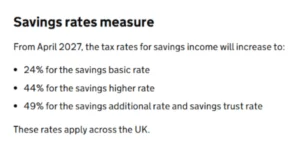
HMRC’s official announcement confirming the new 24%, 44% and 49% savings income tax rates from 6 April 2027.
Why Is the Government Increasing Tax on Savings Interest?
The government has explained that the measure is intended to strengthen public finances and help fund support for households and businesses.
Savings income generally does not attract National Insurance contributions, unlike many forms of employment income.
The policy consequently increases the tax burden on certain investment and savings returns without raising the main income tax rates on employment earnings.
However, the impact differs considerably between households.
Jason Hollands, managing director at Evelyn Partners, described the increase as a “sting in the tail” for savers in comments reported by The Guardian.
His assessment highlights an important financial distinction: higher interest rates do not necessarily translate into stronger after-tax returns.
Someone earning competitive interest may still experience reduced purchasing power once taxation and inflation are considered.
Who Will Be Most Affected by the Savings Tax Increase?
The changes primarily affect people whose taxable savings interest exceeds their available allowances.
The main groups include:
- Higher-rate taxpayers holding substantial cash deposits outside ISAs.
- Pensioners receiving interest alongside retirement income.
- Business owners maintaining large personal cash reserves.
- Individuals receiving substantial interest from fixed-term savings accounts.
- Additional-rate taxpayers who receive no Personal Savings Allowance.
HMRC’s impact assessment estimates that people aged 55 and over will account for approximately 63% of those affected, despite representing around 39% of the adult population in its comparison.
These are projected characteristics of affected taxpayers, not evidence that every older saver will pay additional tax.
People whose interest remains fully covered by allowances should not face additional savings tax solely because the rates increase.
How Much Savings Interest Is Tax-Free After Budget 2026?
The Personal Savings Allowance (PSA) remains an important protection against taxation.
The Budget did not reduce the existing PSA thresholds.
| Income Tax Position | Annual Personal Savings Allowance |
| Basic rate | £1,000 |
| Higher rate | £500 |
| Additional rate | £0 |
A basic-rate taxpayer can generally receive £1,000 of savings interest without paying tax on it.
A higher-rate taxpayer receives a smaller £500 allowance, while additional-rate taxpayers receive none.
These allowances concern interest earned, not the total value deposited.
For instance, £20,000 held in an ordinary savings account earning 4% annually generates approximately £800 interest before tax.
Assuming the saver qualifies for the full £1,000 PSA and has no other savings interest, the entire £800 would remain tax-free.
However, interest from several taxable accounts is combined when determining the individual’s allowance usage.
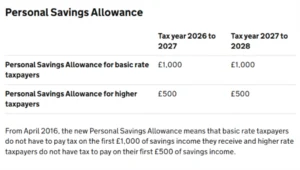
Official 2026–27 and 2027–28 Personal Savings Allowance figures showing the £1,000 and £500 thresholds.
Could Low-Income Savers Still Receive £5,000 Interest Tax-Free?
Yes. The starting rate for savings provides another potential tax advantage.
Eligible individuals can receive up to £5,000 of savings interest taxed at 0%, depending on their other income.
For 2027–28, the starting-rate limit remains £5,000.
The full allowance is generally available when non-savings income does not exceed the £12,570 Personal Allowance.
It gradually reduces as non-savings income increases, disappearing when that income reaches £17,570.
Eligible people may also benefit from their Personal Savings Allowance.
This arrangement is particularly relevant for retirees and individuals working part-time.
Nevertheless, allowances interact with each other, so total taxable income and the order in which reliefs are applied must be considered.
How Much Extra Savings Tax Could You Pay From April 2027?
The financial consequences become clearer when comparing actual interest earnings.
Assume an individual holds £40,000 outside an ISA, earning an illustrative annual interest rate of 4.5%.
Their annual interest would equal £1,800.
| Taxpayer | Taxable Interest | Tax in 2026–27 | Tax From 2027–28 | Extra Annual Tax |
| Basic rate | £800 | £160 | £192 | £32 |
| Higher rate | £1,300 | £520 | £572 | £52 |
| Additional rate | £1,800 | £810 | £882 | £72 |
These simplified calculations assume the individual remains within the same tax band, receives the stated PSA and has no other taxable savings interest.
The additional cost may appear relatively modest for smaller deposits.
However, someone receiving £10,000 of fully taxable annual savings interest would face £400 more tax under the four-percentage-point increase.
Over several years, these differences can influence household wealth accumulation.
Will the £20,000 Cash ISA Allowance Change?
One of the most important announcements was the government’s decision to retain the annual £20,000 cash ISA limit.
An earlier plan would have reduced cash ISA subscriptions to £12,000 for people under 65 from April 2027.
Budget 2026 cancelled that reduction.
Eligible adults can therefore continue placing up to £20,000 annually into cash ISAs, subject to the overall ISA subscription rules.
Interest earned within a cash ISA remains free from UK Income Tax.
The distinction between ISA allowances and savings tax allowances is important.
The ISA limit determines how much new money can be subscribed annually, whereas the PSA determines how much ordinary taxable interest can be received tax-free.
Existing ISA balances can continue accumulating tax-free returns without being restricted to £20,000 overall.
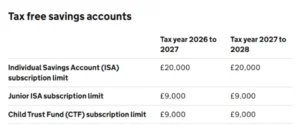
Budget 2026 confirmation that the annual cash ISA subscription limit remains £20,000.
Can Inflation Make the New Savings Tax Rates More Expensive?
Inflation creates an additional challenge because it reduces the purchasing power of savings.
Even when interest increases an account balance, the money may buy less if prices rise faster than the after-tax return.
Personal finance expert Anna Bowes of The Private Office illustrated this issue when discussing the Budget.
Assuming inflation reaches 3.5%, a saver whose interest is fully taxable would need approximately:
| Taxpayer | Gross Interest Rate Needed to Match 3.5% Inflation |
| Basic rate | 4.61% |
| Higher rate | 6.25% |
| Additional rate | 6.86% |
These calculations assume the new 2027–28 savings tax rates apply to all the relevant interest.
Actual outcomes improve where part of the interest is protected by the PSA or other allowances.
For savers comparing accounts, the after-tax return is therefore more informative than the headline advertised rate.
What Do the Savings Tax Changes Mean for Pensioners?
Pensioners may be disproportionately affected because retirement portfolios frequently contain cash accounts, fixed-term deposits and other interest-generating products.
Retirement income can also determine which savings tax band applies.
A pensioner receiving State Pension payments, private pension withdrawals and savings interest must consider how these income sources interact.
Budget 2026 also announced a separate Pensions Tax Allowance for eligible low-income pensioners from April 2027.
Its maximum amount is linked to the full new State Pension of £13,037 for 2027–28 and is withdrawn as income increases.
Becky O’Connor, head of pensions at PensionBee, highlighted concerns that modest additional retirement income could reduce the benefit of this new allowance.
The wider financial planning implication is that pensioners should assess their complete income position rather than treating savings taxation separately.
Those considering accessing retirement funds should also understand the tax consequences of withdrawing a private pension before making irreversible decisions.
How Will the New Tax Rates Affect Small Business Owners?
Small business owners often maintain emergency savings to cover periods of uncertain revenue.
For sole traders, interest earned on personally owned taxable savings may count towards their individual savings income calculation.
Company directors face a different distinction.
Interest earned directly by a limited company generally falls within Corporation Tax rules rather than the director’s personal savings tax regime.
A director cannot transfer company cash into a personal ISA without first moving that money into personal ownership through an appropriate, potentially taxable route.
The professional priority is separating business liquidity from personal wealth planning.
Funds required for VAT, wages, Corporation Tax and suppliers should not be transferred into unsuitable arrangements simply to reduce personal savings tax.
How Will HMRC Collect Tax on Savings Interest?
HMRC generally receives information about savings interest from banks and building societies.
Where additional tax is due, it may be collected through an adjustment to an employee’s or pensioner’s PAYE tax code.
Other taxpayers may need to account for savings income through Self Assessment.
The Budget does not introduce a completely new reporting system specifically for these higher rates.
However, individuals should check that estimated interest figures match their actual records.
Incorrect savings estimates can affect tax codes and the amount deducted from income.
Our examination of HMRC ISA tax code errors explains why savers should distinguish taxable bank interest from tax-free ISA returns when reviewing HMRC calculations.
How Can Savers Legally Reduce Tax After Budget 2026?
Effective savings tax planning involves using existing allowances while preserving appropriate access to money.
Use Available ISA Allowances
Cash ISAs provide a straightforward way to protect eligible savings interest from Income Tax.
Where appropriate, spreading ISA subscriptions across tax years can gradually increase the proportion of savings held within tax-free accounts.
Compare Net Savings Returns
A higher advertised interest rate does not always mean a higher return after tax.
Regular savings products can offer attractive headline percentages but impose monthly contribution restrictions.
For example, understanding how a Santander 8% regular savings account structures contributions helps illustrate why annual returns depend on deposit timing, limits and account conditions.
Consider Savings Between Partners
Married couples and civil partners can each use their individual allowances and ISA eligibility.
Genuine transfers of beneficial ownership may help households use available allowances, although ownership, income and tax rules must be respected.
Maintain Emergency Cash
Tax efficiency should never come at the expense of financial resilience.
Moving short-term reserves into unsuitable long-term investments can expose savings to unnecessary market risk.
What Should Savers Check Before 6 April 2027?
Individuals expecting substantial interest income should review their circumstances before the new tax year.
Important actions include:
- Calculate estimated total interest across taxable savings accounts.
- Identify the Personal Savings Allowance available.
- Check existing cash ISA subscriptions.
- Review fixed-rate maturity and interest payment dates.
- Compare after-tax returns against inflation.
- Check PAYE coding notices or Self Assessment obligations.
- Seek regulated financial or qualified tax advice for complicated circumstances.
The timing of interest payments can be significant because savings income is generally assessed according to the tax year in which it is received.
Consequently, people holding larger fixed-term deposits should examine when interest becomes payable.
Frequently Asked Questions
When Do the New UK Savings Tax Rates Start?
The rates of 24%, 44% and 49% are scheduled to take effect on 6 April 2027, beginning the 2027–28 tax year.
Will Everyone With Savings Pay More Tax?
No. Additional tax generally arises where savings income exceeds available tax-free allowances. Cash ISA interest remains tax-free.
Is the Personal Savings Allowance Being Reduced?
No. The Budget retains the existing £1,000 basic-rate and £500 higher-rate allowances. Additional-rate taxpayers continue receiving no PSA.
Is the Cash ISA Limit £12,000 or £20,000?
The annual cash ISA limit remains £20,000. Budget 2026 reversed the previously announced reduction to £12,000 for under-65s.

Jennifer contributes business-focused articles covering modern business trends, digital growth, entrepreneurship, and practical insights designed to support startups and SMEs.

DWP Energy Bill Letters Dispatched: Six Million Households Could Get £150 Discount
Millions of UK households are being urged to watch their post as the Department for Work and Pensions (DWP) prepares to distribute letters concerning a £150 reduction in…

Kemi Badenoch Inheritance Tax Policy: What the 2026 Plan Could Mean
The Kemi Badenoch inheritance tax policy would make one of the biggest changes to the way family homes are treated for UK inheritance tax in decades if a…
Insights for the Modern
UK Small Business.
Join 15,000+ owners receiving tactical analysis on finance, marketing, and technology. No clutter.
Zero spam. Unsubscribe in one click.