When Is the Social Media Ban Happening in UK? Latest Rules, Start Date and Age Restrictions for 2027

The UK social media ban for under-16s is expected to come into force in Spring 2027, following the government’s announcement on 15 June 2026.
The new restrictions will prevent social media companies from offering certain services to children under 16, while introducing additional protections for 16- and 17-year-olds.
The government plans to introduce the first regulations before the end of December 2026, with implementation expected during Spring 2027. However, the precise enforcement date has not yet been announced.
Popular platforms, including TikTok, Instagram, Snapchat, YouTube, Facebook and X, are expected to be affected. Messaging services such as WhatsApp and Signal are not intended to fall within the main ban.
The changes will also address harmful online features, including livestreaming, communication with strangers, autoplay, personalised feeds and overnight social media use.
According to the government’s official factsheet on new rules to protect children online, updated on 18 September 2026, parents and children do not need to take immediate action. Further guidance will be published before the restrictions are introduced.
When Will the UK Social Media Ban Start?
The UK government expects the social media ban to begin in Spring 2027, although an exact commencement date has not been confirmed.
The first regulations are expected to be presented to Parliament before the end of 2026. They must receive parliamentary approval before coming into force.
Unlike earlier proposals that considered social media restrictions, the government has now committed to introducing an age-based prohibition for under-16s on covered platforms.
UK Social Media Ban Timeline: 2026–2027
| Date | Development | Status |
| 19 January 2026 | Government announced plans to consult on children’s social media use | Completed |
| 2 March 2026 | National consultation opened | Completed |
| 26 May 2026 | Public consultation closed | Completed |
| 15 June 2026 | Government announced the under-16 social media ban | Confirmed |
| 15 July 2026 | Additional default protections for 16- and 17-year-olds announced | Confirmed policy |
| September 2026 | Government published updated guidance | Completed |
| Before 31 December 2026 | First regulations expected to be laid before Parliament | Planned |
| Spring 2027 | Social media restrictions expected to come into force | Target implementation |
The distinction between the announcement date and implementation date is important.
The UK has announced the ban, but the new nationwide under-16 restrictions are not yet in force as of now.
The government must still finalise the regulations, establish implementation requirements and work with Ofcom on enforcement.
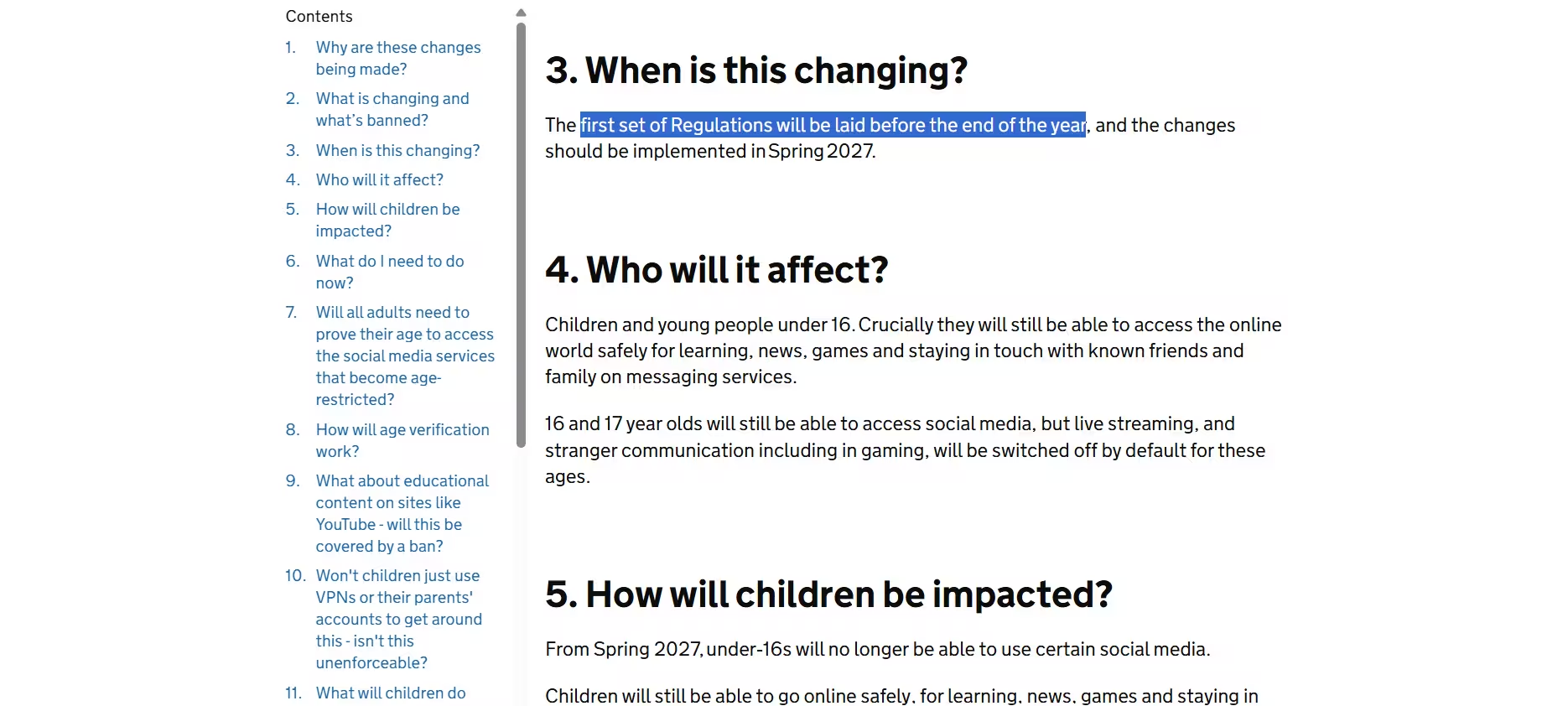
The UK government’s official guidance confirms that the under-16 social media ban is expected to be implemented in Spring 2027.
Is the UK Social Media Ban Officially Confirmed?
Yes. The government confirmed its decision to introduce an under-16 social media ban on 15 June 2026, following a national consultation.
This marks a significant change from the position earlier in 2026, when ministers were still evaluating whether targeted restrictions would be more effective than a wider ban.
The Children’s Wellbeing and Schools Act 2026 provides the legislative framework for introducing further age and functionality restrictions through regulations under the Online Safety Act 2023.
The government intends to use these powers to prevent covered social media companies from providing services to children under 16.
However, the final regulations must still specify exactly which services are covered, how compliance will be assessed and when the restrictions become enforceable.
The distinction is important because an announced government policy is not automatically the same as an operational legal ban.
Which Social Media Platforms Will Be Banned for Under-16s?
The government’s proposed restrictions are expected to cover several of the world’s largest social media platforms.
The approach is based partly on Australia’s under-16 social media restrictions, which came into effect on 10 December 2025.
Expected Platforms Affected by the UK Ban
| Social media platform | Expected position from Spring 2027 |
| Expected to be covered | |
| TikTok | Expected to be covered |
| Snapchat | Expected to be covered |
| Expected to be covered | |
| YouTube | Expected to be covered, subject to final scope and exceptions |
| X (formerly Twitter) | Expected to be covered |
| Threads | Potentially affected; final UK scope pending |
| Potentially affected; final UK scope pending | |
| Twitch | Potentially affected depending on service classification |
| Not intended to be included | |
| Signal | Not intended to be included |
| Dedicated educational platforms | Not intended to be included |
The government has specifically referred to Instagram, YouTube, TikTok, Snapchat, Facebook and X when discussing the Australian model.
However, the final UK regulations will determine the precise services affected. Other platforms should not be described as definitively banned before those rules are published.
Will TikTok Be Banned in the UK?
TikTok is among the platforms expected to be affected by the new restrictions.
Children under 16 would no longer be permitted to access the covered social media service once the regulations take effect.
TikTok’s short-form video model, personalised recommendations and continuous scrolling functionality have featured prominently in broader discussions about addictive platform design.
The restriction is not intended to prevent adults or users aged 16 and above from using TikTok.
Will Instagram and Snapchat Be Banned?
Instagram and Snapchat are also expected to fall within the restrictions.
The government wants to reduce children’s exposure to harmful content, unwanted contact and platform features that encourage excessive engagement.
Snapchat’s communication features may raise questions about how services combining social networking and messaging will be classified.
The final regulations will need to establish how these mixed-function platforms should be treated.
Will YouTube Be Banned for Children Under 16?
YouTube is included among the mainstream platforms identified by the government as potentially covered.
However, the government has emphasised that it does not intend to prevent children from accessing legitimate educational resources.
A distinction may therefore be made between mainstream social media functionality and age-appropriate educational environments.
Parents should not assume that every YouTube video, educational resource or child-focused product will automatically become inaccessible.
The precise treatment of YouTube’s different services and features will depend on the final regulations.
Will WhatsApp and Signal Be Banned?
No. The government has stated that it does not intend to include messaging services such as WhatsApp and Signal in the main social media ban.
This means children should still be able to communicate with known friends and family through permitted messaging services.
However, services that allow strangers to contact children may face additional restrictions depending on their functionality.
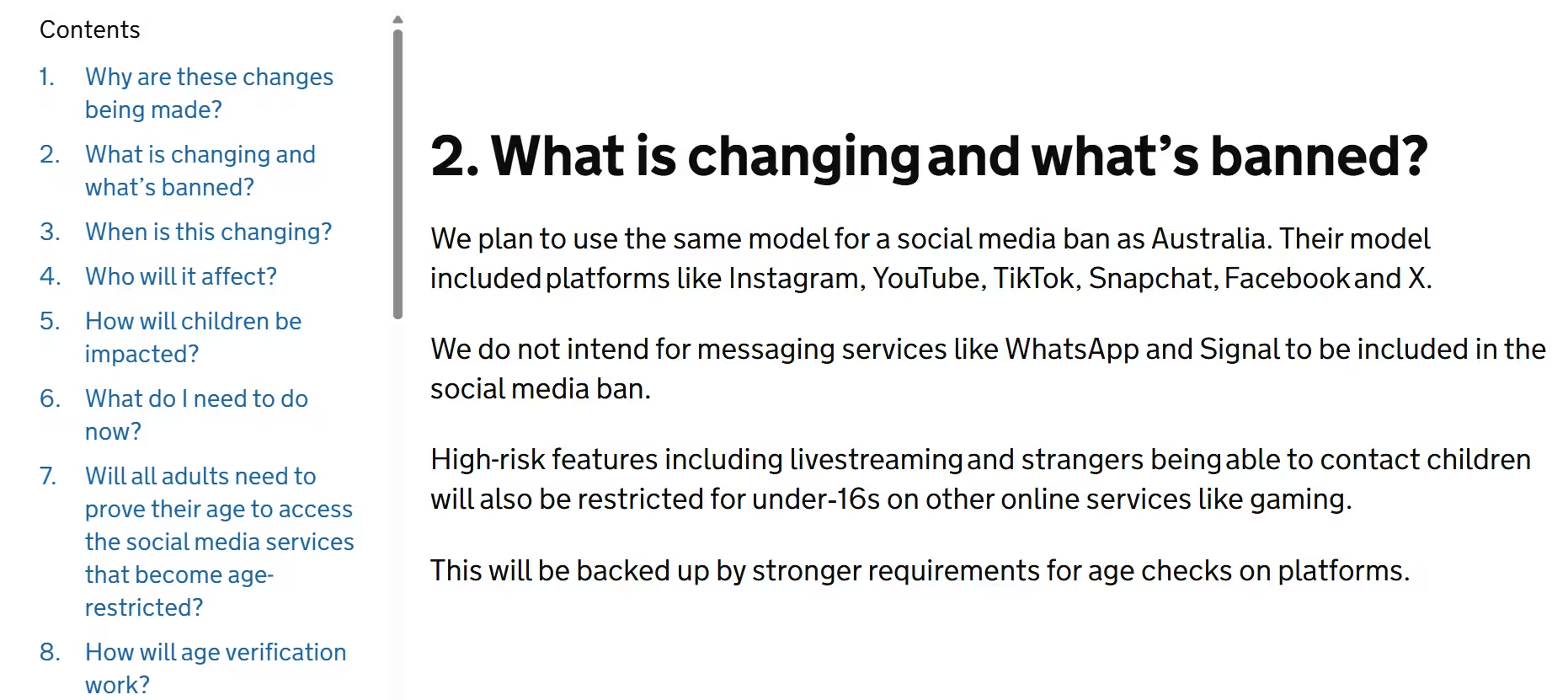
The government identifies major social media platforms expected to be affected while explaining that messaging services such as WhatsApp and Signal are not intended to be included.
What Age Will You Have to Be to Use Social Media in the UK?
Under the planned rules, children will generally need to be at least 16 to access social media platforms covered by the ban.
Different protections will apply depending on the user’s age.
| Age group | Planned restrictions |
| Under 13 | Covered by the new under-16 ban, as well as existing protections |
| 13–15 | Access to covered social media services prohibited |
| 16–17 | Access permitted, with additional safety restrictions and default settings |
| 18 and over | Access permitted, potentially subject to age verification |
The government is not introducing a blanket internet ban for children.
Children will still be able to access appropriate learning resources, permitted games, information services and communication tools.
The policy is focused on particular social media services and high-risk functionality.
What New Social Media Restrictions Will Apply to 16- and 17-Year-Olds?
Although 16- and 17-year-olds will remain eligible to use social media, they will face additional default protections.
These measures are designed to reduce exposure to potentially harmful features without completely removing access.
1. Social Media Curfew From Midnight to 6 AM
The government plans to introduce an overnight curfew for users aged 16 and 17.
Social media access will be restricted by default between midnight and 6am.
The policy is intended to reduce late-night screen use and support healthier sleeping habits.
However, the curfew is designed as a default setting rather than an absolute prohibition.
Users aged 16 and 17 will be able to change the relevant settings if they choose.
2. Notifications Switched Off Overnight
Social media notifications will also be disabled during the proposed midnight-to-6am period.
Notifications can encourage repeated checking of applications, including when young people are preparing to sleep.
Disabling them by default is intended to reduce interruptions and unnecessary engagement.
3. Autoplay Disabled by Default
Autoplay automatically begins another video after the current one finishes.
On video-focused platforms, this can encourage continued viewing without requiring the user to make a deliberate decision.
Under the announced measures, autoplay will be switched off by default for 16- and 17-year-olds.
4. Personalised Feeds Switched Off by Default
Personalised feeds use information about a user’s activity and preferences to recommend content.
The government plans to disable these feeds by default for 16- and 17-year-olds, while allowing them to change their settings.
This measure is intended to address concerns about recommendation systems encouraging prolonged engagement.
5. Restrictions on Livestreaming and Stranger Communication
Additional protections will limit livestreaming and communication with strangers.
For 16- and 17-year-olds, livestreaming and stranger-contact features are intended to be unavailable by default on relevant services.
For younger children, restrictions on high-risk functions will also apply beyond conventional social media platforms, including gaming services.
These protections may be introduced through further regulations, so they should not automatically be assumed to have the same commencement date as the initial under-16 ban.
Why Is the UK Government Banning Social Media for Under-16s?
The government says the restrictions are necessary because of growing concerns about children’s exposure to harmful content, excessive screen use and online exploitation.
Social media can offer educational and social benefits, but some platform features may also create risks.
Key concerns include cyberbullying, inappropriate content, grooming, harassment, excessive screen time, sleep disruption and unwanted contact from strangers.
What Did the 2026 Government Consultation Find?
The national consultation, Growing up in the online world, ran from 2 March to 26 May 2026.
It received 116,211 responses across the government’s consultation and engagement exercises.
The results indicated strong public support for further action.
90%
Approximately nine in ten parents supported an under-16 social media ban.
2 in 3
Young people supported restricting under-16s from at least some social media platforms.
The consultation also highlighted differences between adult and children’s attitudes towards social media.
Only 11% of respondents to the parent consultation believed the benefits of social media outweighed the risks, compared with 40% of children who held that view.
These differences demonstrate why children and parents may have different perspectives on the proposed restrictions.
Are Social Media Platforms Harmful to Children’s Mental Health?
Researchers have identified associations between problematic social media use and concerns such as sleep disruption, anxiety and emotional wellbeing.
However, establishing direct causation is more complicated.
The government’s evidence review acknowledges that excessive social media use and poor mental health are correlated, but that this does not automatically prove social media causes every reported mental health difficulty.
Professor Sonia Livingstone, a researcher specialising in children’s digital experiences at the London School of Economics, has argued that policymakers should exercise caution when introducing broad social media bans.
In her January 2026 analysis, she emphasised the importance of stronger evidence and ensuring children themselves have a meaningful voice in decisions affecting their digital lives.
Her work highlights an important consideration: protecting children online should not mean overlooking the educational, social and emotional support that digital communities can provide.
What Do Child Protection Professionals Say?
Chris Sherwood, Chief Executive of the NSPCC, welcomed the government’s June 2026 announcement but warned that a ban alone would be insufficient without effective implementation.
He stressed that age verification, enforcement and action against addictive design features would remain essential.
Similarly, Lynn Perry, Chief Executive of Barnardo’s, welcomed the decision while recognising that some young people would lose opportunities for connection and learning.
She emphasised that social media companies must continue to take responsibility for making their services safe.
These professional perspectives reinforce the argument that a ban should form part of a wider child protection strategy rather than operate as a standalone solution.
How Will Age Verification Work Under the UK Social Media Ban?
Stronger age verification is central to the government’s plan.
Simply asking users to enter their date of birth is unlikely to provide sufficient assurance that they meet the minimum age requirement.
Instead, platforms will be expected to use reliable methods to determine whether users are eligible to access restricted services.
What Age Verification Methods Could Be Used?
The methods being assessed include:
- Facial age estimation to estimate a person’s age.
- Credit card-based verification where appropriate.
- Trusted third-party age verification services.
- Existing verified age information associated with accounts.
- Other robust age assurance technologies that meet Ofcom’s requirements.
These are potential or existing age assurance approaches, not a final mandatory checklist for every social media service.
Ofcom is responsible for assessing how these technologies can operate effectively and fairly.
Will Everyone Need to Upload Their ID?
Not necessarily.
The government has indicated that many adults may already have sufficient evidence of their age associated with their accounts.
Examples include accounts that have existed for more than 16 years, accounts connected to a credit card or accounts associated with independently verified information.
Some users may already have completed suitable verification through existing online safety requirements.
Others may need to complete an additional check.
Importantly, the government has not announced a universal requirement for every adult to upload a passport or driving licence.
Can Age Verification Protect User Privacy?
Age assurance systems must be designed with data protection and privacy in mind.
For example, facial age estimation may be capable of establishing whether a user exceeds a particular age threshold without requiring the service to permanently retain an identity document.
However, the privacy implications depend on how the technology is implemented.
The Information Commissioner’s Office and Ofcom have emphasised the importance of privacy-conscious approaches to children’s online safety.
For businesses, any age verification system should be assessed for accuracy, security, accessibility and appropriate handling of personal data.
In July 2026, Ofcom also concluded that relying solely on behavioural age inference after someone has already used a platform would not be sufficient to enforce the new under-16 entry restrictions.
Ofcom’s October 2026 updates continue to emphasise the need for effective age assurance and compliance with existing online safety obligations.
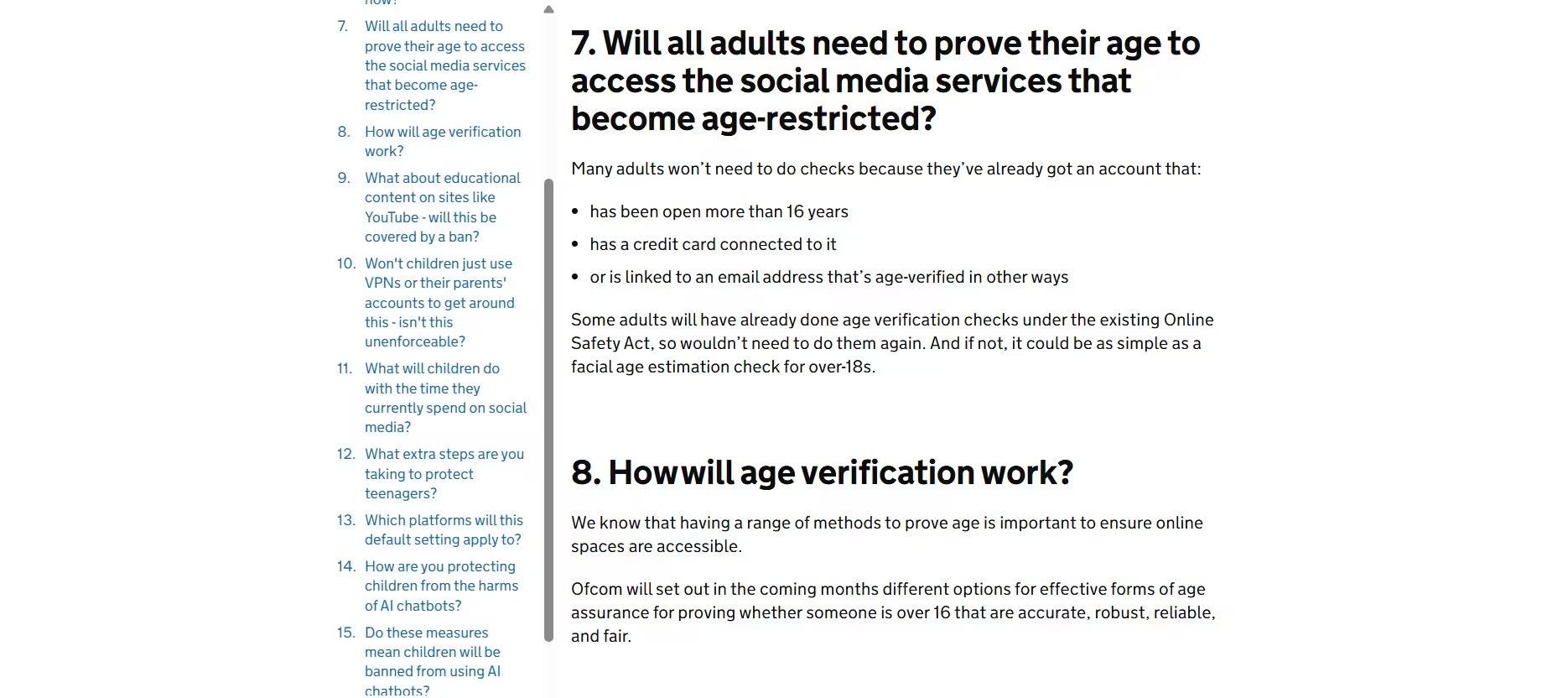
UK government guidance explains why many adults may not require additional age checks and how Ofcom will assess acceptable verification methods.
Will Children Be Able to Use VPNs to Bypass the Social Media Ban?
Virtual Private Networks, commonly called VPNs, can disguise aspects of a user’s internet connection and location.
This raises concerns that some children could attempt to bypass platform restrictions by appearing to access services from another country.
The government has acknowledged this risk.
Research has been commissioned to understand how children use VPNs and what implications this may have for age verification.
However, using a VPN does not necessarily allow someone to bypass an effective age verification system.
A platform may use several forms of evidence to assess whether an account holder meets the relevant age requirement.
Will VPNs Be Banned in the UK?
The government has not announced a general prohibition on VPN use as part of the under-16 social media restrictions.
VPNs also have legitimate applications, including privacy protection and secure remote working.
Policymakers must therefore consider circumvention risks without unnecessarily restricting legitimate technology.
The effectiveness of the final rules will depend partly on how platforms distinguish eligible users from those attempting to evade age restrictions.
Will Children Still Be Able to Play Online Games?
Yes. The proposed social media ban does not automatically prohibit children from accessing online games.
However, high-risk features within gaming environments may face additional restrictions.
The government is particularly concerned about situations where unknown adults can communicate directly with children.
What Gaming Features Could Be Restricted?
Potentially affected features include:
- Direct messages from unknown users.
- Livestreaming functions.
- Unrestricted communication between children and strangers.
- Other interactive features that create significant safeguarding risks.
For example, a multiplayer game may remain accessible while certain communication functions are restricted according to the user’s age.
For children under 16, the government intends to restrict these high-risk features rather than prohibit every gaming experience.
For 16- and 17-year-olds, some of these features will be disabled by default.
The precise application will depend on the final rules governing different types of online services.
Will Educational Websites and YouTube Learning Videos Be Banned?
The government has confirmed that children’s access to educational resources should continue.
The intention is not to prevent pupils from completing homework, accessing learning materials or using appropriate digital tools.
Dedicated educational services are not intended to fall within the proposed social media ban.
However, platforms such as YouTube combine educational videos with mainstream social media functionality.
This creates practical questions about how children will access useful material without being exposed to unrestricted recommendations, comments or other potentially harmful features.
The government has indicated that platforms could develop safer, age-appropriate environments to preserve educational access.
Schools and educational providers should therefore monitor the final regulations before making assumptions about the availability of particular digital learning resources.
Will AI Chatbots Be Banned for Children Under 18?
The government is also considering additional protections for children who use artificial intelligence chatbots.
However, there is no announced general ban on children using all AI chatbots.
The government’s stated approach recognises that AI can support education, research and creativity.
Its concerns focus on harmful chatbot interactions, including sexually explicit functionality, unsafe advice and the risk of emotional dependency.
Restrictions on Harmful AI Chatbots
The government has proposed restrictions preventing under-18s from accessing certain sexualised chatbot services and features.
It is also examining stronger action against chatbot services that provide dangerous, misleading or unverified mental health advice.
Possible measures include restrictions or prohibitions where particular services pose serious risks to children.
The precise legal treatment of different AI services remains subject to implementation.
Will AI Chatbots Require Mandatory Breaks?
The government has proposed regular breaks for users under 18.
These breaks would encourage healthier usage habits and help reduce excessive reliance on chatbot interactions.
However, the frequency and duration have not yet been finalised.
The government intends to work with experts to determine how mandatory breaks could operate without unnecessarily limiting beneficial educational uses.
This distinction is important because proposals for chatbot breaks should not be presented as rules already being enforced.
Will the Social Media Ban Affect Existing Accounts?
One major practical question concerns children who already have social media accounts.
For example, a 14-year-old may have used Instagram or Snapchat for several years before the new restrictions begin.
Once the law takes effect, covered services will need to prevent under-16s from continuing to access prohibited social media functionality.
However, the government has not yet published complete operational rules explaining what must happen to every existing account.
Platforms may need procedures for identifying affected users, restricting access and managing account data.
Parents should not assume that all existing accounts will automatically be permanently deleted on a specific date.
Whether account suspension, removal, data recovery or other arrangements apply will need to be clarified through the regulations and individual platform policies.
How Will the UK Social Media Ban Be Enforced?
The responsibility for implementing the restrictions will primarily fall on covered technology companies.
Social media providers will be expected to introduce suitable systems for enforcing the minimum age and restricting prohibited features.
Ofcom will play a central role in regulating compliance.
What Will Ofcom Do?
Ofcom already regulates online safety under the Online Safety Act 2023.
Its responsibilities include monitoring whether regulated platforms adequately protect users, assessing compliance and taking enforcement action where necessary.
In its official statement on the under-16 social media restrictions, published in June 2026, Ofcom confirmed that it was preparing to work with the government on implementing the new measures.
The regulator also warned that technology companies must strengthen existing protections.
Under the current Online Safety Act framework, serious compliance failures can result in fines of up to £18 million or 10% of qualifying worldwide revenue, whichever is greater.
The precise application of enforcement powers to the new age restrictions will depend on the final regulatory framework.
Will Parents Be Fined if Their Children Use Social Media?
The announced policy focuses on requiring social media companies to prevent prohibited access.
The government has not announced a general system of fines for parents whose children attempt to access restricted platforms.
Similarly, the proposals are not framed around criminalising children for using social media.
The central objective is to make technology companies responsible for implementing effective safeguards.
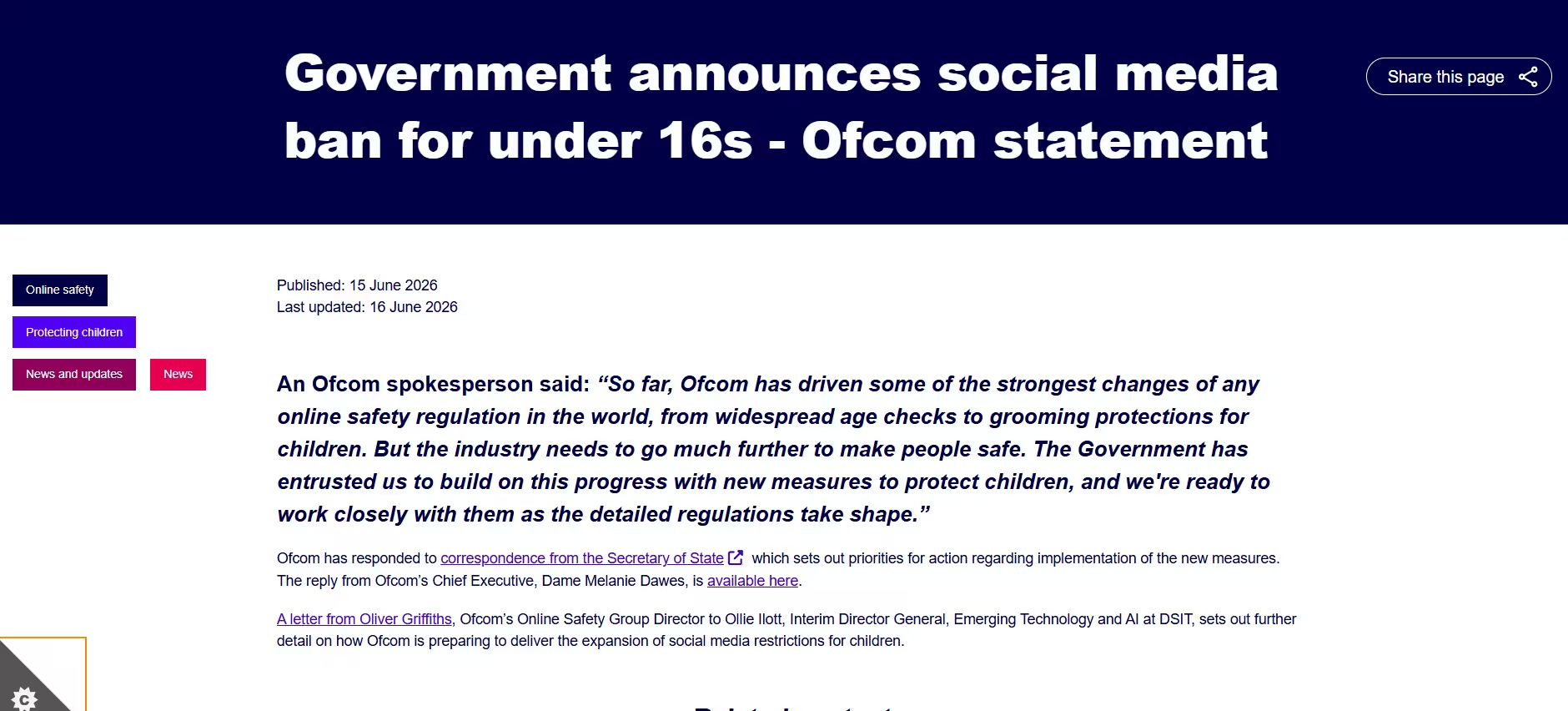
Ofcom has confirmed its role in preparing for the new restrictions and strengthening accountability across online platforms.
How Is the UK Social Media Ban Different From the Online Safety Act 2023?
The Online Safety Act 2023 already imposes important obligations on online services operating in the UK.
However, the planned 2027 restrictions introduce additional requirements specifically targeting social media access by children under 16.
| Area | Existing Online Safety Act obligations | Planned 2027 restrictions |
| Children’s online access | Safety requirements and age-related protections | Under-16 access prohibited on covered social media |
| Harmful content | Risk assessments and protective measures | Additional protection through restricted access |
| Age assurance | Required in relevant circumstances | Stronger checks to establish eligibility at age 16 |
| Livestreaming | Existing relevant safeguarding obligations | Further age-based functionality restrictions |
| Stranger communication | Existing safety responsibilities | Additional restrictions and default protections |
| Personalised feeds | Existing duties relating to harmful content and recommendation systems | Disabled by default for 16- and 17-year-olds under announced plans |
The new rules are intended to build on existing legislation rather than replace it.
In its October 2026 communications, Ofcom specifically reminded online service providers that existing legal obligations remain in force while the government prepares the additional restrictions.
Companies should therefore continue implementing existing child safety requirements rather than delaying improvements until Spring 2027.
How Will the UK Social Media Ban Affect Small Businesses and Digital Marketing?
Although the proposed restrictions focus on protecting children, they could also influence the digital marketing strategies of businesses that rely on younger audiences.
Companies selling products or services to teenagers may need to reconsider their audience targeting, content distribution and social media engagement strategies.
Businesses Targeting Under-16 Customers
Brands targeting younger consumers may experience changes in the availability of audiences on affected social media platforms.
Businesses should assess whether campaigns rely on users who will no longer be permitted to access those platforms.
Marketing teams may need to review campaign objectives, audience assumptions and distribution channels.
However, the government has not introduced a universal ban on advertising products used by children.
The central issue is access to covered social media platforms, alongside existing advertising and data protection obligations.
Changes to Influencer Marketing
Businesses working with influencers whose audiences include substantial numbers of under-16s may need to reconsider how campaigns are planned and measured.
For example, a brand previously relying on social media engagement among younger teenagers may need to consider alternative communication methods that remain appropriate and lawful.
This could include educational partnerships, age-appropriate websites or campaigns directed towards parents.
Why Diversifying Marketing Channels Matters?
Businesses should avoid relying entirely on a single social media platform to reach their audience.
A broader approach may include search engine optimisation, website content, email marketing where legally appropriate and other relevant digital channels.
Companies developing their online presence can also benefit from understanding how to start digital marketing from home, particularly when building skills in SEO, content creation and audience engagement.
Businesses operating social platforms, online communities or user-generated content services should also assess whether they have direct obligations under the Online Safety Act.
What Will Children Do Instead of Using Social Media?
The government recognises that removing access to social media could affect how children communicate, learn and spend their leisure time.
For some children, social media provides entertainment, friendship and opportunities for creative expression.
A restriction may therefore create challenges unless suitable alternatives are available.
To address this, the government has announced wider investment in activities that support children’s development.
Government Investment in Offline Activities
The government’s September 2026 factsheet identifies several funding commitments.
| Investment | Intended purpose |
| £500 million | Strategy to expand access to enrichment activities, including sport, arts and youth services |
| £132.5 million | Education enrichment package supporting additional activities in schools and colleges |
| More than £3 billion | Wider investment supporting youth centres, sporting facilities and cultural provision |
The wider investment programme includes building or refurbishing up to 250 youth centres and supporting grassroots sports facilities.
The government has also referred to measures intended to protect more than 1,000 arts venues, museums, libraries and heritage buildings from closure.
These funding programmes have different scopes and should not automatically be treated as entirely new spending created solely because of the social media ban.
Supporting Children Who Feel Socially Isolated?
One concern is that social media restrictions could disproportionately affect children who already find it difficult to make friends offline.
For example, some young people rely on online communities to communicate with others who share similar interests or experiences.
The government has recognised these concerns and wants children to continue accessing safe opportunities for connection.
Schools, parents and community organisations may therefore play a greater role in helping children maintain friendships and participate in activities.
What Should Parents Do Before the Social Media Ban Starts?
The government says that parents and children do not need to take any immediate formal action.
However, families may find it helpful to prepare gradually for the proposed changes.
Review Existing Social Media Accounts
Parents can begin by identifying which platforms their children currently use.
This includes understanding whether accounts are used primarily for entertainment, communication, education or social interaction.
It may also be useful to identify friendships or communities that children would find difficult to maintain without social media access.
Discuss the Changes Before They Happen
Children may be concerned about losing access to familiar platforms.
Explaining the proposed restrictions early can help families understand what is changing and why.
Parents should also listen to their children’s concerns, particularly where social media plays an important role in friendships or school-related activities.
Explore Permitted Communication Services
Since messaging services such as WhatsApp and Signal are not intended to fall within the main ban, families may have alternatives for maintaining contact.
However, parents should still review privacy settings, safety features and the applicable minimum ages of individual services.
Being excluded from the new social media ban does not automatically mean every messaging application is suitable for every child.
Plan Alternative Activities
Families may consider encouraging hobbies, sports, creative activities, reading and face-to-face social opportunities.
The purpose should not simply be to replace every minute spent online.
A more sustainable approach is to establish balanced routines that support sleep, education, friendships and wellbeing.
Follow Official Updates
Parents should watch for government announcements confirming the start date and final platform requirements.
They should also look for updates from individual social media platforms explaining how existing accounts and age verification will be handled.
What Are the Main Concerns About the UK Social Media Ban?
Although public support is substantial, the proposals continue to raise questions about enforcement, children’s rights and unintended consequences.
1. Children Could Move to Less Regulated Platforms
One concern is that children may move from mainstream platforms to smaller services with weaker safety protections.
If this happens, restrictions could reduce access to popular services without eliminating the underlying risks.
This is why regulators and child protection organisations have emphasised the need for safety measures across the wider digital environment.
2. Age Verification Could Affect Privacy
Effective age checks require platforms to establish whether users meet the minimum age.
Some methods involve processing sensitive information or obtaining evidence about identity or age.
Appropriate data minimisation, secure handling and accessible verification options will therefore be important.
3. Some Children Could Lose Valuable Support Networks
Online communities may provide meaningful social support to children who feel isolated.
A blanket restriction may affect different groups in different ways.
Professor Sonia Livingstone’s research highlights the importance of considering these differences rather than assuming all children’s online experiences are identical.
4. The Rules May Be Difficult to Enforce
Children may attempt to bypass restrictions through shared accounts, inaccurate age information or technical workarounds.
However, this does not automatically make regulation ineffective.
The practical challenge is ensuring that platforms implement safeguards robust enough to reduce prohibited access without creating unreasonable barriers for legitimate users.
What Happens Next Before Spring 2027?
The government has established a broad implementation timetable, but several important details remain outstanding.
Before the new restrictions take effect, policymakers and regulators will need to clarify the final scope of affected services, acceptable age verification methods, implementation procedures and enforcement arrangements.
Ofcom is also continuing to assess how effective age assurance should work for the new 16-year-old threshold.
Its report on content harmful to children, published on 22 October 2026, confirms that further work on age assurance and the planned restrictions is ongoing.
The next major milestone is the presentation of the first regulations to Parliament, which the government expects to happen before the end of 2026.
Additional measures addressing older teenagers and other online services may follow through further regulations.
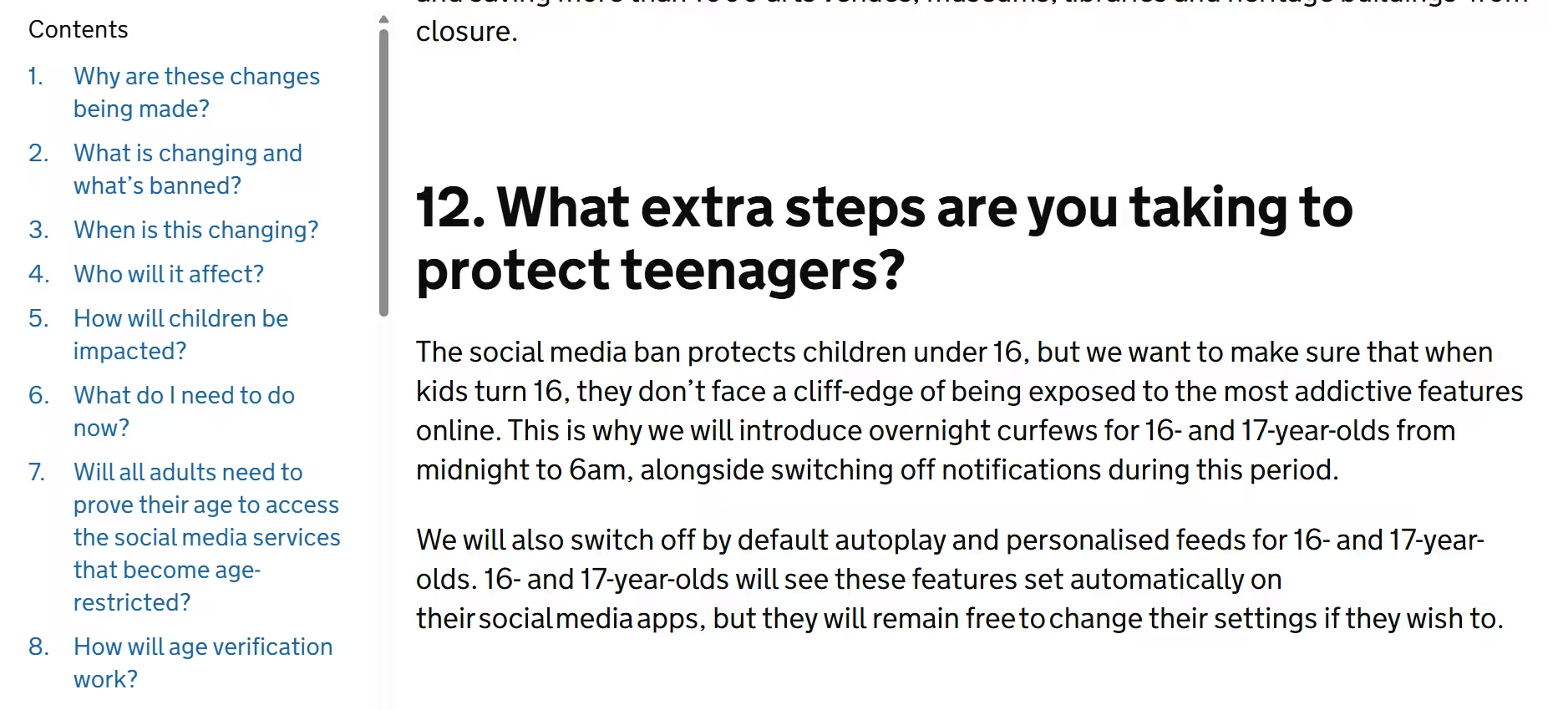
Government guidance sets out plans for overnight social media curfews, default restrictions on addictive features and further safeguards for children using AI chatbots.
FAQs About the UK Social Media Ban
When is the UK social media ban happening?
The UK social media ban for under-16s is expected to begin in Spring 2027. The government plans to introduce the first regulations before the end of December 2026, but the exact start date has not yet been confirmed.
Is the UK social media ban already in force?
No. As of now, the new nationwide under-16 restrictions are not yet operational. Existing obligations under the Online Safety Act 2023 continue to apply.
Will children under 16 be banned from TikTok?
TikTok is among the platforms expected to be covered by the new restrictions. Once the regulations take effect, the service is expected to be prohibited from providing covered social media access to under-16s.
Will Snapchat and Instagram be banned in 2027?
Instagram and Snapchat are expected to fall within the planned restrictions for children under 16. The final rules and implementation requirements are still being prepared.
Can 16-year-olds still use social media in the UK?
Yes. Users aged 16 and 17 will still be able to use covered social media services, but additional protections will apply, including default overnight curfews and restrictions on certain features.
Will WhatsApp be banned for under-16s?
No. The government has stated that it does not intend to include WhatsApp or Signal in the main social media ban. Existing platform age requirements and safety protections will still be relevant.
Will the social media ban affect adults?
Adults will still be allowed to use social media. However, some users may need to complete age verification checks, depending on the information already associated with their accounts.
Will parents be fined if their children use social media?
The government has not announced a general fine for parents whose children attempt to access restricted social media platforms. Enforcement is primarily focused on the responsibilities of covered technology companies.

Jennifer contributes business-focused articles covering modern business trends, digital growth, entrepreneurship, and practical insights designed to support startups and SMEs.

Does Gross Misconduct Always Lead to Dismissal?
No. Gross misconduct does not always lead to dismissal. It can be serious enough to justify dismissal without notice, including for a first offence, but dismissal is not…
Andy Burnham Whitehall Job Cuts: What Is Changing In 2026?
The Andy Burnham Whitehall job cuts story has become part of a much wider debate about how the UK Government should operate and where political power, public money…
Insights for the Modern
UK Small Business.
Join 15,000+ owners receiving tactical analysis on finance, marketing, and technology. No clutter.
Zero spam. Unsubscribe in one click.