When is the Social Media Ban Happening in UK? | Under-16 Restrictions

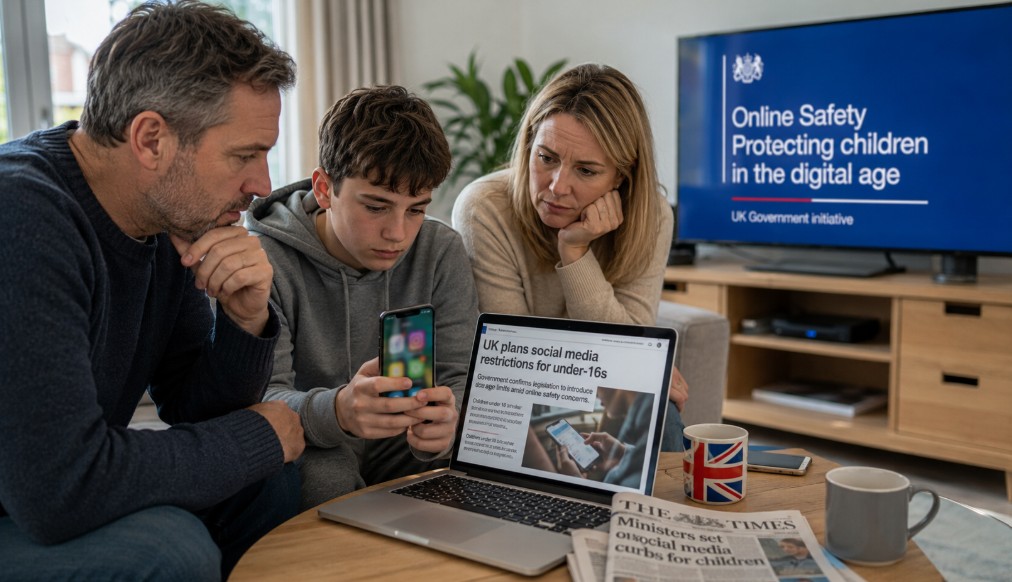
The UK government is expected to introduce some form of social media restrictions for under-16s by summer 2026 following a national consultation that closes on 26 May 2026.
While many people refer to it as a “social media ban”, the government has not confirmed a full Australia-style ban yet.
Instead, ministers are considering several measures including age verification, digital curfews, time limits on apps and restrictions on addictive platform features.
Key highlights:
- The consultation on children’s social media use ends on 26 May 2026
- Government action is expected by summer 2026
- Restrictions are mainly aimed at under-16s
- A trial involving 300 UK families is already underway
- Platforms such as TikTok, Instagram and Snapchat could face stricter rules
The debate has become one of the biggest online safety discussions in the UK, especially as concerns grow around children’s mental health, cyberbullying and excessive screen time.
Is the UK Actually Introducing a Social Media Ban?
Yes, the UK is preparing to introduce restrictions on children’s social media use, but a complete nationwide ban has not yet been confirmed.
The government has repeatedly stated that “the status quo cannot continue” when it comes to children accessing harmful or addictive online content.
Ministers are now under increasing pressure from MPs, campaigners and the House of Lords to take stronger action against social media companies.
At the centre of the debate is whether under-16s should be prevented from accessing certain platforms altogether or whether more targeted controls would be more effective.
Current Government Position:
| Issue | Current Status |
| Full social media ban | Under consultation |
| Restrictions for under-16s | Expected |
| Consultation deadline | 26 May 2026 |
| Expected implementation | Summer 2026 |
| Platforms affected | Potentially TikTok, Instagram, Snapchat and others |
Although some politicians want immediate legislation, the government has focused on gathering evidence before making final decisions. This cautious approach is partly due to concerns about privacy, enforcement and unintended consequences.
Technology Secretary Liz Kendall recently stated:
“We are determined to give young people the childhood they deserve and to prepare them for the future.”
That statement reflects the government’s broader aim of reducing online harms without introducing measures that are difficult to enforce in practice.
The current expectation is that some form of age or functionality restriction will become law later in 2026.
When will the UK Government Announce Social Media Restrictions?
The key date is 26 May 2026, when the government’s consultation on children’s digital wellbeing and social media use officially ends.
After the consultation closes, officials will review responses from parents, schools, child safety groups, academics, and social media companies. Ministers have already indicated that action is likely during summer 2026.
Although no exact launch date has been confirmed, reports suggest the government wants new regulations introduced before the end of the year. The timeline has accelerated because of growing political pressure and public concern over children’s online safety.
Expected Timeline for UK Social Media Restrictions
| Timeline | Expected Development |
| January 2026 | Government announced consultation |
| March 2026 | Consultation officially opened |
| May 2026 | Consultation closes |
| Summer 2026 | Restrictions expected to be announced |
| Late 2026 | Potential implementation phase |
The Children’s Wellbeing and Schools Bill has also intensified the debate. Members of the House of Lords have repeatedly pushed for stronger measures, including a direct under-16 social media ban.
Education Secretary Bridget Phillipson explained the government’s position clearly:
“We are clear that under any outcome we will impose some form of age or functionality restrictions for children under 16.”
That statement suggests restrictions are no longer a possibility but an eventual certainty.
Why is the UK Considering a Ban on Social Media for Under-16s?
The push for stricter social media controls is largely driven by concerns about children’s mental health, online addiction and exposure to harmful content.
Studies and official reports have highlighted the growing amount of time young people spend online and the risks associated with unregulated access to social media platforms.
According to Ofcom statistics published in 2025:
- 95% of children aged 13 to 15 use social media regularly
- 97% of teenagers aged 13 to 15 own a mobile phone
- 37% of children aged 3 to 5 already use social media
Critics argue that platforms are intentionally designed to maximise screen time through features such as endless scrolling, autoplay recommendations and algorithm-driven content feeds.
Supporters of tighter restrictions believe limiting access could reduce:
- Cyberbullying
- Exposure to violent or sexual content
- Online harassment
- Social comparison anxiety
- Sleep disruption
- Digital addiction
However, opponents warn that a total ban could force teenagers towards less regulated online spaces or reduce access to positive online communities and educational resources.
Former Conservative minister John Nash described children’s social media use as “a societal catastrophe.”
That strong language highlights how emotionally charged the debate has become across UK politics and child safety campaigns.
Despite disagreements over the best solution, there is broad political agreement that stronger protections are needed.
What Does the 26, May 2026 Government Consultation Mean?
The consultation is the government’s formal process for collecting evidence before deciding exactly how social media restrictions should work.
Key Goals of the UK Digital Wellbeing Consultation
The consultation focuses on improving children’s online experiences and reducing harmful digital behaviours.
Ministers are reviewing whether social media companies should face stricter obligations around child safety and addictive platform design.
Key issues being explored include:
- Whether under-16s should be banned from social media
- If overnight app curfews should be introduced
- Whether stronger age verification systems are needed
- How to reduce addictive online features
- What role parents should play in enforcement
The government has already received nearly 30,000 responses from parents and children across the UK.
Why Ministers Want More Evidence Before Acting?
One reason the government has delayed a direct ban is because officials want stronger evidence about what actually works.
Instead of introducing immediate legislation, ministers are testing practical restrictions through pilot programmes involving real families.
This approach is intended to avoid rushed policies that could create loopholes or unintended consequences.
Public and Parent Responses to the Consultation
Public opinion appears divided. Many parents support stronger restrictions because they worry about online safety and excessive screen time. Others believe education and parental controls are more effective than government bans.
The consultation has also become politically sensitive because social media use now affects schools, family life and youth mental health on a national scale.
As a result, the government is expected to balance child protection with concerns around privacy and digital freedom.
Could the UK Introduce Restrictions Instead of a Full Ban?
Yes, and this is currently the most likely outcome.
Although headlines often focus on a “social media ban”, ministers have repeatedly suggested they are considering a range of alternative restrictions rather than a complete prohibition.
Possible Restrictions Being Considered:
| Restriction Type | What It Could Mean |
| Digital curfews | Blocking social media access overnight |
| App time limits | Limiting daily usage |
| Age verification | Stronger identity checks |
| Feature restrictions | Limiting infinite scrolling or autoplay |
| Platform-specific rules | Restrictions on selected apps |
The government appears especially concerned about addictive design features that encourage excessive use.
Olivia Bailey, a junior education minister, recently stated that restrictions on “harmful algorithmically-driven content and features” remain a major focus.
This could eventually force social media companies to redesign certain engagement systems for younger users.
What Social Media Rules Are Being Tested with UK Families?

The UK government is already testing potential restrictions with 300 families across England, Scotland, Wales and Northern Ireland.
Social Media Curfews for Teenagers
One pilot group blocks social media access between 9pm and 7am. Officials want to measure whether overnight restrictions improve sleep, concentration and family routines.
Daily App Time Limits and Screen Restrictions
Another group limits children to one hour per day on apps such as TikTok, Snapchat and Instagram.
Researchers are examining whether reduced screen time changes behaviour, school performance or emotional wellbeing.
Testing Age Verification and Parental Controls
Some families are also trialling parental controls that completely disable selected apps.
Parents involved in the trials are reporting practical difficulties, including teenagers finding workarounds to bypass restrictions.
One parent involved in a local online safety discussion shared their experience with me while discussing the pilot schemes. They explained:
“At first my son was angry about losing access after 9pm, but after a few weeks he actually started sleeping earlier and focusing more on school. The hardest part was making the rules consistent without constant arguments.”
That example reflects the wider challenge facing the government. Even if restrictions improve wellbeing, enforcing them consistently across millions of households may prove difficult.
Professor Amy Orben from the University of Cambridge also highlighted the importance of evidence-led policymaking:
“We currently lack critical insights about how different types of social media policies might work in practice.”
The results from these pilot programmes are expected to heavily influence the final government decision.
How Would a UK Social Media Ban Affect Children and Teenagers?
If restrictions are introduced, they could significantly change how teenagers interact with digital platforms.
Many young people currently use social media for entertainment, communication, school collaboration and identity development. A sudden ban could therefore reshape daily routines for millions of families.
Supporters believe restrictions may improve:
- Sleep quality
- Attention spans
- Mental wellbeing
- School performance
- Offline social interaction
Critics, however, argue there are risks associated with overregulation.
Some experts believe strict social media bans could push children towards hidden online spaces, while others warn vulnerable teenagers may lose access to supportive communities.
There are also concerns about whether age verification can work without affecting privacy. Many teenagers acknowledge online risks but still value social media for communication and creativity.
Because of this, the UK may focus more on limiting harmful features rather than introducing a complete ban.
What Role Does the Online Safety Act 2023 Play in UK Social Media Rules?

The Online Safety Act 2023 already gives regulators significant powers over online platforms operating in the UK.
The legislation requires social media companies to assess risks to children and remove harmful or illegal content more effectively.
Under the Act, platforms must:
- Protect children from harmful material
- Enforce minimum age requirements
- Improve reporting systems
- Reduce harmful recommendation algorithms
- Provide safer online experiences for minors
Ofcom now plays a central role in enforcing these standards.
Online Safety Act Responsibilities:
| Requirement | Purpose |
| Age-appropriate experiences | Protect younger users |
| Content moderation | Remove harmful material |
| Risk assessments | Identify platform dangers |
| Child safety enforcement | Improve online protections |
| Algorithm monitoring | Reduce harmful recommendations |
Many technology companies have already started introducing new safety features to comply with the law.
However, campaigners argue current measures still do not go far enough, especially regarding addictive platform design and excessive screen time.
The proposed 2026 restrictions would therefore build on the foundations already established by the Online Safety Act.
How Are Parliament and Ofcom Responding to the Under-16 Social Media Debate?
The debate over under-16 social media restrictions has increased tension between the House of Lords and the UK government.
Peers in the Lords have supported stronger measures, including proposals for a full social media ban, while the government argues that more evidence and consultation are needed before introducing major changes.
This disagreement has led to repeated parliamentary “ping pong” between the Commons and Lords. Support for tougher online safety rules now exists across several political parties.
Meanwhile, charities and child safety groups remain divided. Some support stricter controls, while others worry about digital exclusion and reduced access to online support communities.
Ofcom is expected to oversee age verification, compliance standards, and platform accountability once new restrictions are introduced.
What Should Parents, Schools and Businesses Expect Before Summer 2026?

Parents, schools and digital businesses should prepare for increased regulation regardless of whether a full ban is introduced.
Schools may need updated smartphone policies, while social media platforms could face stricter compliance requirements around age verification and content moderation.
Parents are also likely to see greater emphasis on digital wellbeing guidance and parental control tools.
For businesses targeting younger audiences online, advertising and engagement strategies may need to adapt significantly.
Potential Areas of Impact:
| Group | Likely Impact |
| Parents | Increased use of parental controls |
| Schools | Stricter smartphone policies |
| Social media firms | Enhanced compliance requirements |
| Advertisers | Reduced youth targeting options |
| Teenagers | Restricted app access or usage |
The coming months will be critical as consultation findings shape the future of online safety policy in Britain.
Although uncertainty remains around the exact rules, it is increasingly clear that the UK government intends to tighten controls on how children use social media platforms.
Conclusion
The UK is expected to introduce social media restrictions for under-16s during summer 2026 after the government consultation ends on 26 May 2026. However, a full nationwide ban has not been officially confirmed.
The government is considering measures such as age verification, app time limits, digital curfews, and restrictions on addictive features.
Pilot programmes and the Online Safety Act 2023 are shaping future decisions. Parents, schools, and digital businesses should prepare for stricter online safety rules later this year.
FAQs About
Will TikTok, Instagram and Snapchat face new restrictions in the UK?
Yes, these platforms are among the apps most likely to face stronger child safety rules, usage limits or age verification requirements.
Could social media curfews become mandatory for children?
Possibly. The government is actively testing overnight social media curfews as part of its pilot programmes with UK families.
How many UK families are involved in the government pilot programme?
Around 300 families across all four UK nations are participating in the six-week trials.
What harmful online content is the government trying to reduce?
The government is targeting cyberbullying, violent content, self-harm material, pornography and addictive algorithm-driven content.
Could stricter age verification affect adult users as well?
Yes, stronger identity checks may impact all users depending on how platforms implement verification systems.
Why are some experts against a full social media ban for teenagers?
Critics believe bans could push children towards less regulated online spaces or reduce access to beneficial online communities.
What happens after the UK consultation closes in May 2026?
The government will review evidence and consultation responses before announcing its final restrictions, expected during summer 2026.

Jennifer contributes business-focused articles covering modern business trends, digital growth, entrepreneurship, and practical insights designed to support startups and SMEs.

Does Gross Misconduct Always Lead to Dismissal?
No. Gross misconduct does not always lead to dismissal. It can be serious enough to justify dismissal without notice, including for a first offence, but an employer should…
Andy Burnham Whitehall Job Cuts Begin Under Devolution Push
Andy Burnham’s government has begun the first operational stage of its Whitehall devolution push, with civil servants due to be seconded into regional mayoral authorities from autumn 2026.…
Insights for the Modern
UK Small Business.
Join 15,000+ owners receiving tactical analysis on finance, marketing, and technology. No clutter.
Zero spam. Unsubscribe in one click.