Scottish Engineering Group Collapse Administration: £3m Debt

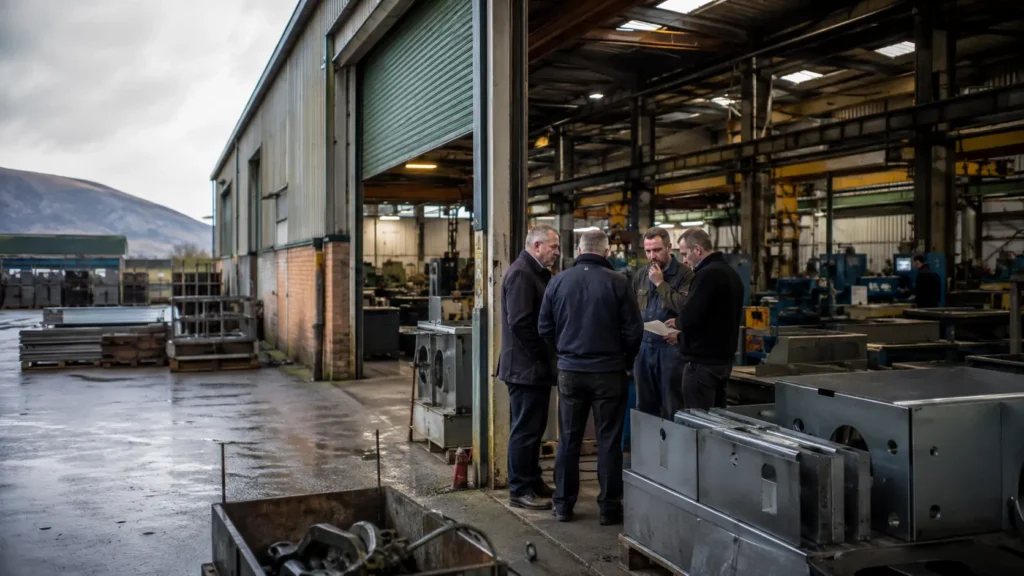
Scottish engineering firm Wallace McDowall entered administration after a sharp fall in orders from its two biggest customers, pressure on already tight margins and worsening cash flow.
The operating business and assets were subsequently sold, with all 56 employees working for the company at the administrators’ appointment transferring to the purchaser. The original legal company, now called WMCD Realisations 2026 Limited, nevertheless remains in administration.
→ Latest status: Companies House continues to list WMCD Realisations 2026 Limited, company number SC046491, as “In Administration”.
→ Jobs and sale: Leonard Curtis confirmed that the business and assets were sold and all 56 employees in place at appointment transferred to the purchaser.
What Happened to Wallace McDowall?

Wallace McDowall was a long-established Ayrshire engineering and sheet-metal manufacturing business. The company behind the operation was incorporated in April 1969 and operated from Monkton, near Prestwick, with registered activities covering cold forming or folding and the manufacture of fabricated metal products.
Leonard Curtis says Hilary Pascoe and Mike Dillon were appointed joint administrators on 22 May 2026. Companies House subsequently recorded the appointment filing on 28 May, followed by the administrators’ proposals on 29 May and approval of those proposals on 17 June.
The important point is that administration did not result in the whole engineering operation simply disappearing. The administrators secured a sale of the business and assets, allowing the operation to continue under a purchaser while the original company remained in the insolvency process.
For another manufacturing example of administrators attempting to preserve operations rather than immediately close them, see WCM Europe administration.
How Much Did Wallace McDowall Owe?
The supplied news reports describe Wallace McDowall as having entered administration with around £3 million owed to creditors.
That figure needs one important qualification: it should be treated as a reported creditor figure, not necessarily the eventual value of claims admitted by the administrators or the final financial loss suffered by creditors.
Companies House confirms that detailed administrator proposals were filed on 29 May 2026 and approved in June, but the register summary itself does not establish that every reported liability will become an admitted claim of the same value.
The distinction matters. In an administration, asset realisations, secured claims, costs of the process, preferential claims and the eventual acceptance or rejection of creditor claims can all affect recoveries.
What Does Administration Mean for Suppliers and Creditors?
Administration places control of the company with licensed insolvency practitioners. GOV.UK explains that an administrator can attempt to rescue the company, sell the business as a going concern or realise assets to obtain a better result for creditors than an immediate winding-up might achieve. GOV.UK guidance on company administration
A supplier owed money should therefore not assume that a headline debt figure equals the amount it will ultimately lose or recover.
Creditors should retain invoices, contracts, statements and supporting correspondence and follow instructions issued by the joint administrators. Payment is not guaranteed.
Readers following other recent insolvency cases can also see how creditor debt and administration are handled in the Millennium Dough Company administration.
Why Did the Scottish Engineering Firm Collapse?

No single factor should be presented as the sole cause of Wallace McDowall’s financial problems.
Leonard Curtis identified three significant pressures.
Loss of Major Customer Orders
The strongest company-specific warning sign was customer concentration.
According to the administrators, Wallace McDowall experienced a substantial decline in orders during the previous 12 months from its two main customers, which together represented 50% of its order book.
For a manufacturer with machinery, premises, skilled employees and other relatively fixed operating costs, losing a large proportion of expected work can quickly reduce capacity utilisation while many expenses continue.
This is why customer concentration can become a serious SME risk even when the individual customers themselves are strong businesses. A separate analysis of the TG Jones restructuring plan and customer-concentration risk similarly highlights the danger of relying too heavily on a small number of buyers.
US Tariffs Put Further Pressure on Margins
Joint administrator Hilary Pascoe also pointed to US tariffs introduced in April 2025.
The administrator’s position was not that tariffs alone caused the administration. Rather, they were said to have put already tight margins under further pressure.
That distinction is important. Wallace McDowall was simultaneously dealing with falling orders and cash-flow pressure, so the tariff issue should be understood as part of a wider commercial problem rather than a standalone explanation.
Supplier Credit Insurance Was Withdrawn
Leonard Curtis also said credit insurance from various suppliers had been withdrawn in the lead-up to administration, creating additional pressure on working capital and cash flow.
Trade credit insurance can affect how comfortable suppliers are about allowing customers to buy now and pay later. If insurance support disappears, a supplier may reduce the credit it is willing to extend or seek stronger payment terms.
For a business already experiencing weaker orders, that can increase the amount of cash needed to keep operating.
What Happened to the Company’s Employees?
The outcome for the workforce was considerably better than an immediate shutdown.
Leonard Curtis confirmed that Wallace McDowall had 56 employees at the time of the administrators’ appointment and that every one of those employees transferred to the purchaser when the sale completed.
Earlier reporting around the financial problems referred to substantially larger numbers of jobs potentially being at risk. The later administrator statement provides the clearer figure for the workforce actually employed by the company at appointment.
That is therefore the number that should be used when describing the completed sale.
The case also demonstrates why an administration and a liquidation should not automatically be treated as the same event. A business sale can preserve employment and productive assets even while the previous company remains insolvent.
A similar distinction between the survival of a trading operation or brand and the continuing insolvency of its former legal owner can be seen in coverage of the Russell & Bromley administration and asset sale.
Who Bought the Wallace McDowall Business?

Leonard Curtis confirmed that a purchaser acquired the business and assets but did not identify the purchaser by name in its public sale announcement.
That means the buyer should not be named purely through assumption.
There is now a separate active company on Companies House called Wallace McDowall Limited, company number 15358627. It was previously called HTBT Investments Limited and adopted the Wallace McDowall name on 26 May 2026. John Hume Gemmell and Yvonne Ward were appointed directors on 25 May.
However, the public records reviewed for this article do not, by themselves, prove that company 15358627 was the purchaser in the administrator’s transaction. It would therefore be unsafe to state that as fact without additional transaction documentation.
Why Did Wallace McDowall Become WMCD Realisations 2026 Limited?
The original company with number SC046491 changed its name from Wallace, McDowall Limited to WMCD Realisations 2026 Limited on 26 May 2026.
The name change helps distinguish the insolvent legal entity from the Wallace McDowall trading name now appearing on a separate active company.
However, Companies House records the change of name; it does not state the commercial reason for it. The name change itself should therefore not be treated as evidence identifying the purchaser or determining which liabilities moved with the business.
As of 8 August 2026, the important legal position is straightforward: WMCD Realisations 2026 Limited remains in administration.
What Does the Collapse Mean for Scottish Engineering and Manufacturing?

Wallace McDowall should not be used as evidence that the whole Scottish engineering industry is collapsing.
It is, however, a useful example of several risks that manufacturing SMEs can face simultaneously:
- A high proportion of orders concentrated among a small number of customers.
- Fixed production costs continuing while volumes decline.
- Already narrow margins being squeezed further by external cost changes.
- Suppliers or credit insurers becoming less willing to provide normal credit.
- Working-capital requirements increasing just as incoming cash weakens.
For businesses further down a manufacturing supply chain, the failure of one customer can also transmit cash-flow pressure through unpaid invoices or reduced future orders.
What Happens Next in the Wallace McDowall Administration?
The administration of WMCD Realisations 2026 Limited continues even though its business and assets have been sold.
Companies House records the administrators’ proposals as filed on 29 May and approved on 17 June 2026. The company remains formally listed as in administration.
The administrators can continue dealing with remaining assets, liabilities, creditor claims, statutory reporting and the eventual exit from administration.
For creditors, that means the sale announcement is not necessarily the end of the process. Further reports may establish whether particular classes of creditor will receive distributions and, if so, how much.
Any forecast return should be treated as provisional until confirmed by the administrators.
What UK SMEs Can Take From the Wallace McDowall Collapse?

Wallace McDowall’s administration is both a business failure and a partial rescue.
The original company remains in administration, and published reporting places creditor debt at around £3 million. But the operational outcome was not a complete shutdown: the administrators found a buyer and all 56 employees working for the company at appointment transferred as part of the sale.
For UK SMEs, the most useful lesson lies in what happened before administration. Heavy dependence on two customers, falling order volumes, tight margins, declining credit-insurance support and worsening working capital can reinforce each other quickly.
Businesses that monitor those signals individually may spot difficulties. Businesses that assess how they interact are more likely to understand the real level of risk.
Frequently Asked Questions
Is Wallace McDowall Still in Administration?
The original company is. Companies House lists company number SC046491, now called WMCD Realisations 2026 Limited, as in administration. Its operating business and assets have already been sold.
How Much Did Wallace McDowall Owe When It Collapsed?
Published reports put the creditor figure at around £3 million. This should not automatically be treated as the final amount of admitted creditor claims or the eventual creditor loss, which depends on the administration process.
Why Did Wallace McDowall Go Into Administration?
The administrators identified a significant fall in orders from two customers representing 50% of the order book, pressure on tight margins associated with US tariffs and the withdrawal of credit insurance by various suppliers, which put further pressure on working capital and cash flow.
Were Wallace McDowall Employees Made Redundant?
The administrator’s final sale announcement says all 56 employees working for the business at appointment transferred to the purchaser.
What Is WMCD Realisations 2026 Limited?
WMCD Realisations 2026 Limited is company number SC046491, the legal entity previously called Wallace, McDowall Limited. It changed its name on 26 May 2026 and remains in administration. It should not be confused with the separate active Wallace McDowall Limited registered under company number 15358627.

Jermaine writes informative business content related to entrepreneurship, finance, innovation, operations, and emerging opportunities for growing businesses in the UK.

Does Gross Misconduct Always Lead to Dismissal?
No. Gross misconduct does not always lead to dismissal. It can be serious enough to justify dismissal without notice, including for a first offence, but dismissal is not…

Andy Burnham Whitehall Job Cuts: What Is Changing In 2026?
The Andy Burnham Whitehall job cuts story has become part of a much wider debate about how the UK Government should operate and where political power, public money…
Insights for the Modern
UK Small Business.
Join 15,000+ owners receiving tactical analysis on finance, marketing, and technology. No clutter.
Zero spam. Unsubscribe in one click.