Andy Burnham Cost of Living Tour: New Measures Unveiled

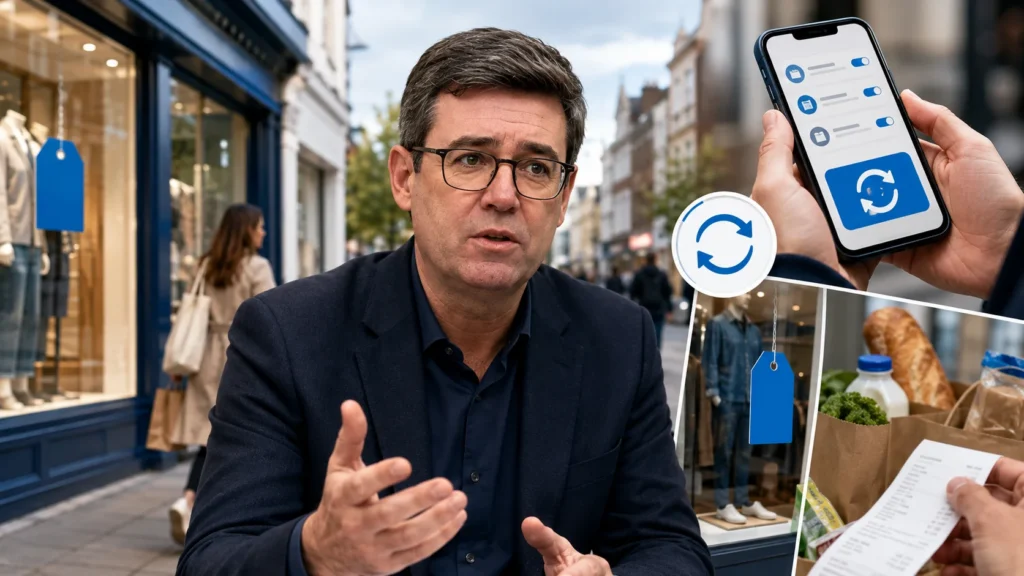
Prime Minister Andy Burnham has begun rolling out a new series of cost-of-living measures as he starts a national tour focused on household finances and struggling high streets.
The first changes target unwanted subscriptions and misleading retail discounts, with further “everyday fixes” expected to follow.
→ Subscription protections: New rules are being brought forward to January 2027, including clearer information, renewal reminders, easier cancellation and a new cooling-off period.
→ Misleading discounts: The government plans an autumn 2026 consultation on whether fake “was” prices, invented discounts and misleading recommended retail prices should become automatically prohibited practices.
For small businesses, the distinction matters. The subscription timetable is confirmed, while the proposed changes to specific discounting practices are not yet final law.
What Has Andy Burnham Announced?

Burnham announced the first two measures in his “everyday fixes” programme on 9 August 2026: accelerated protections against subscription traps and plans for tougher action against deceptive discounting.
The government says consumers currently hold around 155 million active subscriptions and spend an estimated £1.6 billion a year on subscriptions they do not want.
Its estimate is that cancelling an unwanted subscription could save an average of about £14 a month.
These announcements follow other recent cost-of-living interventions.
Burnham’s government has already announced a reduction in domestic electricity VAT from 5% to 0% from 1 October 2026, alongside a £2 cap on eligible single bus fares in England outside London from January 2027.
The practical impact of the home electricity VAT cut is also worth considering, particularly for households that charge electric vehicles at home.
Crackdown on Misleading Discounts
One of the biggest proposals concerns how retailers advertise savings.
The government says it wants to tackle practices such as artificially increasing a price before immediately reducing it, using an invented previous price to exaggerate a saving, or presenting a misleading recommended retail price.
However, businesses should not treat every element of this proposal as an immediate new prohibition.
A consultation is due to launch in autumn 2026 on whether practices including fake “was” prices, invented discounts and misleading RRPs should be added to the list of automatically unfair practices under the Digital Markets, Competition and Consumers Act 2024.
That would make enforcement more straightforward where the specified practice occurs.
Businesses already have obligations not to mislead consumers. The CMA’s unfair commercial practices guidance explains that the relevant DMCC Act provisions have applied to commercial practices since 6 April 2025.
The implications are significant. The CMA can impose penalties for consumer-law infringements of up to 10% of a business’s global turnover or £300,000, whichever is greater, depending on the circumstances.
Retailers should therefore see transparent promotional pricing as an existing compliance issue as well as a forthcoming policy debate. That is particularly relevant while businesses and shoppers continue dealing with wider retail pricing pressures.
Subscription Rules Coming Earlier
The second measure has a firmer timetable.
The government says the new subscription protections will now take effect in January 2027, rather than later in the spring.
Businesses covered by the rules will need to give customers clearer information before they subscribe, issue regular reminders and make leaving a contract substantially easier.
A new 14-day cooling-off period will also allow consumers to cancel after a trial or long-term contract renews. Certain charitable memberships connected with cultural and heritage organisations are expected to be excluded.
For subscription businesses, this creates a relatively short preparation window.
Companies should review their customer journeys alongside existing consumer cancellation rights, particularly where recurring payments, renewal disputes and chargebacks overlap.
What Is the Andy Burnham Cost of Living Tour?
Burnham is expected to spend much of August travelling around the country, with officials describing the exercise as a listening tour focused on the cost of living and the future of local high streets.
The tour is therefore wider than the two measures announced on 9 August.
It is intended to give the Prime Minister opportunities to hear directly about financial pressures affecting households and communities while the government develops further interventions.
Downing Street has said the current announcements are only the beginning of a series of “everyday fixes”.
At this stage, businesses should be cautious about treating speculation around future measures as policy.
Further announcements are expected, but their precise scope, eligibility rules and implementation dates will need to be assessed as they are published.
How Do the Measures Fit Burnham’s Wider Cost of Living Plan?
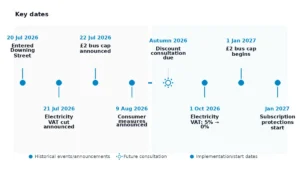
Burnham entered Downing Street on 20 July 2026 and quickly placed household costs near the centre of his government’s early programme.
On 21 July, the government announced that VAT on domestic electricity would fall from 5% to zero from 1 October 2026. It estimates the change will save a typical household around £45 a year.
A day later, ministers announced a £2 cap on single bus fares outside London from 1 January 2027 for the remainder of that year, supported by £400 million in additional funding.
The latest consumer measures add pricing and recurring contracts to that agenda.
They also build on earlier cost-of-living support introduced before Burnham became Prime Minister.
Taken together, the announcements suggest a strategy based on several smaller interventions across household energy, transport and consumer markets rather than relying on one universal cost-of-living payment.
What Could the Changes Mean for UK Small Businesses?

For SMEs, the direct impact depends heavily on business model.
Retailers using frequent promotions may need to pay particular attention to how previous prices and percentage savings are calculated and presented.
A business should be able to explain why a claimed saving is genuine rather than relying on a reference price that could give customers a false impression.
Subscription companies face more concrete operational work before January 2027. Signup pages, renewal emails, payment reminders, cancellation buttons and customer-service procedures may all need reviewing against the final requirements.
Businesses already offering transparent terms and straightforward cancellation may face less disruption.
Indeed, Downing Street argues clearer rules could create a more level competitive environment by preventing less transparent operators from gaining an advantage.
There could also be an indirect economic effect if the wider package succeeds in leaving households with more disposable income.
But that should not be treated as guaranteed extra revenue for SMEs: consumer spending will continue to depend on wages, inflation, borrowing costs and wider household expenses.
Reaction to Burnham’s programme has also been mixed.
Consumer organisations including Which? and Citizens Advice welcomed stronger protections while calling for effective implementation, whereas opposition politicians have argued that the measures do not go far enough to address wider living costs.
What Should Small Businesses Do Now?

Businesses do not need to wait for every detail of the tour before reviewing their exposure.
- Audit promotional pricing. Check how previous prices, RRPs, percentage reductions and limited-time savings are calculated.
- Keep evidence behind discounts. Maintain records capable of supporting the price comparison presented to customers.
- Review subscription information. Make charges, contract length and renewal arrangements easy to understand.
- Test cancellation journeys. A customer should not face unnecessary friction simply because they want to leave.
- Prepare for January 2027. Subscription businesses should identify system, website and customer-communication changes early.
- Monitor the autumn consultation. Retailers should examine the government’s detailed proposal once published and assess how it affects current promotional practices.
What Happens Next?

The next major step for deceptive pricing is the government’s autumn 2026 consultation.
That process should provide more detail on exactly which discounting tactics could become automatically unfair practices and how the changes would operate.
Subscription businesses have a clearer deadline: the accelerated protections are scheduled for January 2027.
Burnham’s national tour is meanwhile expected to continue through August, with further cost-of-living announcements possible as the government develops its wider programme.
For SMEs, the practical approach is to act on confirmed requirements now while monitoring proposals that remain subject to consultation.
Conclusion
The Andy Burnham cost of living tour is beginning with two consumer-focused measures: faster action against subscription traps and a proposed tougher regime for misleading discounts.
The subscription reforms provide businesses with the clearest immediate deadline, with new protections due in January 2027.
The proposed treatment of fake “was” prices, invented discounts and misleading RRPs is less settled and will be tested through consultation in autumn 2026.
Small retailers and subscription businesses should therefore review their pricing, renewals and cancellation processes now, while watching closely for the next details from Downing Street.
The tour is only starting, and the government has explicitly indicated that more “everyday fixes” are planned.
FAQs
What is Andy Burnham’s cost of living tour?
It is a national tour during which Prime Minister Andy Burnham intends to focus on household financial pressures, local high streets and ideas for further government action on the cost of living.
What cost of living measures has Andy Burnham announced?
The latest measures include accelerating new subscription protections to January 2027 and consulting on tougher rules against practices such as fake “was” prices, invented discounts and misleading RRPs.
Earlier announcements included zero VAT on domestic electricity from October 2026 and a £2 bus fare cap from January 2027.
When do the new subscription rules start?
The government says the new subscription protections will come into force in January 2027. They include clearer upfront information, reminders, easier cancellation and a new 14-day cooling-off period following certain renewals.
Are misleading discounts already banned under the new plan?
The specific new proposal announced by Burnham is not yet finalised. The government plans an autumn 2026 consultation on adding certain deceptive discounting practices to the DMCC Act’s list of automatically unfair practices.
Existing consumer law already prohibits unfair and misleading commercial practices.
What should small businesses do about the changes?
Retailers should review promotional pricing and retain evidence supporting advertised savings.
Subscription businesses should start checking signup, renewal, reminder and cancellation processes ahead of January 2027 and monitor further government guidance as implementation approaches.

Jennifer contributes business-focused articles covering modern business trends, digital growth, entrepreneurship, and practical insights designed to support startups and SMEs.

Universal Credit Cost of Living Payment: When Will It Be Paid?
There is no Universal Credit Cost of Living Payment due in 2026. The Department for Work and Pensions (DWP) says it is not planning any more Cost of…

What Triggers a DWP Investigation?
A DWP investigation can be triggered by information suggesting that a benefit claim may be incorrect. Common triggers include unreported changes in income, employment, savings, household circumstances or…
Insights for the Modern
UK Small Business.
Join 15,000+ owners receiving tactical analysis on finance, marketing, and technology. No clutter.
Zero spam. Unsubscribe in one click.