Kemi Badenoch Inheritance Tax Policy: What the 2026 Plan Could Mean


The Kemi Badenoch inheritance tax policy would make one of the biggest changes to the way family homes are treated for UK inheritance tax in decades if a future Conservative government introduced it.
At the Conservative Party Conference on 7 October 2026, Badenoch announced plans to remove inheritance tax entirely from a qualifying family home passed to direct descendants.
At the same time, the Conservatives propose increasing the general inheritance tax allowance to £500,000 per person, allowing a married couple or civil partners potentially to pass another £1 million of other assets tax-free, in addition to the exempt home.
The Conservatives estimate the changes would cost around £6 billion a year and cut the number of estates paying inheritance tax by more than half.
Badenoch has also described the policy as a first step towards her longer-term ambition of abolishing inheritance tax completely when the public finances allow.
However, independent economists have raised questions about the cost, who would gain most and whether exempting one particular asset—the family home—could alter behaviour in the housing market.
The important starting point is that none of these proposed changes is currently law. Existing inheritance tax rules continue to apply unless a future government legislates otherwise.
What Is Kemi Badenoch’s Inheritance Tax Policy?
The proposal has two central components.
First, a qualifying main family home would become completely exempt from inheritance tax when passed to children or other direct descendants, rather than benefiting from only the existing capped residence nil-rate band.
Second, the ordinary inheritance tax allowance would rise from £325,000 to £500,000 per person.
For a qualifying couple, that would potentially mean:
Family home: No inheritance tax, regardless of its value.
Other assets: Up to £1 million tax-free using two £500,000 allowances.
The Conservative announcement says the new £500,000 allowance could be used against assets more generally, while the uncapped home exemption would sit separately.
| Feature | Current system | Conservative proposal |
| Basic nil-rate band | £325,000 per person | £500,000 per person |
| Couple’s basic allowance | Up to £650,000 | Up to £1 million |
| Residence allowance | Up to £175,000 per person | Family home potentially fully exempt |
| Maximum current combined allowance for qualifying couple | Up to £1 million including home allowance | £1 million of other assets plus qualifying home |
| Home-value cap | Residence relief capped | Proposed exemption has no stated value cap |
| Direct descendants | Required for residence nil-rate band | Required for proposed family-home exemption |
| IHT headline rate | 40% | No general 40% rate change announced |
| Long-term Conservative ambition | Current tax retained | Eventual abolition when finances allow |
The proposal therefore goes substantially further than simply increasing an existing threshold.
How Does Inheritance Tax Work Under the Current Rules?
Inheritance tax is normally charged at 40% on the taxable portion of an estate after relevant exemptions, allowances and reliefs have been applied.
The basic nil-rate band remains £325,000.
A further £175,000 residence nil-rate band may apply when a qualifying home passes to direct descendants.
HMRC has confirmed that these thresholds remain frozen, with the £325,000 nil-rate band and £175,000 residence nil-rate band continuing under current legislation.
This means an individual may currently be able to pass on:
£325,000 basic allowance + £175,000 residence allowance = £500,000
without inheritance tax where all the necessary conditions are satisfied.
Unused allowances can usually transfer between spouses and civil partners.
A qualifying surviving spouse can therefore potentially have:
£650,000 basic nil-rate band + £350,000 residence nil-rate band = £1 million
available on the second death.
The crucial difference is that the current £1 million figure includes the residence allowance. Under Badenoch’s proposal, a qualifying home could sit outside inheritance tax completely, while the couple would separately have £1 million of general allowance.
The current official thresholds can be checked through HMRC’s inheritance tax threshold guidance.
The £2 Million Taper Under Current Law
The current residence nil-rate band is not available in full to every large estate.
It begins to taper when an estate exceeds £2 million.
For every £2 by which the estate exceeds that threshold, £1 of residence nil-rate band is withdrawn.
This means very wealthy estates can lose the home-related allowance altogether.
The proposed Conservative family-home exemption would fundamentally alter that treatment because the announcement contains no equivalent value cap on the qualifying home.
How Much Difference Could Badenoch’s Policy Make to an Estate?
The largest changes could occur where an estate contains a valuable home.
Consider a married couple whose combined estate eventually consists of:
- Family home: £1.2 million.
- Investments and cash: £800,000.
- Total estate: £2 million.
For illustration, assume all available current allowances can transfer between the couple and the home passes to direct descendants.
Under today’s rules, the estate may have up to £1 million of combined nil-rate bands, leaving approximately £1 million potentially taxable before considering any other exemptions or reliefs.
At the standard 40% rate, that could produce a theoretical bill of around £400,000.
Under the Conservative proposal:
- £1.2 million family home: potentially exempt.
- £800,000 investments/cash: within the proposed £1 million couple’s allowance.
- Illustrative IHT liability: potentially £0.
Real estates can contain gifts, debts, trusts, business assets, charitable gifts and other factors, so this is an illustration rather than an individual tax calculation.
How Many Estates Currently Pay Inheritance Tax?
Inheritance tax still affects a relatively small proportion of deaths.
The latest detailed HMRC statistics, published in July 2026, show that 30,400 estates incurred an inheritance tax charge for deaths in 2023/24.
That represented 4.72% of all UK deaths—fewer than one in twenty.
| HMRC measure for 2023/24 | Latest figure |
| UK deaths | Approximately 644,000 |
| Estates paying IHT | 30,400 |
| Share of deaths resulting in IHT | 4.72% |
| IHT liabilities | £7.03 billion |
| Average effective rate for taxpaying estates | 13% |
| Spouse/civil-partner exempt transfers | £6.8 billion |
The 13% average effective rate is particularly important.
Although the headline marginal inheritance tax rate is 40%, HMRC says taxpaying estates paid an average effective rate of approximately 13% in 2023/24 because allowances, exemptions and reliefs substantially reduce the amount actually exposed to tax.
That makes statements suggesting that an entire estate is simply taxed at 40% misleading.
How Many Families Could Still Pay Inheritance Tax Under the Plan?
The Conservatives say their changes would reduce the number of families paying inheritance tax by more than half.
Their projections indicate approximately 22,000 estates could remain liable around 2030 under the proposed system, compared with a baseline estimate of approximately 52,100 without the reform.
That projected increase under existing policy partly reflects:
- Frozen inheritance-tax thresholds.
- Rising house prices.
- Higher financial-asset values.
- Increasing inherited wealth.
- Changes already made to other inheritance-tax reliefs.
Badenoch’s proposal would therefore reduce the tax base at the same time that demographic and asset-price trends are expected to increase it.
How Much Revenue Does Inheritance Tax Raise?
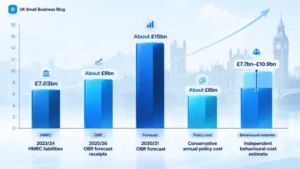
HMRC recorded £7.03 billion of inheritance-tax liabilities for 2023/24, up approximately £330 million, or 5%, from the previous year.
Cash receipts are forecast to increase significantly over the remainder of the decade.
The Office for Budget Responsibility’s current forecast has inheritance-tax receipts reaching approximately £15 billion in 2030/31, driven by factors including higher house and equity prices and existing policy changes.
| Period | IHT figure |
| 2023/24 HMRC liabilities | £7.03bn |
| 2025/26 OBR forecast receipts | About £9bn |
| 2030/31 OBR forecast | About £15bn |
| Conservative estimated annual policy cost | About £6bn |
| Independent behavioural-cost estimate | £7.7bn–£10.9bn |
If the Conservatives’ £6 billion estimate proved accurate, the reform would remove a substantial portion of future inheritance-tax receipts rather than eliminating the tax entirely.
Could the Policy Cost More Than £6 Billion?
This is one of the main areas of disagreement.
The Conservative Party estimates the policy would cost approximately £6 billion a year by the end of the decade.
Tax lawyer and researcher Dan Neidle has produced a significantly higher estimate.
His modelling puts the annual cost at approximately £7.7 billion to £10.9 billion, once possible behavioural responses are included.
Neidle’s analysis states:
“Our analysis suggests £7.7bn–£10.9bn.”
The disagreement largely concerns behaviour.
A static calculation asks how much tax would disappear if today’s estates were simply subjected to the new rules.
A behavioural calculation asks what wealthy households could do differently once their home receives unlimited preferential treatment.
That difference matters because tax policy can change where people choose to hold their wealth.
Could the Family-Home Exemption Change the Housing Market?
Potentially.
One of the strongest criticisms of the proposal is not simply that it cuts tax, but that it would tax different forms of wealth differently.
Under the proposed system:
- £1 million in shares could potentially face inheritance tax.
- £1 million held in cash could potentially face inheritance tax.
- £1 million added to a qualifying family home could potentially escape inheritance tax.
That creates a financial incentive to hold wealth in housing.
Stuart Adam, a senior economist specialising in tax policy, summarised the concern:
“The biggest beneficiaries would be those with the highest wealth and the most valuable homes.”
He also argues that exempting homes while continuing to tax investments could encourage wealthy older people to buy more expensive homes or remain in larger properties rather than moving their wealth into other assets.
The Downsizing Problem
Suppose an older homeowner owns:
- £1.5 million home.
- £300,000 investments.
Under a system where the home is fully exempt, keeping wealth inside the property could be tax-efficient.
If the homeowner instead downsizes to a £750,000 house and places £750,000 of released equity into investments, more of that wealth could potentially become subject to inheritance tax.
The tax system could therefore create a reason not to downsize, even when moving to a smaller property would otherwise make practical sense.
Dan Neidle’s modelling estimates that behavioural responses could shift £60 billion to £110 billion from investments and savings towards housing and reduce the flow of £1 million-plus homes onto the market in London and the South East.
Those are modelling estimates rather than forecasts of certain outcomes.
Would the Policy Mainly Benefit Wealthier Estates?
Every estate that would otherwise pay inheritance tax could receive some benefit from a reduction.
But the cash value of that benefit increases rapidly as the value of the exempt home rises.
A family inheriting a £400,000 qualifying property already has substantial protection under today’s rules.
Someone inheriting a £5 million qualifying home could potentially receive a much larger tax saving from an uncapped home exemption.
That distributional issue is central to the debate.
IFS research predating Badenoch’s announcement found that if inheritance tax were abolished completely, approximately 47% of the benefit would go to the wealthiest 1% of estates, those worth £2.1 million or more.
That figure relates to full abolition, not specifically to Badenoch’s narrower 2026 proposal, so the two should not be treated as identical.
However, it helps explain why the distributional consequences of her longer-term ambition to abolish IHT have attracted scrutiny.
Why Does the Policy Matter More in London and the South East?
Inheritance-tax liabilities are geographically concentrated.
The latest HMRC commentary for 2023/24 shows:
| Region | Estates with IHT liability | Total IHT liability |
| South East | 6,310 | £1.83bn |
| London | 4,810 | £1.43bn |
Together, those two regions accounted for a substantial share of taxpaying estates and liabilities.
High property prices are an important part of that pattern.
That makes a policy specifically exempting family homes particularly significant in areas where the home represents a large proportion of household wealth.
It also explains why national averages can be misleading. The probability of encountering inheritance tax differs substantially depending on property values, accumulated wealth and region.
Would Childless Homeowners Receive the Same Family-Home Exemption?
Based on the policy as currently described, not necessarily.
The Conservative announcement refers to allowing the main home to pass inheritance-tax-free to direct descendants.
That is similar to the beneficiary restriction attached to today’s residence nil-rate band.
Direct descendants can include children, grandchildren and certain other qualifying descendants.
A person without direct descendants could therefore receive the proposed higher £500,000 general allowance, but may not qualify for the unlimited family-home exemption under the policy as currently presented.
This creates an important fairness question.
Two estates with identical homes and identical wealth could potentially receive different tax treatment depending on who inherits the property.
Detailed legislation would be needed before the exact boundaries were known.
Families considering estate structures such as trusts would also need to wait for the eventual statutory wording rather than assuming existing planning arrangements would automatically qualify.
Does the Policy Solve the Problem Badenoch Says It Addresses?
Badenoch has framed the proposal around the idea of protecting family homes and allowing parents to pass the fruits of work and saving to their children.
At the conference she said:
“Nobody will ever pay inheritance tax on their family home.”
Critics question whether inherited homes normally remain within families in that literal sense.
Jill Rutter, a former senior Treasury and No.10 civil servant, argues that the proposal is based on a mistaken picture of modern inheritance patterns, calling it:
“myth-based policy making at its worst.”
Her argument is that adult children commonly have their own homes by the time their parents die. Where several siblings inherit a property, the house is frequently sold and the proceeds divided rather than one child simply moving into the parental home.
That does not remove the financial effect of inheritance tax on the property, but it changes the policy question.
The issue becomes less about whether children can physically retain a childhood family house and more about how inherited property wealth should be taxed.
What Are the Arguments in Favour of Badenoch’s Policy?
Supporters of the policy generally make several arguments.
- Home ownership: A home built up over decades should be easier to transfer between generations.
- Frozen thresholds: The £325,000 basic nil-rate band has remained unchanged since 2009, while asset and property values have risen.
- Saving incentives: Lower inheritance tax can increase the reward for accumulating wealth that will eventually be passed to family.
- Simplicity: Replacing the current £325,000 basic allowance and complex £175,000 residence allowance with a larger general allowance and home exemption could be easier to understand.
- Predictability: Families with substantial property wealth could plan succession without worrying that house-price growth alone will create a larger tax bill.
The IFS acknowledges that cutting inheritance tax would increase the reward for working and saving to leave wealth, although it notes that existing evidence suggests the behavioural effect is likely to be limited.
What Are the Main Arguments Against the Policy?
Critics focus primarily on distribution, revenue and economic distortions.
Housing Could Receive Preferential Tax Treatment
An unlimited exemption would make residential property more tax-advantaged than shares, savings and many other assets.
That can influence economic decisions.
Larger Homes Generate Larger Cash Tax Savings
An uncapped exemption means a family inheriting a particularly expensive home could receive a far larger cash benefit than someone inheriting an average property.
Public Revenue Would Fall
The Conservatives estimate an annual cost of around £6 billion, while independent modelling places it potentially closer to £11 billion after behavioural responses.
That money would ultimately need to be matched by lower spending, higher revenue elsewhere, additional borrowing or stronger-than-expected growth.
Existing IHT Already Affects a Minority
HMRC’s latest data shows only 4.72% of deaths currently generate an inheritance-tax charge.
Supporters respond that frozen thresholds mean the number is expected to rise significantly.
How Would the Conservatives Fund the Tax Cut?
The Conservatives say the inheritance-tax reduction forms part of a wider programme combining tax cuts with reductions in public spending.
Their October 2026 conference policy package identified around £71 billion of annual savings, primarily through welfare reform and reductions in the size and cost of government.
The party says these savings would create room to fund priorities while reducing the deficit.
However, the direct cost of the IHT policy remains disputed because independent analysis predicts stronger behavioural responses than the Conservative costing assumes.
The distinction is important:
£71 billion is the party’s wider proposed savings programme. It is not £71 billion being spent specifically on the inheritance-tax measure.
The IHT proposal itself is costed by the Conservatives at approximately £6 billion annually.
Could the Conservatives Eventually Scrap Inheritance Tax Completely?
Badenoch says that is the longer-term objective.
The October announcement explicitly describes the family-home reform as an initial step towards eventual abolition.
But Badenoch also acknowledged that the Conservatives do not currently believe the public finances allow immediate full abolition.
That makes the current proposal materially different from promising that inheritance tax will disappear as soon as a Conservative government takes office.
The sequence being proposed is:
Family-home exemption + £500,000 general allowance → further fiscal savings → possible eventual abolition
Whether the final stage could happen would depend on future revenues, spending commitments and economic conditions.
The policy also enters a wider debate about alternative inheritance tax proposals and how estates might be treated under different future tax systems.
What Would Full Abolition Cost and Who Would Benefit?

Full abolition would go substantially further than the policy announced in October 2026.
Previous IFS distributional analysis estimated that:
- Around 47% of the benefit would go to the top 1% of estates.
- These estates were worth at least £2.1 million.
- Their average tax saving would be approximately £1.1 million.
- Estates that were already outside IHT would receive no direct tax reduction.
Those estimates predate the latest OBR revenue forecasts and therefore should not be interpreted as a current 2026 costing of abolition.
Current OBR forecasts now show IHT receipts potentially reaching around £15 billion by 2030/31, so the future fiscal price of outright abolition could be substantially larger than earlier estimates.
What Could the Policy Mean for Small-Business Owners?
For many business owners, the family-home announcement is only one part of the inheritance-tax picture.
A business owner’s estate might contain:
- The family home.
- Shares in a trading company.
- Commercial property.
- Investments.
- Cash.
- Pensions.
- Agricultural assets.
Business Property Relief and Agricultural Property Relief operate under separate rules from the residence exemption.
That means the proposed family-home exemption would not automatically make a business owner’s entire estate tax-free.
Succession planning would still need to consider how shares and business assets are valued and which reliefs remain available.
The policy also sits alongside wider 2026 debate over social-care funding plans that could eventually influence the taxation of estates, although no competing estate-based social-care levy has currently been enacted.
Why Is the £500,000 General Allowance an Important Part of the Proposal?
The home exemption has received most of the attention, but the general allowance may affect more estates directly.
Today, the standard nil-rate band is £325,000.
The extra £175,000 residence nil-rate band:
- Depends on having a qualifying residence.
- Requires it to pass to direct descendants.
- Is limited by the home’s value.
- Tapers away for estates above £2 million.
Badenoch’s proposal would instead establish a general £500,000 individual allowance.
For someone without a qualifying home, that could increase the ordinary exemption by £175,000.
For a qualifying couple, the general allowance could therefore rise from £650,000 to £1 million, before considering the separate home exemption.
That element makes the proposal relevant beyond homeowners whose properties alone would generate a tax liability.
What Information Is Still Missing From the Policy?
Although the political commitment is clear, detailed legislation does not yet exist.
Several technical questions therefore remain.
- Exactly what property counts as the “family home”?
- Would the exemption cover only one property?
- How would homes held through trusts be treated?
- What happens when the property is partly used for business?
- Would downsizing relief still be necessary?
- How would lifetime gifts of the home interact with the exemption?
- How would estates with several beneficiaries be treated?
- Would stepchildren and adopted children follow current direct-descendant rules?
- Would the existing £2 million residence-band taper disappear completely?
- What anti-avoidance rules would prevent late-life conversion of financial wealth into housing?
These details could materially change both the cost of the policy and individual outcomes.
That is why households should not reorganise estates today on the assumption that a future Conservative proposal will become law unchanged.
What Is the Current Position as of October 2026?
The position can be summarised clearly.
| Issue | Position in October 2026 |
| Badenoch family-home exemption | Proposed Conservative policy |
| £500,000 individual general allowance | Proposed |
| £1 million general allowance for qualifying couple | Proposed |
| Complete IHT abolition | Long-term Conservative ambition |
| Policy currently law? | No |
| Current basic nil-rate band | £325,000 |
| Current residence nil-rate band | £175,000 |
| Current headline IHT rate | 40% |
| Latest share of deaths producing IHT | 4.72% |
| Latest detailed HMRC liabilities | £7.03bn |
| OBR 2030/31 receipts forecast | Around £15bn |
| Conservative estimated policy cost | Around £6bn annually |
| Independent estimated cost | £7.7bn–£10.9bn annually |
| Conservative estimate of estates paying after reform | Around 22,000 |
The existing legal position remains the one shown in current HMRC inheritance-tax statistics and guidance until Parliament changes the law.
Conclusion
The Kemi Badenoch inheritance tax policy would create a substantially more generous treatment of inherited family homes than exists today.
Its central promise is straightforward: a qualifying main family home passed to direct descendants would no longer face inheritance tax, while the general tax-free allowance would rise to £500,000 per person—or potentially £1 million for a qualifying couple.
The Conservatives estimate the policy would cost around £6 billion annually and reduce the number of families paying inheritance tax by more than half.
Independent analysis raises two major questions. First, the fiscal cost could be higher once people adjust their behaviour.
Second, making homes exempt while continuing to tax other forms of wealth could encourage additional investment in expensive property and discourage downsizing.
Current HMRC data also provides important context: only 4.72% of UK deaths currently result in an inheritance-tax charge, although OBR forecasts suggest receipts will rise sharply over the remainder of the decade.
For now, the distinction between policy proposal and current law is critical. The £325,000 nil-rate band, £175,000 residence nil-rate band and 40% standard inheritance-tax rate remain in place.
Frequently Asked Questions
What is Kemi Badenoch’s inheritance tax policy?
Badenoch proposes exempting qualifying family homes passed to direct descendants from inheritance tax and raising the general tax-free allowance to £500,000 per person.
Would couples get a £2 million inheritance tax allowance?
Not exactly. Under the proposal, a qualifying couple could potentially pass £1 million of other assets tax-free plus their qualifying family home, regardless of its value.
Has inheritance tax on family homes already been abolished?
No. The announcement is Conservative Party policy, not current UK law.
What is the inheritance tax threshold in 2026?
The standard nil-rate band remains £325,000, with a potential additional £175,000 residence nil-rate band where the qualifying conditions are met.
How many estates currently pay inheritance tax?
HMRC’s latest detailed figures show that 30,400 estates, equivalent to 4.72% of UK deaths, generated an inheritance-tax charge in 2023/24.
How much would Badenoch’s inheritance tax plan cost?
The Conservatives estimate approximately £6 billion annually. Dan Neidle’s independent modelling estimates approximately £7.7 billion to £10.9 billion after behavioural effects.
Would childless people get the family-home exemption?
The policy is currently described as applying where the home passes to direct descendants. Detailed legislation would be needed to confirm precisely how estates without direct descendants would be treated.
Could the policy increase house prices?
No outcome can be stated with certainty. Economists have warned that the exemption could increase demand for expensive housing and discourage some older homeowners from downsizing because housing would receive preferential inheritance-tax treatment.
Does Kemi Badenoch want to scrap inheritance tax completely?
Yes, she has stated that full abolition is the longer-term Conservative ambition, but the party says the public finances do not currently allow it.
When could Kemi Badenoch’s inheritance tax policy begin?
No start date is currently in law. The Conservatives would first need to win power and then introduce and pass legislation implementing the policy.

Jennifer contributes business-focused articles covering modern business trends, digital growth, entrepreneurship, and practical insights designed to support startups and SMEs.

DWP Energy Bill Letters Dispatched: Six Million Households Could Get £150 Discount
Millions of UK households are being urged to watch their post as the Department for Work and Pensions (DWP) prepares to distribute letters concerning a £150 reduction in…

Can I Withdraw My Private Pension Before 55? | UK Rules, Tax Charges and Exceptions
Usually, you cannot withdraw money from a UK private pension before age 55. The main exceptions are qualifying ill-health and having a protected pension age under the rules…
Insights for the Modern
UK Small Business.
Join 15,000+ owners receiving tactical analysis on finance, marketing, and technology. No clutter.
Zero spam. Unsubscribe in one click.