Andy Burnham’s Inheritance Tax Plan: What Could Change In 2026?


Andy Burnham has accelerated England’s social-care review, but he has not announced a 10% inheritance tax or confirmed that inheritance tax will be replaced.
The idea comes from earlier proposals for a National Care Service funded through estates. It remains an unconfirmed funding model.
The Position In Brief:
- Inheritance Tax Remains In Force: The existing rates, thresholds and reliefs still apply.
- A 10% Levy Is Not Confirmed: No rate, threshold or start date has been announced.
- Social-Care Funding Is Under Review: Burnham has asked for different versions of a National Care Service to be assessed.
- The 28 October 2026 Budget Is A Date To Watch: The Budget may provide more information, but an estate levy has not been promised.
Its effect would depend on which estates paid it and whether existing allowances and reliefs survived.
Last Updated: 04.09.2026
How Has Burnham’s Care Levy Proposal Developed?
Several versions of the idea have appeared over time. That history explains why reports do not always agree on whether the levy would replace inheritance tax or sit alongside it.
| Date | Development | Current Significance |
| 2009–10 | A 10% levy on estates was discussed as a way to fund social care | Contemporary analysis treated it as an additional care charge |
| 2023 | Burnham again backed an estate-funded National Care Service | His later comments suggested replacing inheritance tax |
| 29 June 2026 | Burnham delivered an economic speech without restating the levy | No detailed estate-tax policy was announced |
| 29 July 2026 | The social-care review was accelerated and cross-party talks began | Care models and funding options remain under consideration |
| 28 October 2026 | The next Budget is scheduled | It may clarify policy, but no tax announcement is guaranteed |
The 10% figure is therefore based on Burnham’s previous proposals. It was not introduced in his July 2026 social-care speech.
Would The Care Levy Replace Inheritance Tax?
That remains unknown.
The earlier proposals have been described in two different ways:
- An Additional Levy: Estates could pay a social-care charge as well as inheritance tax.
- A Replacement Tax: The existing inheritance tax system could be removed and replaced by a broader estate contribution.
An additional levy could increase bills for estates already liable for inheritance tax. A replacement could reduce bills for some larger estates while bringing smaller estates into the system.
Describing the proposal as a straightforward reduction from 40% to 10% is therefore misleading.
What Is Confirmed And What Is Still Unknown?
| Confirmed In 2026 | Still Unknown |
| Inheritance tax remains in force | Whether a care levy will be introduced |
| The social-care review has been accelerated | Whether the levy would replace inheritance tax |
| Different National Care Service models will be assessed | Whether the rate would be 10% |
| Funding options will form part of the review | Whether there would be a tax-free threshold |
| The Budget is scheduled for 28 October 2026 | How homes, gifts, pensions and trusts would be treated |
| Business and Agricultural Relief rules changed in April 2026 | Whether either relief would continue under a new levy |
How Does Inheritance Tax Works in 2026?
Inheritance tax is normally charged at 40% on the taxable part of an estate after exemptions, allowances and reliefs.
The main rules include:
- Nil-Rate Band: The basic tax-free allowance is £325,000.
- Residence Nil-Rate Band: Up to £175,000 may be available when a qualifying home passes to children or grandchildren.
- Combined Individual Allowance: A qualifying individual may pass on up to £500,000 before inheritance tax becomes due.
- Transferred Allowances: A qualifying married couple or civil partners may have combined allowances of up to £1 million.
- Spouse Exemption: Transfers between spouses and civil partners are normally exempt.
- Large-Estate Taper: The residence allowance starts to reduce when an estate exceeds £2 million.
Most estates do not pay inheritance tax. HMRC figures show that 4.72% of UK deaths resulted in a charge in 2023–24. The average effective rate among taxpaying estates was 13%.
Inheritance tax raised £8.5 billion in 2025–26.
How Could a Hypothetical 10% Levy Change Estate Bills?
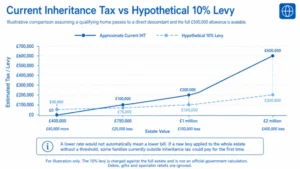
A lower rate would not automatically mean a lower bill. If a new levy applied to the whole estate without a threshold, some families currently outside inheritance tax could pay for the first time.
The examples assume a qualifying home passes to a direct descendant and the full £500,000 allowance is available. They ignore debts, gifts and specialist reliefs.
The 10% levy is charged against the full estate for illustration. It is not an official government calculation.
| Estate Value | Approximate Current IHT | Hypothetical 10% Levy | Possible Difference |
| £400,000 | £0 | £40,000 | £40,000 more |
| £750,000 | £100,000 | £75,000 | £25,000 less |
| £1 million | £200,000 | £100,000 | £100,000 less |
| £2 million | £600,000 | £200,000 | £400,000 less |
The comparison shows the main trade-off. Different thresholds or progressive rates would produce different results.
Who Could Pay More Or Less?
Estates Below The Current Threshold
- These estates usually pay no inheritance tax. They could face a new bill if a care levy applied from the first pound.
- Homeowners may be particularly exposed if their property has increased substantially in value but the estate has little cash.
Larger Estates
- Some larger estates could pay less if a flat 10% levy replaced the existing system. Their saving would depend on which exemptions and reliefs remained.
Married Couples And Civil Partners
- Current rules normally exempt transfers between spouses and civil partners. Unused allowances can also transfer to the surviving partner.
- It is not known whether a care levy would preserve both protections. Removing the exemption could create a bill on the first death.
Unmarried Partners
- Unmarried partners do not receive the current spouse exemption, regardless of how long they have lived together. A new system could keep this difference or introduce a wider partner exemption.
- No protection has been announced.
People Making Lifetime Gifts
- Many outright gifts can fall outside an estate if the donor survives for seven years, subject to detailed inheritance tax rules.
- A new levy would need rules for gifts made before death. No look-back period, gift allowance or transitional arrangement has been published.
What Could The Plan Mean For Small-Business Owners?
For business owners, the treatment of company shares and trading assets could matter more than the headline tax rate.
Business Relief Under The 2026 Rules
From 6 April 2026, qualifying business and agricultural property can receive:
- 100% Relief: Available on a combined allowance of up to £2.5 million.
- 50% Relief: Generally available on qualifying value above the £2.5 million allowance.
- Transferred Allowance: An unused allowance may pass between spouses or civil partners, potentially creating a combined £5 million allowance.
Qualifying assets can include an interest in a trading business and shares in an unlisted trading company. Investment businesses and many property-holding activities do not normally qualify.
The Risk If Business Relief Disappeared
A universal levy with no Business Relief could create a tax charge on company shares that are currently protected.
Family businesses are often asset-rich but cash-poor.
Beneficiaries might need to:
- Borrow Against The Business
- Take Cash From The Company
- Sell Part Of The Shareholding
- Give Up Some Family Control
Current rules allow tax on qualifying business and agricultural property to be paid through ten annual interest-free instalments. A care levy may not offer similar terms.
A Family-Business Example
Consider an unmarried owner with qualifying company shares worth £3 million and £200,000 of other assets. Assume there are no debts, gifts, charitable exemptions or residence allowance.
Under the April 2026 rules:
- The first £2.5 million of qualifying shares could receive 100% Business Relief.
- The remaining £500,000 could receive 50% relief, leaving £250,000 exposed.
- Adding £200,000 of other assets would produce £450,000 before the £325,000 nil-rate band.
- The approximate inheritance tax bill would be £50,000.
A hypothetical 10% levy on the entire £3.2 million estate, without Business Relief or a threshold, would produce a £320,000 bill.
This shows why a 10% levy could cost a business-owning family more than the current 40% rate.
Why Is The Proposal Linked To Social Care?
Burnham’s argument is that families face unpredictable care costs while services remain divided between the NHS, councils and private providers.
A National Care Service could provide more consistent access and connect health and social care more closely.
Funding it through estates would shift part of the cost from income earned during working life to wealth transferred after death.
It also raises a fairness question about whether care should be funded by taxpayers, care users or estates.
What Could A National Care Service Cover?
“Free social care” does not necessarily mean that every care-related cost would disappear.
| Possible Model | Likely Scope | Potential Cost Left To Families |
| Limited Support | A defined amount of personal care | Costs above the limit |
| Free Personal And Nursing Care | Help with washing, dressing, medication and nursing needs | Accommodation, food and ordinary living costs |
| Comprehensive National Care Service | Wider support based on assessed need | Dependent on the final funding and eligibility rules |
England’s current means test has an upper capital limit of £23,250 and a lower limit of £14,250. The upper limit has been frozen since 2010–11.
The King’s Fund estimated in September 2026 that the upper limit would exceed £35,600 if it had kept pace with inflation. It calculated that some people could therefore face around £12,400 more in care costs.
It also estimated that approximately 221,000 people fund their own home care or care-home places.
Could A 10% Levy Raise Enough?
The amount required depends on the level of care promised.
The Health Foundation estimated that:
- Free Personal And Nursing Care: A Scottish-style model for people aged 65 and over could require £6.5 billion of extra funding in 2026–27, rising to £7.5 billion by 2035–36.
- Capped Support: A more limited model could initially cost around £500 million, rising to roughly £4 billion by 2035–36.
- Comprehensive Universal Care: A much broader service could require around £18.5 billion of additional funding in 2035–36.
Current inheritance tax receipts cannot be compared directly with these costs. A replacement levy could reach more estates, but the Government would lose the inheritance tax revenue it replaced.
Any future costing would need to show the levy’s gross revenue and the additional money left after replacing the current tax.

Could The Impact Differ By Region?
HMRC data shows that London and the South East account for 46% of UK inheritance tax liability. High property values help concentrate the current tax in these regions.
A levy with no substantial threshold could spread the burden more widely across the UK. A levy retaining generous allowances could remain concentrated among higher-value estates.
Does The Public Support The Levy?
More in Common polling published on 4 August 2026 found:
- 47% supported a possible 10% levy on estates.
- 21% opposed the idea.
- 22% Were Neutral about the proposal.
The poll also found that 58% believed care payments should depend on wealth. Another 61% prioritised good-quality care despite possible tax or spending changes.
Public opinion could shift once the final thresholds, exemptions and example bills are known.
How Would A UK-Wide Tax Fund An England-Only Service?
Social care is devolved. Burnham’s proposed National Care Service would apply to England, while Scotland, Wales and Northern Ireland operate their own systems.
Inheritance tax is charged across the UK.
Using a replacement estate levy for an England-only service would require decisions about:
- Revenue Allocation Across The Four Nations
- Assets Held In Different Parts Of The UK
- People Who Move Between Nations
- The Responsibilities Of Devolved Governments
Conclusion
Andy Burnham’s inheritance tax plan is not yet a detailed government policy. The 10% figure comes from earlier social-care proposals, and it is still unclear whether a future levy would replace inheritance tax or be charged alongside it.
A broad levy could make smaller estates liable for the first time while reducing bills for some larger estates. For family businesses, Business Relief, payment terms and the treatment of company shares would be decisive.
The threshold, exemptions and tax base will matter far more than the 10% headline rate.
Frequently Asked Questions
Has Andy Burnham Introduced A 10% Inheritance Tax?
No. Inheritance tax remains in force, and no 10% estate levy has been announced.
Would The Levy Replace The 40% Inheritance Tax Rate?
That has not been confirmed. Earlier versions have been described as both an additional levy and a replacement tax.
Would Every Estate Pay The Levy?
It is not known. No tax-free threshold or minimum estate value has been published.
Would The Spouse Exemption Remain?
No decision has been announced. Transfers between spouses and civil partners remain exempt under current inheritance tax rules.
Would The Seven-Year Gift Rule Continue?
There is no confirmed gift rule for a care levy. The existing inheritance tax rules remain in place.
Would Business Relief Continue?
That is unknown. The Business Relief rules introduced in April 2026 continue to apply unless new legislation changes them.
Would Pensions Be Included?
Most unused pension funds and death benefits are due to enter estates for inheritance tax purposes from 6 April 2027.
Death-in-service benefits are excluded from that reform. No pension rules have been announced for a care levy.
Would A National Care Service Pay Every Care-Home Cost?
Not necessarily. Free personal and nursing care could still leave residents paying for accommodation, food and other living costs.
When Could The Tax Rules Change?
There is no confirmed start date. The Budget on 28 October 2026 may provide more information, but no inheritance tax replacement has been promised.

John covers a wide range of business topics including technology, productivity, startups, digital transformation, and business development for modern companies.

DWP Universal Credit Rollout End: Is the Move to Universal Credit Finally Finished?
The DWP Universal Credit rollout has officially finished, ending a programme that began in 2013. DWP completed its exercise to contact remaining legacy-benefit claimants in late March 2026,…

Andy Burnham Cash ISA Rules: What Changes for UK Savers?
Searches for Andy Burnham cash ISA rules centre on a practical question: will savers still be able to put £20,000 a year into tax-free cash savings? Under the…
Insights for the Modern
UK Small Business.
Join 15,000+ owners receiving tactical analysis on finance, marketing, and technology. No clutter.
Zero spam. Unsubscribe in one click.