How to Get a Small Business Credit Card in the UK: Eligibility and Application Guide


Knowing how to get a small business credit card starts with understanding that there is no single UK eligibility rule. Each lender sets its own criteria around business structure, trading history, turnover, banking relationship and credit profile.
Some cards are open to sole traders, partnerships and limited companies, while others accept only incorporated businesses.
Certain high-street banks require an existing business current account, whereas some specialist providers allow applications without moving your everyday banking.
A business credit card can provide short-term working capital, separate personal and company spending and make expense tracking easier.
However, it remains borrowing, so approval depends on whether the lender believes the business can comfortably manage repayments.
| Area | What usually matters |
| Applicant age | Normally 18 or over |
| UK connection | UK residence and/or UK-based business |
| Business structure | Depends on provider |
| Trading history | Can range from none to 12+ months |
| Turnover | Some cards impose limits or minimum requirements |
| Credit assessment | Business and sometimes personal credit |
| Existing bank account | Required by some banks |
| Personal guarantee | May be required |
| Application method | Usually online, telephone or business banking portal |
What Is a Small Business Credit Card?
A business credit card is a revolving credit facility designed for business expenditure.
Instead of spending money directly from the business bank account, the card provider gives the business an agreed credit limit. Purchases are added to the balance, and the business then repays some or all of that balance according to the card agreement.
Official small-business finance guidance identifies business credit cards as a form of short-term finance that can help companies manage expenses and temporary cash-flow requirements.
Credit limits and eligibility can depend on financial health, credit history and the provider’s own underwriting rules.
Common uses include:
- Software subscriptions.
- Business travel.
- Advertising.
- Office supplies.
- Equipment.
- Fuel.
- Professional services.
- Small emergency expenses.
- Employee expenditure.
The important distinction is that a credit card should normally support manageable short-term expenditure rather than become a substitute for sustainable long-term finance.
Who Can Apply for a Small Business Credit Card?
The answer depends heavily on the card.
A business being legitimate does not automatically make it eligible for every provider.
For example, current provider rules show considerable differences:
| Provider example | Selected current eligibility requirements |
| NatWest Business Credit Card | UK resident, 18+, UK-registered/tax-registered business, existing business account in same legal entity; standard card aimed at turnover up to £2m |
| Lloyds Business Credit Card | Existing Business Current Account holder; sole trader, partner or company director authorised to borrow; 18+ |
| Virgin Money Business Credit Card | Existing business current account, UK-based business trading for at least 12 months; owners/directors UK resident and over 18 |
| Capital on Tap | Active UK director or 25%+ shareholder; Ltd, LLP or PLC active on Companies House; currently excludes sole traders |
| American Express Business Card | 18+, permanent UK address, business UK bank/building-society account and no CCJs for non-payment under its stated eligibility rules |
These are current published criteria, not universal UK rules, and lenders can change their underwriting standards.
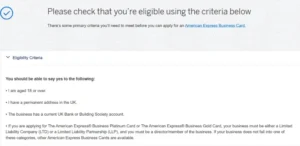
Current business credit card eligibility requirements showing the applicant, business account and turnover criteria.
Does Your Business Structure Affect Which Card You Can Get?
Yes. This is one of the first things to check.
Sole Traders and Partnerships
Some traditional providers accept sole traders and partnerships.
With a sole trader, there is no separate legal personality between the individual and the business in the same way there is with a limited company. That makes the owner’s personal financial position particularly important when lenders assess borrowing.
Anyone who has only recently started trading should also make sure they understand when business registration with HMRC becomes necessary before presenting financial information to a lender.
Limited Companies and LLPs
Limited companies generally have a wider range of dedicated commercial cards available, although that does not guarantee acceptance.
Providers may check:
- Companies House status.
- Directors.
- Persons with significant control.
- Trading activity.
- Company accounts.
- Turnover.
- Business bank activity.
- Existing debts.
- CCJs.
- Director credit information where applicable.
One provider currently requires applicants to be active directors or shareholders holding at least 25% and limits eligibility to Ltd, LLP and PLC structures.
Do You Need an Existing Business Bank Account?
Sometimes.
This is an important distinction because applying for the wrong card can waste time and potentially create an unnecessary credit application.
Current published requirements show that:
- NatWest requires a business bank account in the same legal entity name.
- Lloyds requires applicants for its standard business credit card to hold its Business Current Account.
- Virgin Money requires an existing business current account.
- American Express requires a UK business bank or building-society account but not necessarily one supplied by American Express.
- Some specialist card providers do not require you to move your current account to them.
This difference can matter significantly to a new business.
A founder may technically be eligible for a credit card but first have to establish the banking relationship required by that particular provider.
What Information Do You Need Before Applying?
Preparing your information before opening the application form can make the process much smoother.
You will commonly need a combination of personal, business and financial information.
Personal Information
Be ready to provide:
- Full legal name.
- Date of birth.
- Nationality where requested.
- Current home address.
- Previous address if recently moved.
- Phone number.
- Email address.
- Details of directors, partners or major shareholders.
Business Information
You may need:
- Legal business name.
- Trading name.
- Registered address.
- Trading address.
- Company registration number.
- Business structure.
- Industry.
- Date trading began.
- Number of employees.
- VAT or tax information where applicable.
Financial Information
Depending on the provider and size of facility, you may be asked for:
- Annual turnover.
- Average monthly turnover.
- Profit or loss figures.
- Business bank details.
- Recent accounts.
- Bank statements.
- Tax information.
- Existing borrowing commitments.
American Express currently states that its application can require personal details, trading address, registered company information and details of people owning or controlling 25% or more of the business.
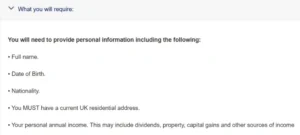
Official application-information checklist showing the personal and business details applicants should prepare before applying.
How Do Lenders Decide Whether to Approve a Business Credit Card?
A lender is trying to answer a relatively simple question:
How likely is this business to repay the money it borrows?
The evidence used to answer that question can be much more complicated.
Official business-finance guidance says providers may assess factors including:
- Affordability.
- Financial health.
- Company assets.
- Business credit history.
- Repayment record.
- Current financial behaviour.
For newer SMEs, personal credit can sometimes become more important because the company has little financial history of its own.
A healthy application therefore needs more than a high headline turnover.
Consistent cash flow, clean records and manageable commitments can matter just as much.
Will Applying Affect Your Personal Credit Score?
It can, but the process varies between providers.
Some lenders initially offer a soft eligibility search.
A soft search normally lets the provider estimate eligibility without creating the same visible application footprint as a hard credit application.
For example, NatWest currently states that its initial business credit card process uses a soft search on the applicant’s personal credit file. Tide’s current card marketplace also describes an initial soft-search eligibility stage.
That does not mean every business credit-card application is soft-search-only.
A lender may subsequently undertake additional business or personal credit checks as part of full underwriting.
Lloyds explicitly states that, where lending is agreed, it carries out a credit check on both the applicant and the business.
Before submitting an application, check:
- Whether the initial check is soft.
- Whether a later hard search occurs.
- Which credit file is searched.
- Whether the business credit file is also checked.
Avoid sending multiple speculative applications simply to see which provider says yes.
Do CCJs Affect a Business Credit Card Application?
They can.
Different lenders apply different rules.
Some explicitly exclude applicants with certain recent or unsatisfied County Court Judgments.
A CCJ can therefore matter to:
- The company.
- A sole trader personally.
- A director where personal credit is considered.
- A guarantor.
Understanding what happens if you lose in small claims court is useful because a money judgment can remain relevant to future borrowing, particularly if it is not resolved promptly.
Before applying, check both business and personal credit records for:
- Incorrect addresses.
- Old satisfied debts still shown incorrectly.
- Unknown credit accounts.
- Incorrect company information.
- CCJs.
- Late-payment markers.
Fix genuine errors before submitting an important finance application.
Can a New Start-Up Get a Business Credit Card?
Potentially, yes.
There is no universal rule requiring every business to trade for a year.
Current provider policies demonstrate the difference clearly.
Capital on Tap currently states that eligible incorporated businesses can apply without a minimum trading-history requirement. Virgin Money, by contrast, requires the business to have been actively trading for at least 12 months.
Official small-business finance guidance also notes that different business cards are designed for different stages, including start-ups.
A young business may nevertheless face more scrutiny because it lacks:
- Filed accounts.
- Long repayment history.
- Established cash flow.
- Business credit history.
The founder’s personal financial record can therefore carry greater weight.
How Can You Improve Your Chances Before Applying?
There is no legitimate method that guarantees approval.
However, an applicant can make the financial picture cleaner and easier to assess.
Check Business Information
Make sure:
- Companies House details are current.
- The registered office is correct.
- Director information is accurate.
- Accounts and confirmation statements are filed when due.
- Tax registrations are current.
Review Your Credit Position
Check for obvious adverse information or errors before applying.
Official guidance notes that business credit records can include payment history, debt levels, finance history and recent applications.
Keep Financial Records Clear
Maintain:
- Accurate bank statements.
- Accounts.
- Invoices.
- Receipts.
- Tax records.
- Cash-flow forecasts.
For sole traders in particular, keeping business transactions distinguishable from personal activity makes it easier to explain business income and expenditure.
The importance of maintaining identifiable business banking and financial records extends beyond lending applications to other financial reporting obligations.
Reduce Avoidable Financial Problems
Unpaid tax or persistent arrears can signal that the business is already under financial pressure.
Businesses dealing with unresolved liabilities should understand how HMRC debt recovery can affect business cash flow instead of taking further short-term borrowing without addressing the underlying issue.
How Do You Apply for a Small Business Credit Card Step by Step?
The exact interface differs by provider, but the process usually follows a similar pattern.
Step 1: Define Why You Need the Card
Decide whether it is for:
- Everyday expenses.
- Travel.
- Employee spending.
- Advertising.
- Short-term cash flow.
- Cashback or rewards.
- Overseas purchasing.
This helps identify which card features actually matter.
Step 2: Check the Eligibility Page
Do this before clicking “Apply”.
Confirm:
- Business structure.
- Turnover limits.
- Trading-history requirement.
- Existing account requirement.
- Applicant age/residence.
- Industry restrictions.
Step 3: Compare the Total Cost
Do not choose solely because a card advertises cashback.
Consider:
| Cost or feature | Why it matters |
| Representative APR | Indicates potential borrowing cost |
| Purchase interest | Matters if balance is carried |
| Annual fee | Can reduce rewards value |
| FX fee | Important for overseas purchases |
| Late fees | Adds cost if repayments are missed |
| Cashback | Valuable only if it exceeds costs |
| Interest-free period | Useful for planned short-term cash flow |
| Employee cards | Useful where staff make purchases |
Step 4: Gather the Documents
Prepare personal, company and financial information before starting.
Step 5: Run an Eligibility Check Where Available
If a provider offers a soft-search checker, consider using it before a full application.
Step 6: Submit the Application
Answer accurately.
Do not:
- Inflate turnover.
- Hide existing debts.
- Guess financial figures.
- Misstate trading history.
Step 7: Review the Offer
Approval does not mean you must accept every term.
Check:
- Credit limit.
- APR.
- Fees.
- Personal guarantee.
- Repayment method.
- Employee-card conditions.
Step 8: Set Up Repayments Immediately
Where practical, consider a Direct Debit that prevents accidental missed payments.
Will You Need to Sign a Personal Guarantee?
Possibly.
A personal guarantee means the individual giving the guarantee can become personally responsible for qualifying unpaid business borrowing if the company cannot repay.
This matters particularly to directors who assume the limited-company structure automatically protects them from every business credit obligation.
Lloyds states that a guarantee may be needed for limited companies and LLPs. Virgin Money likewise states that it may require a personal guarantee or security when lending to the business.
Before signing:
- Read the guarantee separately from the card agreement.
- Check whether it covers only this facility or wider borrowing.
- Understand when the lender can enforce it.
- Consider independent legal advice where the exposure is material.
Do not treat “approved” and “personally risk-free” as the same thing.
How Much Credit Limit Can a Small Business Get?
There is no standard UK limit.
The lender can consider:
- Turnover.
- Profitability.
- Cash flow.
- Existing borrowing.
- Credit history.
- Trading record.
- Requested facility.
- Internal risk policy.
Official guidance describes the available amount as dependent on the business’s credit history and overall financial health.
Some providers advertise potentially substantial limits, but that does not mean every applicant receives the maximum.
A smaller limit that the business can reliably clear may be more useful than a large facility that encourages permanent revolving debt.
Should You Choose Cashback, Rewards or Low Borrowing Costs?
Start with your spending pattern.
A cashback card might suit a business that:
- Spends regularly.
- Pays the balance in full.
- Has predictable expenditure.
Travel rewards may be useful where directors or employees fly frequently.
A lower-fee or lower-interest product may be more valuable where the business expects to carry a balance.
The basic calculation is:
Rewards earned − fees − interest − FX costs = real value
A card offering attractive points can still be expensive if the business regularly carries debt at a high interest rate.
Is a Business Credit Card Good for Cash Flow?
It can help with short timing gaps, but it should not disguise a structural cash-flow problem.
For example:
A business buys £4,000 of materials today, completes a client project and receives £7,000 several weeks later.
A short interest-free credit period may help bridge the timing difference.
That is different from a business repeatedly borrowing each month because normal revenue cannot cover wages, tax and suppliers.
The British Business Bank identifies credit cards as one of several working-capital tools but also distinguishes them from loans, overdrafts, invoice finance and other options.
Graeme Reynolds, the FCA’s Director of Competition, has emphasised that:
“Small businesses need to be able to access the finance they need at the right time to start up, grow and invest.”
Timing matters—but so does choosing finance appropriate to the purpose.
What Tax Rules Apply When Employees Use a Company Credit Card?
A company card should not be treated as free personal spending.
HMRC’s current rules distinguish between genuine authorised business expenditure and private or incorrectly handled purchases.
Where an employee is authorised to make a qualifying purchase on behalf of the business and the relevant conditions are met, there may be no additional reporting or National Insurance obligation for that purchase.
Different treatment can apply where:
- The purchase is private.
- The employee was not authorised.
- The transaction was not clearly made on the employer’s behalf.
- Special rules apply to the expense category.
Businesses should therefore keep receipts and explain the business purpose of expenditure.
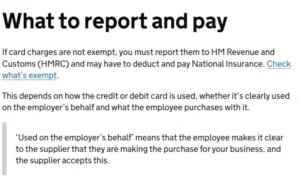
HMRC guidance explaining when employee credit card expenditure must be reported and when National Insurance contributions may apply.
What Should You Do If Your Application Is Declined?
A rejection does not automatically mean the business cannot obtain finance anywhere.
Different providers have different risk criteria.
First, determine whether you can identify the problem.
Possible reasons include:
- Insufficient trading history.
- Business structure not accepted.
- Turnover outside product criteria.
- Poor credit history.
- Recent CCJ.
- Existing borrowing.
- Affordability concerns.
- Incorrect application information.
- Industry excluded by lender policy.
Avoid immediately applying to five more providers without understanding why the first application failed.
A better response is:
- Check your credit files.
- Review Companies House information.
- Recheck application data.
- Examine cash flow.
- Ask whether the lender can explain the decline.
- Wait and improve the underlying position where appropriate.
- Consider another type of finance if the card itself is unsuitable.
The FCA’s current work on SME finance has also identified application complexity, duplicated checks and difficulties accessing suitable products as recurring issues for smaller firms.
What Alternatives Are Available If a Credit Card Is Not Suitable?
A credit card is only one form of business finance.
Alternatives can include:
- Business overdraft.
- Term loan.
- Start Up Loan.
- Invoice finance.
- Asset finance.
- Business line of credit.
- Equity investment.
- Grants.
- Supplier credit.
The right choice depends on what the money is for and how quickly it can realistically be repaid.
For example:
| Need | Finance that may be worth investigating |
| Short temporary expense | Credit card/overdraft |
| Equipment | Asset finance |
| Large planned investment | Business loan |
| Cash tied up in invoices | Invoice finance |
| Early-stage founder funding | Start Up Loan/equity |
| Eligible project | Grant/support programme |
Business owners should avoid trying to solve an ordinary working-capital problem by accessing protected retirement savings incorrectly.
The rules around using pension money to fund a business before normal pension age are significantly different from conventional business borrowing.
The government’s current finance and business-support finder also allows businesses to filter available schemes by finance type, business stage, industry, size and location.
How Should You Use a Business Credit Card After Approval?
Approval is only the beginning.
Strong card management can make bookkeeping and cash-flow control easier.
Set basic rules from day one:
- Use it only for business expenditure.
- Set spending limits for employees.
- Require receipts.
- Reconcile transactions monthly.
- Review subscriptions.
- Pay on time.
- Avoid withdrawing cash unless necessary and understood.
- Monitor utilisation.
- Remove employee cards when staff leave.
- Review whether the card still represents good value annually.
One of the strongest benefits of a dedicated business card is the clearer separation it creates between commercial and personal expenditure.
That separation makes accounting easier and can produce cleaner information when the business later applies for larger finance.
Is It Worth Getting a Small Business Credit Card?
It can be, provided the business has a clear use for it and can comfortably manage the repayments.
A card can help a small company:
- Separate personal and business spending.
- Manage short timing gaps.
- Issue controlled employee cards.
- Build a business credit history where reporting applies.
- Track expenses.
- Earn rewards on expenditure already planned.
It becomes less useful when the business is carrying expensive debt month after month because operating income is insufficient.
The deciding question should therefore not simply be:
“Can I get approved?”
It should be:
“Will this card improve the way the business manages money without creating an unaffordable debt?”
Conclusion
Learning how to get a small business credit card is mainly about preparation.
Check which providers accept your business structure, whether an existing current account or trading history is required, and what credit checks or guarantees apply before submitting an application.
Prepare accurate turnover, banking, ownership and company information, then compare the total borrowing cost rather than focusing only on cashback or rewards.
A credit card can be useful for controlled short-term spending and cash-flow timing, but it should not finance an underlying business deficit.
The best application is one supported by clear records, affordable repayments and a genuine commercial reason for borrowing.
Frequently Asked Questions
Can a sole trader get a small business credit card?
Yes, some providers accept sole traders, but others restrict their cards to limited companies, LLPs or other incorporated structures. Always check the individual eligibility rules.
Can a brand-new business get a credit card?
Potentially. Some providers have no stated minimum trading-history requirement, while others require the business to have operated for 12 months or longer.
Do I need a business bank account first?
Not always. Some banks require an existing business current account with them, while other providers only require a suitable UK business bank account or do not require you to move your everyday banking.
Will a business credit card check my personal credit?
It may. The approach varies according to the lender, business structure and stage of application. Some providers use a soft personal check initially, while others may undertake broader checks during underwriting.
What documents do I need for a business credit card?
Common requirements include your personal details, company information, turnover, trading history and bank details. Providers can request accounts, statements or additional verification information.
Can I get a business credit card with bad credit?
Possibly, but acceptance, credit limits and pricing can be less favourable. Check eligibility before making repeated full applications.
Does a limited company director need a personal guarantee?
Not every card uses the same structure, but some providers may require a director or another individual to give a personal guarantee.
How long does a business credit card application take?
It varies. Some digital providers can offer rapid eligibility decisions, while more detailed underwriting can take several working days. Official finance guidance notes that some applications can take around 5–10 days, depending on the provider.
Can I use a business credit card for personal purchases?
It is better to keep the card for genuine business expenditure. Personal use can create accounting, tax, employment-benefit and repayment complications.
What should I compare before applying?
Compare eligibility, APR, purchase interest, annual fees, foreign-exchange fees, interest-free periods, employee-card controls, rewards and any personal guarantee.

Angela specializes in being a business writer focused on delivering informative content about entrepreneurship, startups, industry trends, finance, marketing, and small business growth across the UK.

Best Rubbish Removal Companies in London: 6 Services to Know
London residents often need rubbish cleared quickly after moving home, renovating a property, replacing furniture or completing a garden project. Businesses also regularly require unwanted office furniture, packaging…

Mark Brennan M&S WRC Decision: The Legal Test Behind the Unfair Dismissal Finding
The Mark Brennan M&S WRC decision is more revealing than a simple “employee wins unfair dismissal case” headline suggests. Marks & Spencer Ireland had a clear staff-discount policy,…
Insights for the Modern
UK Small Business.
Join 15,000+ owners receiving tactical analysis on finance, marketing, and technology. No clutter.
Zero spam. Unsubscribe in one click.