Prison Officer Pay Rise 2026: Confirmed 3.5% Increase, New Salaries and Take-Home Pay

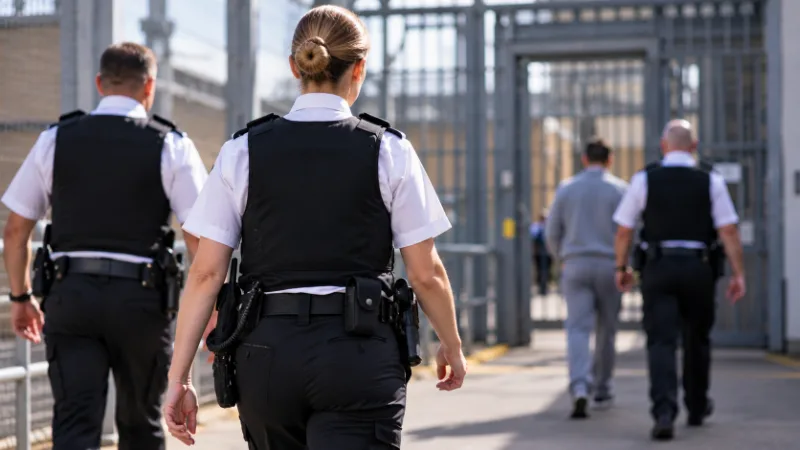
The prison officer pay rise 2026 has been confirmed at 3.5% for eligible operational prison staff in England and Wales.
The Government accepted all 12 recommendations from the Prison Service Pay Review Body (PSPRB) on 26 March 2026, with the award backdated to 1 April 2026.
The increase covers prison officers, operational support grades, custodial managers and governors. Some employees also benefited from pay progression, revised London salary rates and an increase in Payment Plus overtime.
For a newly recruited Band 3 prison officer outside London, annual starting pay is £34,928 for 37 hours, £36,816 for 39 hours or £39,334 for 41 hours, including the 20% unsocial working hours allowance.
However, the amount employees receive after Income Tax, National Insurance and pension contributions can be considerably lower.
What Was Confirmed in the Prison Officer Pay Rise 2026?
The Government formally accepted the PSPRB recommendations through written ministerial statement HCWS1463.
The settlement applies to the Fair and Sustainable pay structure operated by His Majesty’s Prison and Probation Service (HMPPS).
| Staff category | Confirmed 2026 pay change |
| Band 2 – Operational Support Grade | 3.5% plus NLW adjustment |
| Band 3 – Prison Officer | 3.5% plus eligible progression |
| Band 4 – Specialist/Supervising Officer | 3.5% |
| Band 5 – Custodial Manager | 3.5% plus eligible progression |
| Bands 7–12 – Managers and Governors | 3.5% |
| Bands 8–11 – Eligible progression | Additional 3⅓%, capped at band maximum |
| Payment Plus | £23 per hour |
The 3.5% headline increase is consolidated, meaning it becomes part of the employee’s continuing salary rather than a one-off bonus.
This distinction is important when comparing the settlement with the NHS pay rise 2026/27, which delivered a separate 3.3% award for Agenda for Change employees.
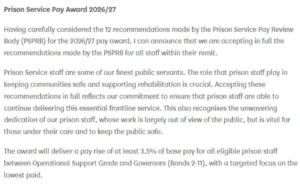
Government confirmation of the 2026/27 prison staff pay award.
What Is the Prison Officer Salary in 2026/27 by Band and Location?
The PSPRB Twenty-Fifth Report provides the official salary scales in Appendix E.
National Prison Officer Salary by Band
| Band | 2026 base salary, 37 hours | Including unsocial hours |
| Band 2 – OSG | £25,409 | £31,761 |
| Band 3 – Prison Officer | £29,107–£30,648 | £34,928–£36,778 |
| Band 4 – Specialist Officer | £34,440 | £41,328 |
| Band 5 – Custodial Manager | £37,417–£39,214 | £44,900–£47,057 |
| Band 7 – Head of Function | £54,148 | £64,978 with required-hours addition |
| Band 8 – Deputy Governor/Head of Function | £57,398–£63,139 | £68,878–£75,767 with required-hours addition |
These are annual gross amounts before deductions. The Band 8 figure of £63,139 is the upper base salary, not its starting salary.
Band 2 receives a 25% unsocial hours payment, while Bands 3–5 generally receive 20%.
Band 3 Starting Salary by Location
| Contract | National | Outer London | Inner London |
| 37 hours | £34,928 | £38,840 | £40,876 |
| 39 hours | £36,816 | £41,290* | £43,453* |
| 41 hours | £39,334 | £43,739 | £46,031 |
The 39-hour London figures shown use the standard ACH arrangement. Pensionable ACHP arrangements have different published rates.
Some establishments also pay market supplements above these standard salary figures.
Importantly, £46,031 is an Inner London Band 3 starting salary for 41 hours, not the maximum of the entire pay range. Appendix E shows a 41-hour maximum of £48,468.
How Much Did Prison Officer Salaries Increase in Pounds?
The 3.5% award produces different cash increases depending on the contract and previous salary.
For a national Band 3 officer remaining on the same pay point:
| Starting contract | 2025 salary | 2026 salary | Annual increase |
| 37 hours | £33,746 | £34,928 | £1,182 |
| 39 hours, ACHP | £35,571 | £36,816 | £1,245 |
| 41 hours | £38,003 | £39,334 | £1,331 |
These figures exclude additional pay-point progression.
Employees in Bands 3 and 5 who were in post on 31 March 2026 and were not subject to formal poor-performance procedures qualified for one pay-point progression, subject to the scale maximum.
For example, a Band 3 officer moving from point 1 in 2025 (£33,746 including unsocial hours) to point 2 in 2026 (£36,150) gained £2,404 gross annually.
An eligible Band 5 employee moving from £43,381 to £45,966 gained £2,585.
Therefore, the effective increase for progressing employees could exceed the headline 3.5%.
How Much Is the Prison Officer Pay Rise Worth After Tax and Pension?
Gross salary does not show how much money reaches an employee’s bank account.
Based on illustrative 2026/27 Income Tax, National Insurance and Civil Service alpha pension deductions, typical Band 3 take-home pay is approximately:
| Annual gross salary | Estimated monthly take-home |
| £34,928 – 37 hours | £2,282 |
| £36,816 – 39 hours, ACHP | £2,369 |
| £39,334 – 41 hours | £2,510 |
These estimates assume standard tax treatment, the relevant pension contribution tier and no student loan or additional deductions. Individual payslips can differ.
How Do Civil Service Pension Contributions Affect Pay?
The alpha pension scheme applies contribution rates according to pensionable annual earnings.
| Annual pensionable earnings, 2026/27 | Employee contribution |
| Up to £36,199 | 4.60% |
| £36,200–£56,000 | 5.45% |
| £56,001–£150,000 | 7.35% |
| Above £150,000 | 8.05% |
The contribution percentage generally applies to pensionable pay within the relevant contribution band, rather than only to earnings above the threshold.
Consequently, increasing working hours can move an officer into a higher pension contribution tier.
A 37-hour officer earning £34,928 falls within the 4.60% tier, while a 39-hour officer earning £36,816 falls within the 5.45% tier.
This helps explain why independent take-home estimates suggest some 39-hour officers retained around £50 extra monthly from the 2026 award, compared with approximately £67 for certain 37-hour officers.
These are illustrative comparisons, not guaranteed increases.
Officers should also check their HMRC tax code when reviewing payslips because changes in allowances or taxable income can affect net earnings.
How Do Unsocial Hours, Committed Hours and Market Supplements Work?
Prison officer remuneration includes several components beyond basic salary.
Unsocial Working Hours (UWH): Band 3–5 officers generally receive 20% of qualifying base pay in recognition of rostered unsocial working. Band 2 employees temporarily receive 25%. These payments are pensionable.
Additional Committed Hours (ACH): Officers can increase their contracted hours beyond the standard 37-hour week, including 38-, 39-, 40- and 41-hour patterns.
Pensionable Additional Committed Hours (ACHP): A separate arrangement under which additional hours are treated differently for pension purposes. Employees should distinguish ACH and ACHP when comparing salary quotations.
The PSPRB reported that 45% of Band 3 staff worked 37 hours, 29% worked 39 hours under ACH arrangements and 9% worked 41 hours. Another 15% worked under two-hour ACHP arrangements.
What Are the Market Supplements?
The 2026 report recorded £2,000 Red and £3,500 Red Plus market supplements at 19 sites.
However, the revised HMPPS market-supplement framework introduced reductions at certain prisons. Current recruitment information also identifies £1,500 and £3,000 rates at affected establishments.
These payments are non-pensionable and are not automatically available to every officer.
London salary differences are separate. The fixed 2026 pay-zone differentials at the 37-hour national scale maximum are £5,218 for Inner London and £3,432 for Outer London.
Inner London covers Brixton, Pentonville, Wandsworth and Wormwood Scrubs, alongside relevant Westminster headquarters roles.
Outer London includes Belmarsh, Downview, Feltham, High Down and Isis, plus specified controller offices.
What Happened to Payment Plus and Specialist Allowances?
Payment Plus rose from £22 to £23 per hour from April 2026.
It is a non-consolidated, non-pensionable payment for specified additional operational duties outside scheduled working hours. It should not be confused with pensionable unsocial hours.
Other provisions included a maintained temporary £1,500 annual payment for qualified Physical Education Instructors, increased single-dog care and maintenance allowance of £2,945, and unchanged on-call allowances.
The Physical Education Instructor payment is also non-pensionable.
The PSPRB selected a modest Payment Plus increase because a larger uplift would compete with funding for the consolidated salary award.
Why Did Prison Officers Receive a Pay Rise in 2026?
The settlement followed serious concerns about staffing, recruitment and workplace safety.
The PSPRB reported the following evidence:
| Workforce indicator | Reported figure |
| Operational remit-group workforce | 28,905 FTE |
| Annual workforce reduction | 4.5% |
| Reduction in Band 3–5 officers | 1,015 FTE |
| New Band 3–5 officers | 2,338, down 45.6% |
| Band 3–5 leavers | 2,622, down 18.7% |
| Assaults on staff, year to September 2025 | 10,326 |
| Average operational sickness absence | 13.2 working days |
More than 35% of Band 3–5 employees had less than three years of service.
These statistics demonstrate why retaining experienced officers is important alongside recruiting replacements.
The report also highlighted Skilled Worker visa changes. A temporary exemption permitted certain prison officer sponsorship applications until 31 December 2026, with specified switching and extension provisions extending to December 2027.
Nevertheless, the review body warned that HMPPS would need a stronger domestic recruitment pipeline as immigration arrangements changed.
What Did Prison Officers and Union Leaders Say About the Award?
The Prison Officers’ Association (POA) argued that the 3.5% settlement did not sufficiently reflect operational risks or accumulated cost-of-living pressures.
POA general secretary Steve Gillan described the award as “a kick in the teeth for our members” in the union’s published May 2026 response.
The union had sought a larger 6.3% settlement for frontline grades.
Its survey of approximately 1,600 respondents revealed that 72% believed morale was poor where they worked, while only 32% felt safe at their establishment.
The PSPRB acknowledged these concerns but concluded that a consolidated award was preferable within the available budget.
Its recommendations were estimated to cost approximately £59.9 million, excluding progression and statutory National Living Wage changes, equivalent to roughly 1% of HMPPS’s £7.5 billion operating budget for 2024/25.
How Does Prison Officer Pay Compare With Police and Firefighters?
The PSPRB’s occupational comparisons found that the maximum Band 3 salary remained below the comparable maxima for police constables and firefighters.
However, when the 20% unsocial hours allowance and two additional committed hours were included, Band 3 remuneration exceeded the salary ranges for the private-sector prison officer roles examined.
This highlights why comparing basic salaries alone can produce misleading conclusions.
Different public services also operate separate pay systems. For example, the teachers’ pay rise in 2026 took effect in September, rather than April.
Similarly, Armed Forces pay arrangements follow their own review process and pension structure.
How Have Prison Officer Pay Awards Changed Since 2023?
| Year | Headline award |
| 2023 | 7% for Bands 3–5; 5% for Bands 7–12 |
| 2024 | 5% for Bands 2–5 and 7–12 |
| 2025 | 4% for Bands 2–5 and 7–12 |
| 2026 | 3.5%, with additional eligible progression |
Band 2 received distinct National Living Wage adjustments and targeted treatment in several years.
The National Living Wage rose from £12.21 to £12.71 an hour in April 2026.
Without the additional award, the Band 2 national annual base spot rate would have increased only from £24,527 to £24,549. Applying the recommended 3.5% increase after that adjustment raised it to £25,409.
Closed-grade employees are treated differently. Those unable to benefit financially from joining Fair and Sustainable arrangements received a non-consolidated 3.5% payment, while eligible employees could opt into the newer structure under specified conditions.
When Were Prison Officers Due to Receive Their Backdated Pay?
The Government confirmed that revised salaries applied from 1 April 2026, with payment scheduled by the end of June 2026.
The award is therefore no longer awaiting a decision.
Employees checking arrears should compare the April–June period against their updated salary, contractual hours and progression entitlement. The exact payroll amount depends on employment circumstances.
The PSPRB also disclosed that government evidence arrived approximately one month late, delaying the pay-review timetable again.
What Happens Next for the Prison Officer Pay Rise in 2027?
The 2027/28 review has already begun.
On 15 July 2026, prisons minister Lord Timpson issued the next PSPRB remit letter, formally requesting recommendations for the forthcoming pay round.
The letter confirmed that any new settlement must be funded from departmental budgets, without additional funding specifically for pay awards.
The PSPRB is also expected to examine:
- Unsocial working hours payments across operational grades.
- The Payment Plus system and HMPPS review findings.
- Market supplements and recruitment pressures.
- Specialist allowances and workplace conditions.
- Evidence concerning staff retention and future resourcing requirements.
A two-year settlement was discussed as a possibility in the 2026 report, but no agreed two-year prison officer pay deal has been established.
No 2027/28 percentage increase should be described as confirmed until recommendations and a government decision are published.
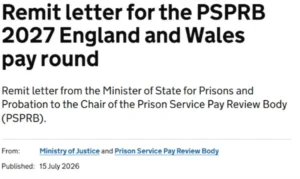
Ministry of Justice remit letter launching the 2027/28 prison service pay review.
Frequently Asked Questions
What is the Band 3 prison officer starting salary in 2026?
The national starting salary is £34,928 for 37 hours, including the 20% unsocial hours allowance.
How much do prison officers earn in London?
Band 3 starting salaries range from £38,840 for 37 hours in Outer London to £46,031 for 41 hours in Inner London, before any additional market supplements.
Is Payment Plus pensionable?
No. Payment Plus is a non-consolidated and non-pensionable payment, unlike the normal unsocial hours allowance.
Do private prison staff receive the 3.5% increase?
Not automatically. Employees of privately managed prisons generally follow employer-specific contractual arrangements, although certain transferred employees remain within the PSPRB remit.
Does the pay rise apply to Scotland and Northern Ireland?
The 2026 settlement described here applies to HMPPS staff in England and Wales. Scotland operates a separate system, while Northern Ireland has its own PSPRB process.
Has the prison officer pay rise for 2027 been confirmed?
No. The 2027/28 review has commenced, but its final salary recommendations and government settlement have not yet been confirmed.

Jermaine writes informative business content related to entrepreneurship, finance, innovation, operations, and emerging opportunities for growing businesses in the UK.

UK Budget Savings Tax Changes 2026: New Rates, ISA Rules and How Much More Savers Could Pay?
The UK Budget savings tax changes announced on 28 October 2026 have introduced significant financial implications for millions of savers, pensioners and small business owners. From 6 April…

DWP Energy Bill Letters Dispatched: Six Million Households Could Get £150 Discount
Millions of UK households are being urged to watch their post as the Department for Work and Pensions (DWP) prepares to distribute letters concerning a £150 reduction in…
Insights for the Modern
UK Small Business.
Join 15,000+ owners receiving tactical analysis on finance, marketing, and technology. No clutter.
Zero spam. Unsubscribe in one click.