Can I Pay Money Into My Bank Account via the Post Office?

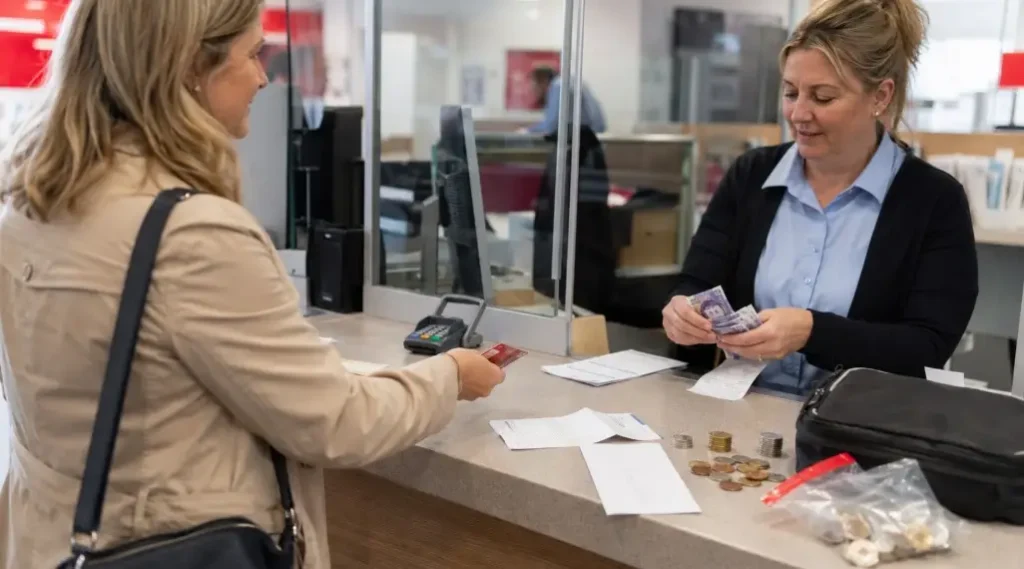
Yes, money can usually be paid into a UK bank account at a Post Office branch, provided the customer’s bank and account support the service.
Most major UK banks allow eligible personal and business customers to deposit cash through participating Post Office branches. Depending on the bank, the customer may need a debit card and PIN, a deposit card or a personalised paying-in slip.
Cheque deposits may also be available, although they normally require a paying-in slip and a bank-branded cheque envelope. Deposit limits, processing times and possible charges are set primarily by the customer’s bank rather than by the Post Office.
Important: A customer should check the rules for the specific bank account before travelling to a branch. A bank may support Post Office withdrawals but impose different conditions on cash or cheque deposits.
How Can Money Be Paid Into a Bank Account at the Post Office?
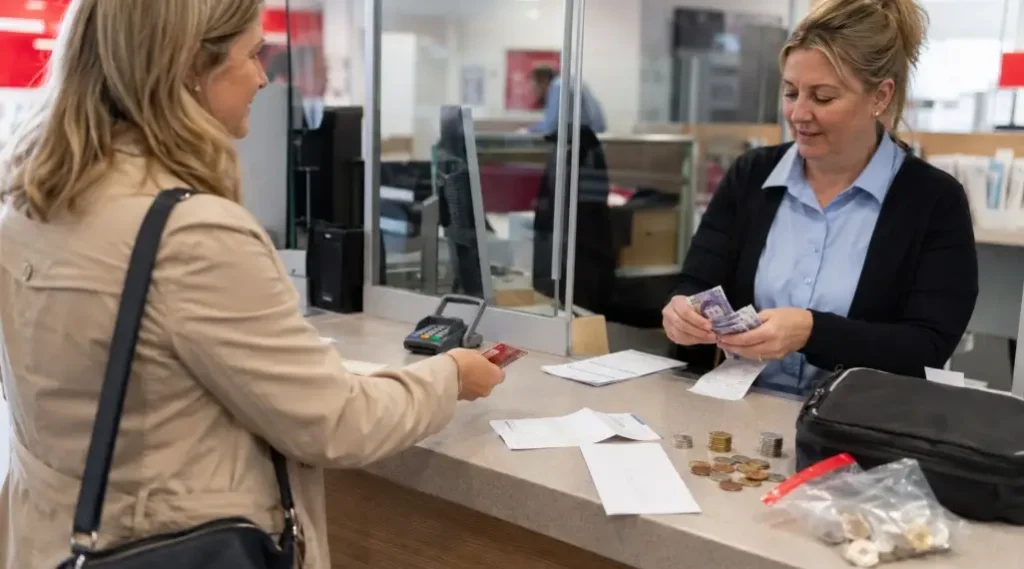
The method depends on the bank, account type and type of payment being deposited.
Paying in Cash Using a Bank Card
Many participating banks allow customers to deposit cash by presenting an eligible debit card at the Post Office counter.
The usual process is:
- The customer presents the bank card.
- The Post Office employee inserts or scans the card.
- The customer enters the PIN when requested.
- The cash is counted and the amount is confirmed.
- A receipt is issued.
Card-based deposits are generally the simplest option because the account details are obtained directly from the card. They will normally appear in the account on the same day, although exact cut-off times and availability rules can vary.
Paying in Cash With a Paying-In Slip
Some banks or business accounts allow cash to be deposited using a personalised or barcoded paying-in slip.
The slip must normally contain the correct account details and be issued or approved by the bank. Money deposited in this way may not reach the account until the Post Office has delivered and processed the deposit through the bank’s arrangements.
The Post Office states that cash deposits made using a deposit slip will normally show in the account on the next working day.
Paying in Cash With a Deposit Card
Certain banks provide cash-deposit cards, sometimes called deposit-only cards or business deposit cards. These allow cash to be credited to a nominated account without giving the user broader access to the account.
Deposit cards can be useful where an employee or authorised person regularly pays in business takings. Availability and authorisation requirements are determined by the bank.
Official source: Customers can select their bank through the Post Office Everyday Banking service to see which deposit methods are supported.
Which Banks Allow Cash Deposits at the Post Office?
Most major UK banks provide at least some everyday banking services through Post Office branches. However, the precise service varies between banks and sometimes between personal, business, current, savings and specialist accounts.
A bank may permit:
- Cash deposits using a debit card and PIN
- Cash deposits using a personalised paying-in slip
- Cheque deposits using an envelope
- Balance enquiries and cash withdrawals
- Business change-giving services
Support should not be assumed simply because the bank allows cash withdrawals at the Post Office. Cash deposits and cheque deposits may have separate eligibility rules. The Post Office therefore advises customers to select their bank on its banking-services page or contact the bank directly.
What Should a Customer Take to the Post Office?
For an ordinary cash deposit, a customer may need:
- An eligible bank debit card and PIN, deposit card or personalised paying-in slip
- The cash, separated into notes and properly bagged coins where required
- Identification in case the bank or branch needs additional verification
Most card-based transactions do not routinely require separate identification. However, identification may be requested if there is a problem with the card, the account information cannot be confirmed or further checks are necessary.
Business customers paying in larger amounts may also need a secure deposit bag. Selected accounts may have dedicated bulk-cash arrangements.
How Much Cash Can Be Paid in at the Post Office?
There is no single UK-wide Post Office deposit limit applying to every customer.
Each bank sets its own limits, which may include:
- A maximum amount per transaction
- A daily cash-deposit limit
- A monthly cash allowance
- A rolling annual limit
- Different limits for personal and business accounts
A bank’s limit may be lower than the amount a Post Office branch can physically accept. The customer must comply with whichever restriction is lower.
Limits for Business Cash Deposits
The Post Office’s business banking guidance also identifies security limits based on the type of counter:
| Post Office counter type | Stated maximum business cash deposit |
| Open-plan counter | Up to £4,000 |
| Counter protected by a glass screen | Up to £20,000 |
These figures are branch-level maximums, not guaranteed account allowances. A customer’s bank may impose a substantially lower daily or monthly limit.
A business expecting to deposit a large amount should check both the bank’s limit and the facilities at the intended branch before visiting.
Why Might a Large Cash Deposit Be Refused?

A deposit may be declined when:
- It exceeds the bank’s transaction or daily limit
- It exceeds the branch’s security limit
- The card or paying-in slip is not accepted
- The account does not support Post Office deposits
- The activity requires additional verification
- The deposit is inconsistent with the expected use of the account
Banks are required to operate financial-crime controls and monitor unusual cash activity.
The FCA has instructed banks to use proportionate deposit limits, card-based verification and effective transaction monitoring while ensuring legitimate personal and business customers retain reasonable access to cash services.
A request for information about the source of money does not necessarily mean wrongdoing is suspected. It may form part of the bank’s routine anti-money-laundering and account-monitoring procedures.
Regulatory source: The FCA’s guidance on cash-based money laundering explains why banks monitor Post Office cash deposits and may apply tailored limits.
Does It Cost Money to Pay Cash in at the Post Office?
The Post Office does not normally take a separate cash-deposit charge at the counter. However, the customer’s bank may charge for the service. Charges are more common with business accounts.
A business account might provide:
- A monthly allowance of free cash deposits
- A percentage charge based on the amount deposited
- A fixed charge for each transaction
- Different rates for notes and coins
- Additional charges after a monthly allowance is exceeded
The account’s tariff or terms and conditions should be checked before depositing regular business takings. A service described as free by the Post Office does not necessarily mean the customer’s bank will process it without a charge.
How Long Does a Post Office Cash Deposit Take?
Processing time depends mainly on how the money is paid in.
Card-Based Cash Deposits
A cash deposit made using an eligible bank card will normally appear in the account on the same day.
“Same day” does not always mean immediately. The balance may take time to update, particularly where the transaction is made late in the day or the bank’s systems are undergoing maintenance.
Paying-In-Slip Deposits
Cash deposited with a paying-in slip will normally appear on the next working day. This is because the deposit may need to be delivered to and processed by the bank.
Business Deposits
Business cash deposits are often credited on the same day, but this depends on the bank and the time of deposit. Money paid in after the relevant cut-off time may not appear until the next working day.
Customers should keep the Post Office receipt until the transaction is visible and the amount has been checked.
Can Cheques Be Paid Into a Bank Account at the Post Office?

Yes, many banks allow cheque deposits through the Post Office, but the service is not available for every bank or account.
A customer will commonly need:
- The cheque
- A completed personalised paying-in slip
- A bank-branded cheque deposit envelope
The cheque and paying-in slip are placed inside the envelope and handed over at the counter. The Post Office provides a receipt confirming that the sealed envelope was accepted.
Cash should not be placed inside a cheque deposit envelope. Cash and cheques follow different processing procedures.
Cheque clearance is handled by the bank rather than the Post Office. The customer should therefore check the bank’s normal cheque-clearing timetable.
Can Coins Be Paid Into a Bank Account at the Post Office?
Coins can be paid into many supported accounts, although the rules depend on the bank and branch.
For business deposits, the Post Office advises that coins should be placed into the correct coin bags. A branch should be contacted in advance when a customer intends to bring a large quantity of change, because the branch must have enough secure storage and handling capacity.
Personal customers should check their bank’s coin-deposit rules before visiting. Limits may apply to the number or value of coin bags accepted.
Can Someone Else Pay Cash Into a Person’s Bank Account?
Some banks allow third-party deposits, but others restrict them or require a specific deposit card, paying-in slip or formal authority.
Banks have increasingly moved towards card-based transactions because these make it easier to verify the account and monitor who is making a deposit. The FCA has specifically supported a move away from unverified paper-based transactions as part of stronger financial-crime controls.
A person planning to pay money into somebody else’s account should check with the account provider first. They should not take the account holder’s ordinary debit card and PIN unless the bank has expressly authorised that arrangement. Bank cards and PINs should not normally be shared.
Can a Business Pay Its Takings in at the Post Office?
Most major UK business banks support at least some Post Office banking services.
Eligible businesses may be able to:
- Pay in notes and coins
- Deposit cheques
- Withdraw cash
- Check the account balance
- Obtain change through selected business accounts
The customer may need a business debit card, deposit card, personalised paying-in slip or secure cash bag. The exact arrangement is established by the bank.
Regular cash-handling businesses should compare the bank’s Post Office deposit allowance with likely weekly or monthly takings. An account with a low deposit limit or a high cash-handling fee may be unsuitable for a cash-intensive business.
Practical Examples
Example 1: A Personal Cash Deposit
A personal current-account customer has received £250 in cash after selling used household items.
The customer checks the Post Office bank-services page and confirms that the bank accepts cash deposits with a debit card and PIN. The customer takes the card and cash to a participating branch, completes the transaction at the counter and keeps the receipt.
The money would normally appear on the same day, subject to the bank’s processing arrangements.
Example 2: Paying in Business Takings
A small retailer needs to pay £2,500 in weekend takings into its business account.
The retailer confirms that:
- The bank supports business cash deposits at the Post Office
- The amount falls within the account’s daily allowance
- The intended branch can accommodate the deposit
- Any coins are placed into the correct coin bags
Because the amount is below the Post Office’s stated £4,000 open-counter business maximum, the branch may be able to accept it. However, the retailer must still comply with any lower limit imposed by the bank.
Example 3: Attempting a Deposit Without a Card
A customer visits with cash but does not have a bank card.
The deposit may still be possible if the bank accepts a personalised or barcoded paying-in slip. It cannot be assumed that the Post Office can identify the correct account from an account number written on an ordinary piece of paper.
The customer should obtain the approved deposit material from the bank before visiting.
What Should Happen If the Deposit Is Missing or Incorrect?
The customer should first check the receipt against the amount handed over.
If the money does not appear within the bank’s stated timeframe, or the account shows an incorrect amount, the customer should contact the bank directly. The Post Office advises customers to retain the receipt and raise discrepancies with their bank, because the bank manages the account and transaction investigation.
The customer should provide:
- The deposit date and approximate time
- The Post Office branch
- The deposited amount
- The account details
- The transaction or receipt reference
The receipt should not be discarded until the issue has been resolved.
How Can a Participating Post Office Branch Be Found?
The majority of Post Office branches provide everyday banking, but customers should confirm the available services and opening times before travelling.
The official Post Office Branch Finder allows a customer to search by postcode, town or street and filter for relevant services.
A nearby Banking Hub may also provide Post Office counter services and access to community bankers from participating banks on selected days. Banking Hubs are not available in every area.
Final Takeaway
Money can usually be paid into a UK bank account through the Post Office when the bank and account participate in the service.
For many personal customers, the transaction involves presenting a debit card, entering a PIN and handing over the cash. Business customers may use a debit card, deposit card, paying-in slip or secure deposit arrangement. Cheques generally require a paying-in slip and branded envelope.
The most important step is to check the account-specific rules beforehand. The bank controls eligibility, deposit limits, processing times and possible charges, while the Post Office branch may impose additional security restrictions on larger business deposits.
A customer should take the correct deposit materials, obtain a receipt and retain it until the full amount appears in the account.
Frequently Asked Questions
Can I pay cash into my current account at any Post Office?
Cash can be paid into a current account only where the bank and account support Post Office deposits. The customer should also confirm that the intended branch provides everyday banking.
Do I need my bank card to pay money in?
Not in every case. Some banks accept a personalised paying-in slip, barcoded slip or deposit card. Other accounts require the customer’s debit card and PIN.
Can I pay money into a savings account at the Post Office?
Some savings accounts may accept branch deposits, while others can only be funded by bank transfer or through a linked current account. The savings provider’s terms should be checked.
How much cash can be deposited in one day?
The bank sets the daily limit. Some accounts may also have monthly or annual limits. Business customers must additionally consider the Post Office branch’s security limits.
Will the Post Office ask where the cash came from?
The Post Office or bank may request information or carry out additional checks, particularly where a deposit is large, unusual or inconsistent with normal account activity. These checks form part of financial-crime prevention procedures.
Can notes and coins be deposited together?
This may be possible, but coins may need to be separated into the correct coin bags. Customers with large quantities of coins should contact the branch first.
Can a cheque be paid in without a paying-in slip?
Usually not where the bank requires a personalised slip. Customers should obtain the correct documents from their bank before visiting.
Can cash be paid in at a Banking Hub?
Banking Hubs include Post Office counter services, which can allow eligible personal and business customers to deposit and withdraw cash. Available services still depend on the customer’s bank and account.
What happens if the Post Office refuses the deposit?
The customer should ask whether the refusal relates to the account, bank limit, branch limit, deposit method or required documentation. The bank should then be contacted for an alternative deposit method or a review of the account limit.
Is a Post Office deposit the same as opening a Post Office bank account?
No. The Post Office provides counter access to services offered by participating banks. It does not open or administer the customer’s ordinary current account at the counter. Account-specific questions must be directed to the bank.
Note: This article has been reviewed against official Post Office and Financial Conduct Authority guidance.

Jermaine writes informative business content related to entrepreneurship, finance, innovation, operations, and emerging opportunities for growing businesses in the UK.

HMRC £473 Payment Letters: 700,000 Told to Claim Refunds
HMRC has confirmed that almost 700,000 UK taxpayers have unclaimed tax refunds worth an average of £473, with customers who have been contacted being urged to claim money…

Can DWP Check Your Bank Account Without Permission?
Yes. The Department for Work and Pensions can receive limited information from a bank or financial institution without asking for your permission when it uses statutory information-gathering powers.…
Insights for the Modern
UK Small Business.
Join 15,000+ owners receiving tactical analysis on finance, marketing, and technology. No clutter.
Zero spam. Unsubscribe in one click.