Elon Musk 2036 Money Prediction Says Cash Could Lose Meaning

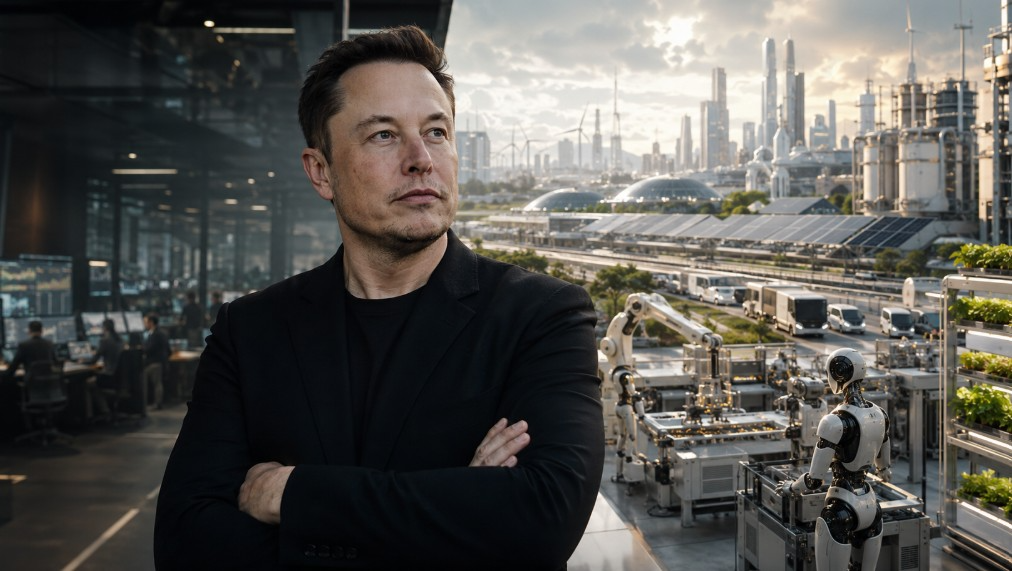
Elon Musk’s 2036 money prediction does not mean that cash, bank accounts or currencies have a confirmed expiry date. His argument is that artificial intelligence and humanoid robots could make goods and services so abundant that people would have less need for money within the next decade.
The forecast depends on machines producing more food, housing, transport and entertainment than people could consume. It also assumes that the benefits of automated production would be widely distributed rather than concentrated among technology owners.
Key Takeaways:
- Musk said that “money won’t matter in 2036”.
- He expects AI and robots to create “incredible abundance”.
- He predicts deflation could become a greater concern than inflation.
- Scarce resources such as land, energy and housing would still require allocation.
- UK businesses are adopting AI, but current use remains far from a post-scarcity economy.
- The 2036 date is a speculative forecast, not an established economic deadline.
The main question is therefore not whether money suddenly disappears, but whether AI can remove enough scarcity to reduce its economic importance.
What Is the Elon Musk 2036 Money Prediction?
The Elon Musk 2036 money prediction is his claim that AI and robotics could produce such large quantities of goods and services that conventional money would no longer play the same central role.
Money helps people exchange labour, measure value, save purchasing power and decide who receives limited resources. Musk’s theory assumes that these functions become less necessary when production is abundant and basic needs are easily met.
The Essential Distinctions:
- Money becoming less important is not the same as money becoming illegal.
- Automated abundance is not the same as unlimited natural resources.
- Universal high income is not an existing government programme.
- Falling production costs do not guarantee equal access.
- A prediction for 2036 is not a scheduled policy change.
Musk is describing a possible economic destination rather than explaining a complete route towards it. His forecast therefore belongs in a debate about post-scarcity economics, automation and wealth distribution—not in the category of confirmed financial developments.
What Did Elon Musk Actually Say About Money in 2036?
Musk made the prediction during an interview released on 23 July 2026 with editor-in-chief Zanny Minton Beddoes. Asked why money would matter to investors in his companies, he replied: “Money won’t matter in 2036.”
He argued that people want money to obtain food, housing, transport, entertainment and other services. If robots and AI supplied more of those things than any individual could consume, he asked, what purpose would money continue to serve?
The interview also addressed the difficult transition. When questioned about supporting people whose jobs might disappear, Musk said the “Treasury should just simply issue people checks”. He later predicted that “deflation will be the issue, not inflation” if real output grew faster than the money supply.
Crypto-focused coverage connected the comments to Musk’s separate statement that “energy is the true currency”. Bitcoin traded near $65,268 on 27 July after falling below $65,000 in February.
SpaceX had disclosed 18,712 bitcoin, while Tesla was reported to hold 11,509, giving the companies a combined 30,221 bitcoin worth about $1.97 billion at that price. Those holdings explain the crypto interest, but they do not prove that Bitcoin would replace money in Musk’s predicted economy.
Musk also became the first person reported to reach trillionaire status following SpaceX’s 12 June 2026 stock-market debut. His estimated wealth subsequently fell to about $725.1 billion by 26 July, illustrating why asset valuations can change dramatically even when an individual’s underlying companies remain valuable.
Why Does Musk Believe AI and Robots Could Make Money Less Important?
Musk’s argument rests on a chain of technological and economic assumptions. AI would need to improve intellectual work while robots expanded production in the physical economy.
How Automated Production Could Create Abundance?
AI could design products, optimise supply chains, forecast demand and manage machinery. Humanoid robots could then perform manufacturing, construction, transport, maintenance and service work continuously.
If each worker or machine produced considerably more, the cost of supplying some goods could fall. Digital products already demonstrate how an item can be reproduced at very low marginal cost, but physical goods still require energy, materials, factories and delivery networks.
The Link Between Higher Output and Falling Prices
Musk describes inflation as a relationship between the supply of money and the supply of goods and services. His reasoning is that governments could expand financial support without creating inflation when real output was increasing even faster.
That is an incomplete description of inflation, which can also reflect demand, wages, expectations, supply shocks and production bottlenecks. The official UK inflation guidance explains inflation as the rate at which the general prices of goods and services rise over time.
Musk’s deflation scenario could apply in highly automated industries, but it would not guarantee falling prices for every household expense.
Universal High Income and Optional Work
Universal high income is Musk’s term for a future in which automation supports living standards well above a minimum safety net. It is more ambitious than universal basic income, which generally aims to provide a financial floor.
The proposal remains undefined. Musk has not supplied a detailed tax structure, eligibility system or ownership model showing how machine-generated wealth would reach every household.
Could Money Really Stop Mattering in an AI-Driven Economy?
Money would become less important only if people could reliably obtain what they needed without competing for limited supply. That condition might develop for selected digital services, but it is much harder to achieve across an entire economy.
How Money’s Functions Could Change?
| Function of money | Possible AI-era change | Why it may remain necessary |
| Medium of exchange | Automated systems could purchase routine services | People would still trade scarce goods |
| Unit of account | AI could calculate resources directly | Businesses would still compare costs and value |
| Store of value | Guaranteed access might reduce some saving needs | Housing, retirement and emergencies would remain uncertain |
| Allocation mechanism | Essentials could be publicly or automatically provided | Desirable locations and limited resources would still need allocation |
| Reward for work | Income could become less tied to employment | Human expertise and responsibility could retain value |
A society might use digital credits, subscriptions, entitlements or automated payments instead of visible cash. Those systems would still perform money-like functions if they controlled access to something scarce.
The more realistic outcome is therefore that money becomes less visible and less important in certain markets, rather than completely unnecessary.
How Realistic Is Musk’s 2036 Deadline?
The deadline is ambitious because advanced language models and reliable physical robots develop at different speeds. Software can be distributed quickly, while robots require factories, parts, energy, maintenance and safe operation in unpredictable environments.
Musk also predicted that AI could exceed the combined intelligence of humanity within roughly five years. However, intelligence benchmarks do not automatically measure the ability to build houses, expand electricity networks or resolve political disagreements.
Conditions the Deadline Depends On:
- Humanoid robots must become reliable and affordable at mass-market scale.
- Energy generation and electricity networks must expand substantially.
- AI systems must operate safely in high-stakes physical environments.
- Productivity gains must reach housing, healthcare, food and transport.
- Governments must create workable income and taxation systems.
- Consumers must trust automated services and decision-making.
- The benefits must spread beyond the owners of AI infrastructure.
Research involving 2,778 AI specialists found substantial uncertainty: the median forecast placed a 50% chance of machines outperforming humans in every task around 2047, while full occupational automation was placed much later. These forecasts can change, but they demonstrate that 2036 is not a settled expert consensus.
The deadline should consequently be read as Musk’s optimistic scenario, not a reliable date for financial planning.
What Could the Elon Musk 2036 Money Prediction Mean for the UK?
The UK would probably experience a long transition involving changing tasks, wages and public finances before money became substantially less important.
UK Employment, Wages and Workplace Automation
AI is more likely to automate portions of jobs before replacing entire occupations. Administrative, clerical, analytical, and routine creative tasks may face greater exposure, while roles involving accountability, physical dexterity, trust, and complex human interaction may remain harder to automate.
The official UK labour projections examine several possible employment outcomes through 2035 rather than offering one certain forecast. Earlier analysis found stronger AI exposure in professional occupations involving clerical work, including areas of finance, law and business.
Employment could increase in AI supervision, cybersecurity, robotics maintenance, compliance and specialist services, even as other tasks disappear. The central risk is a mismatch between the speed of displacement and the availability of new work.
Could Tax and Welfare Systems Adapt?
Lower employment income could reduce receipts from income tax and National Insurance. Governments might respond through taxes on profits, capital, automated production or ownership, although every option would involve economic and political trade-offs.
Issuing payments would also require decisions about eligibility, citizenship, housing support and regional costs. Beddoes raised this political difficulty directly, questioning how a polarised and fearful society could reach Musk’s proposed “nirvana”.
A transition could therefore generate nationalisation demands, higher capital taxes or resistance to automation long before it produced universal abundance.
What Would an AI Abundance Economy Mean for UK Small Businesses?

For small businesses, the immediate issue is not the disappearance of money but the growing gap between firms that use AI productively and those that cannot adopt it.
The latest UK business evidence shows that AI use among businesses with at least 10 employees rose from about 12% in late 2023 to around 35% in June 2026. Adoption reached 49% among firms with at least 250 employees, compared with 28% among businesses employing no more than nine people.
Near-Term Opportunities and Risks:
- Smaller teams can automate scheduling, administration and basic customer support.
- AI can improve forecasting, research, personalisation and stock management.
- Low-cost tools can give small firms capabilities once limited to larger companies.
- Dependence on external platforms can create pricing and continuity risks.
- Weak data controls can expose customer information and commercial material.
- Automated competitors may reduce margins in easily replicated services.
- Employees will need training to check outputs and manage new systems.
Current adoption remains relatively shallow. Robotics was used by only 2% of surveyed businesses, and only 10% of AI-using firms reported extensive use. Official analysis also stated that adoption had “not yet translated into widespread changes in overall workforce headcount”.
UK small businesses should therefore invest selectively in measurable productivity improvements while continuing normal cash-flow, pricing and workforce planning.
What Barriers Could Prevent Money From Losing Its Importance?
Technology can increase supply, but it cannot automatically eliminate physical limits, unequal ownership or political conflict. These barriers determine whether abundance benefits everyone.
Scarcity of Land, Housing and Essential Resources
Prime land, desirable neighbourhoods and unique natural resources cannot be reproduced like software. AI may improve construction and planning, but housing remains constrained by land, infrastructure, regulation, materials and local demand.
Energy is another limit. Robots, factories and data centres would require large and reliable electricity supplies, making Musk’s separate claim that energy is a true currency relevant as an analogy rather than a literal monetary plan.
Who Owns AI-Generated Wealth?
Abundant production does not ensure abundant access. If a small number of companies control AI models, robots, computing capacity and energy, they could capture a large share of the economic gains.
Ownership would influence prices, wages, taxes and political power. Governments could respond with competition rules, public infrastructure, profit taxes, social dividends or shared ownership, but Musk has not specified which model he expects.
Political, Regulatory and Public Resistance
People may resist automation when they expect job losses, surveillance or reduced control. Safety failures could also slow the deployment of robots in homes, workplaces and public spaces.
Prediction Versus Requirement:
| Musk’s Prediction | Required Development | Unresolved Barrier |
| Money matters less by 2036 | Essential goods become abundant | Scarce resources remain |
| Robots perform most work | Mass deployment of reliable machines | Cost, safety and maintenance |
| Governments issue payments | Sustainable distribution system | Funding and eligibility |
| Deflation replaces inflation | Output outpaces money and demand | Sector-specific shortages |
| Work becomes optional | Income is separated from employment | Social and political agreement |
| AI benefits everyone | Broad access to infrastructure | Ownership concentration |
Musk acknowledged his own uncertainty by saying his feelings about AI can move between excitement and fear within the same day. That tension is important because the technology required for abundance could also produce disruption, dependency and new concentrations of power.
Conclusion
Musk may be correct that AI and robotics will lower costs, automate more work and weaken the traditional connection between employment and income. However, those developments would not automatically make money irrelevant.
Achieving his forecast by 2036 would require affordable robots, enormous energy capacity, higher physical productivity, effective regulation and a trusted method of distributing automated wealth.
Housing, land, healthcare, human attention and other scarce resources would probably retain prices or money-like allocation systems.
The Elon Musk 2036 money prediction is therefore best understood as a provocative abundance scenario. Money could become less visible or less important in highly automated sectors, but there is no verified basis for treating 2036 as a confirmed deadline for the end of money.
FAQs About Elon Musk 2036 Money Prediction
Did Musk Publish an Economic Model for the Prediction?
Musk has not published a detailed model showing how production, taxation, ownership and income distribution would operate. His interview presented a broad technological and economic argument rather than a formal forecast.
What Is Universal High Income?
Universal high income describes a proposed future in which automated production supports a relatively high standard of living for everyone. It differs from basic income, which normally aims to guarantee a minimum financial floor.
Would Savings and Pensions Still Matter in 2036?
Savings and pensions would remain important while housing, care, emergencies and retirement resources remained uncertain. A speculative AI forecast is not evidence that existing financial obligations will disappear.
Could AI Make Every Product Cheaper?
AI could lower costs in industries where production is easily automated and expanded. Prices may remain high where land, energy, materials, regulation or skilled human attention restrict supply.
Who Might Own the Humanoid Robots?
Robots could be owned by companies, households, governments, cooperatives or investment funds. The ownership structure would determine who received the income and productivity gains they generated.
Why Has Bitcoin Been Linked to Musk’s Prediction?
The connection comes from Musk’s comments about energy and the disclosed bitcoin holdings of Tesla and SpaceX. Bitcoin was not presented in the interview as the confirmed replacement for conventional money.
What Would Make the Forecast More Credible?
Evidence would include affordable mass-produced robots, sustained productivity growth, falling prices across essential sectors and shorter working hours without lower living standards. Clear taxation and distribution systems would also be required.
Note:
The article distinguishes Musk’s verified statements from interpretation and economic analysis. The $27.9 trillion Bitcoin scenario cited in some market coverage is a speculative valuation narrative, not part of Musk’s demonstrated case for money becoming irrelevant.
Bitcoin prices, corporate holdings and personal-wealth estimates can change rapidly. They provide context for the coverage but do not establish whether the 2036 prediction will occur.

Jermaine writes informative business content related to entrepreneurship, finance, innovation, operations, and emerging opportunities for growing businesses in the UK.

Does Gross Misconduct Always Lead to Dismissal?
No. Gross misconduct does not always lead to dismissal. It can be serious enough to justify dismissal without notice, including for a first offence, but dismissal is not…
Andy Burnham Whitehall Job Cuts: What Is Changing In 2026?
The Andy Burnham Whitehall job cuts story has become part of a much wider debate about how the UK Government should operate and where political power, public money…
Insights for the Modern
UK Small Business.
Join 15,000+ owners receiving tactical analysis on finance, marketing, and technology. No clutter.
Zero spam. Unsubscribe in one click.