How Much Do Deliveroo Drivers Make in the UK?

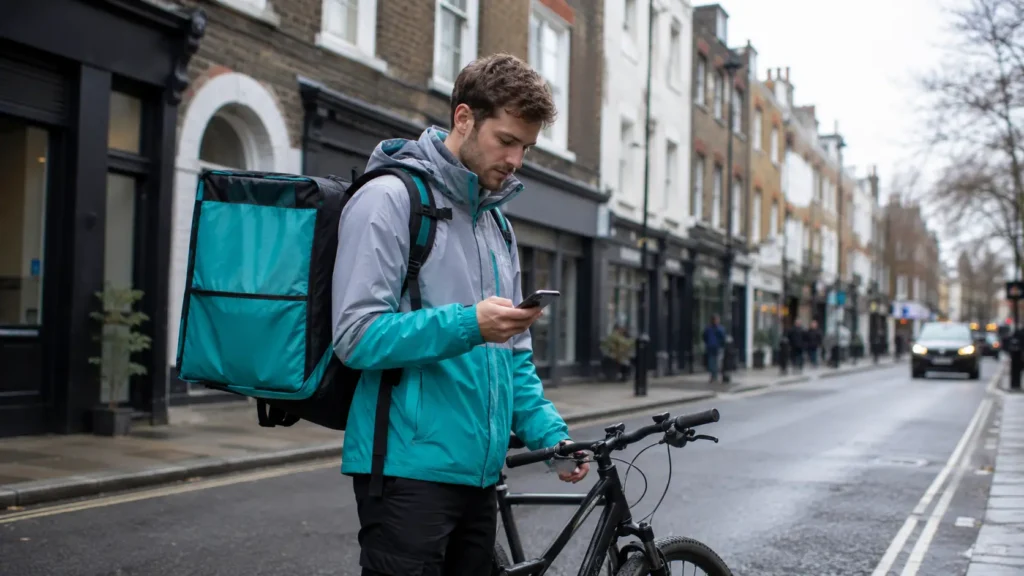
Deliveroo drivers and riders in the UK do not receive one fixed hourly wage or annual salary. Most are self-employed and are paid a separate fee for each completed delivery.
For 2026/27, Deliveroo’s minimum fee floor is based on the estimated time required to complete an accepted order:
| Registered vehicle | Minimum fee based on estimated active-order time |
| Bicycle | £12.88 per hour |
| Electric bicycle | £12.99 per hour |
| Scooter | £14.40 per hour |
| Car | £17.18 per hour |
These rates took effect on 1 April 2026 under Deliveroo’s pay-floor agreement with the GMB union.
However, they should not be interpreted as guaranteed hourly wages.
The calculation applies to the time Deliveroo estimates an accepted delivery should take. A rider may still spend unpaid time waiting for another order, travelling back towards restaurants or remaining online during a quiet period.
As a cautious planning estimate, a Deliveroo rider might gross around £8 to £16 per total online hour, although some busy sessions can produce more and quiet periods can produce substantially less.
A rider working 20 hours a week could therefore gross roughly £160 to £320 per week before deducting fuel, insurance, maintenance, equipment, mobile costs and tax.
How Does Deliveroo Calculate Driver Pay?
Deliveroo calculates each delivery fee separately and shows the offered amount in the Rider app before the rider accepts the job.
According to Deliveroo’s current rider guidance, the fee is primarily influenced by:
- The rider’s location when the offer appears
- The collection location
- The customer delivery location
- Estimated road distance
- Estimated delivery time
- Time and day
- Restaurant demand and expected waiting time
- Available fee boosts
- Registered vehicle type
Cars and scooters generally receive higher fees than bicycles because Deliveroo includes an allowance for the higher costs associated with motorised vehicles.
There is no single fixed collection fee, drop-off fee or universal per-mile rate.
A rider can reject an offered delivery if the distance, destination or fee does not appear worthwhile. Deliveroo states that rejecting an offer does not reduce the number of future orders offered or the fees available on future deliveries.
How Does the Deliveroo Minimum Fee Floor Work?
The 2026/27 fee floor is calculated using estimated active-order time.
For example, if Deliveroo estimates that a bicycle delivery will require 20 minutes:
£12.88 ÷ 60 × 20 = approximately £4.29
For a car delivery estimated to require 20 minutes:
£17.18 ÷ 60 × 20 = approximately £5.73
The difficulty is that estimated active-order time is different from the rider’s complete working session.
Suppose a bicycle rider:
- Spends 20 minutes completing an order
- Earns £4.29
- Waits another 15 minutes for an order
- Spends 10 minutes returning towards restaurants
- Receives no suitable order for another 15 minutes
Although the accepted delivery was calculated using the £12.88 fee floor, the rider has earned only £4.29 during the full hour.
That distinction is essential when answering how much Deliveroo drivers actually make.
How Much Do Deliveroo Drivers Make Per Hour?
There is no single reliable UK-wide hourly figure because riders work in very different locations, at different times and using different vehicles.
Two measurements are particularly useful.
Active-Order Earnings
Active-order earnings measure delivery fees against the time spent completing accepted orders.
If a rider earns £13 while continuously completing orders for one hour, the active-order rate is £13 per hour.
This is the type of time against which Deliveroo’s pay floor operates.
Total Online Earnings
Total online earnings include the complete period the rider is available for work, including unpaid gaps.
Suppose a rider earns £13 from deliveries but stays online for two hours.
The effective gross return becomes:
£13 ÷ 2 = £6.50 per online hour
For somebody deciding whether Deliveroo is financially worthwhile, this can be a much more useful figure.
Illustrative Deliveroo Hourly Earnings

These are planning examples rather than official Deliveroo averages.
| Working conditions | Possible gross earnings per online hour |
| Quiet weekday period | £6–£9 |
| Moderate lunch or dinner period | £9–£13 |
| Busy evening period | £13–£17 |
| Strong demand, boosts and tips | £17–£20+ |
Riders should not assume that every Friday night or busy-looking area will produce the top end of the range.
Restaurant delays, traffic, competition between riders and deliveries ending away from restaurant clusters can all reduce effective hourly earnings.
How Much Can Deliveroo Drivers Make Per Week?
Using a cautious gross range of £8 to £16 per total online hour produces the following illustration:
| Online hours per week | Lower gross estimate | Higher gross estimate |
| 10 hours | £80 | £160 |
| 15 hours | £120 | £240 |
| 20 hours | £160 | £320 |
| 25 hours | £200 | £400 |
| 30 hours | £240 | £480 |
| 40 hours | £320 | £640 |
These amounts are gross revenue, not take-home pay.
A rider who receives £400 from Deliveroo during one week may still have substantial operating expenses.
How Much Can Deliveroo Drivers Make Per Month?
Multiplying estimated weekly earnings by approximately 4.33 gives the following rough monthly figures:
| Online hours per week | Approximate monthly gross range |
| 10 hours | £346–£693 |
| 20 hours | £693–£1,386 |
| 30 hours | £1,039–£2,078 |
| 40 hours | £1,386–£2,771 |
These figures should not be interpreted as guaranteed monthly income.
Demand can change because of weather, seasonality, university holidays, restaurant opening hours, local events, fee boosts and the number of riders online.
A rider considering Deliveroo for regular income should ideally record earnings over several weeks.
How Much Do Deliveroo Riders Make After Expenses?
Gross Deliveroo earnings can look considerably better than the amount a rider actually keeps.
Vehicle choice makes a major difference.
Bicycle Rider Costs
A cyclist may have expenses for:
- Tyres and inner tubes
- Brake pads
- Servicing
- Lights
- Locks
- Waterproof clothing
- Mobile data
- Phone accessories
- Replacement delivery equipment
Suppose a bicycle rider grosses £250 per week but allocates £15 to £30 to equipment, maintenance and phone costs.
Profit before tax may be closer to £220 to £235.
Electric Bicycle Costs
An e-bike can allow riders to complete more distant deliveries while reducing physical effort, but it introduces additional expenses such as:
- E-bike rental
- Finance repayments
- Battery charging
- Battery replacement
- Repairs
- Servicing
- Locks and secure storage
An e-bike rider grossing £350 may spend £50 or more on weekly rental alone.
After other costs, the amount retained before tax could be closer to £275.
Scooter and Car Costs
Motorised riders may need to pay for:
- Petrol or electricity
- Hire-and-reward delivery insurance
- Ordinary motor insurance
- Vehicle tax where applicable
- MOT testing
- Servicing
- Repairs
- Tyres
- Parking
- Depreciation
Drivers should also keep the vehicle roadworthy, particularly when high-mileage delivery work causes tyres, brakes and other components to wear faster.
A car rider grossing £600 during a week might spend £120 to £200 on fuel, delivery insurance and allocated vehicle costs.
The resulting profit before tax may therefore be around £400 to £480.
Ordinary social, domestic and pleasure insurance is not sufficient for paid food delivery work.
For readers comparing business-use car insurance costs, it is important to recognise that food delivery normally requires hire-and-reward or specific food-delivery cover, which is a stricter requirement than ordinary business use.
Do Deliveroo Drivers Keep Their Tips?
Yes. Deliveroo states that riders receive 100% of customer tips.
Tips may be added through the app and can improve the profitability of a session.
They should not, however, be treated as guaranteed income.
For example:
- Delivery fees: £180
- Tips: £15
- Gross income: £195
- Weekly operating expenses: £25
- Profit before tax: £170
Tips received through delivery work also form part of trading income for tax purposes.
When Are Deliveroo Drivers Paid?
Deliveroo normally pays riders weekly on Tuesday.
Riders can also use the cash-out feature to claim their available delivery fees and tips earlier.
The current fee is 50p per cash-out.
Where a cash-out is made before 5:30pm on a weekday, Deliveroo says the payment can normally be received immediately. Later requests and weekend requests may reach the bank on the next working day.
Frequent cash-outs can gradually reduce earnings.
For example:
50p × four cash-outs per week × 52 weeks = £104 per year
Riders who do not need immediate access to their earnings may therefore prefer the normal weekly payment cycle.
What Benefits and Perks Do Deliveroo Riders Receive?
Pay per delivery is not the only financial value available to riders.
Deliveroo currently provides a Rider Perks programme after the rider has completed their first order.
Current advertised examples include:
- 10p per litre off Shell fuel
- A free Caffè Nero drink every day
- 25% off at PizzaExpress
- Free access to more than 700 courses through Lynx Educate
- Discounts on selected e-bike services
- Discounted rider mobile plans and eSIM offers
- Vehicle-maintenance and other partner discounts
These benefits can change, so riders should check the current Rider Perks area rather than assuming an older offer remains available.
The Shell discount is particularly worth updating: older comparisons commonly mention 4p per litre, whereas Deliveroo’s current perks page advertises 10p per litre.
Likewise, some older sources mention OpenClassrooms, while Deliveroo currently advertises its 700+ free-course perk through Lynx Educate.
Does Deliveroo Give Riders Free Insurance?
Deliveroo also provides eligible riders with insurance-related protection at no separate cost.
Current rider guidance includes:
- Personal accident insurance
- Public liability protection in qualifying circumstances
- Accident-related earnings support
- Sickness-related earnings support for eligible riders
- Certain new-parent payments
For an eligible rider unable to work because of a covered accident, earnings support can equal 75% of average daily Deliveroo earnings, up to £50 per day for up to 30 days, subject to the policy conditions and waiting-period rules.
This does not replace the motor insurance required to ride a scooter or drive a car.
Motorised riders must still arrange suitable food-delivery insurance themselves.
How Can Deliveroo Riders Increase Their Earnings?
There is no guaranteed method of making a particular hourly amount, but riders can improve their chances of earning efficiently.
Work During the Busiest Hours
Deliveroo identifies 6pm to 9pm on Fridays and Saturdays as particularly busy periods.
Those hours can generate more frequent order offers and reduce unpaid waiting time.
A rider should still measure the actual result locally rather than assuming every peak period will be profitable.
Use the Deliveroo Heatmap
The Rider app contains a demand heatmap showing how busy different areas currently are.
Deliveroo says the heatmap refreshes approximately every five minutes.
Where demand is low, a rider can decide whether to:
- Move towards a busier restaurant area
- Take a break
- Go offline temporarily
- Return during lunch or dinner demand
Travelling a significant distance solely to chase a busy zone can create additional unpaid mileage, so the cost of repositioning should still be considered.
Look for Fee Boosts
Deliveroo may offer additional fees or boosts at certain times and locations.
A boost can improve the economics of individual orders, but riders should judge the complete trip rather than accepting an order solely because a promotional fee is displayed.
Consider Bank Holidays and Major Events
Bank holidays, Valentine’s Day, New Year’s Day and other high-demand occasions can generate additional takeaway orders.
However, higher demand does not automatically guarantee a specific boost or earnings rate.
The app should be checked before travelling specifically for an expected busy period.
Reduce Unproductive Restaurant Waiting
Restaurant delays can turn what looked like a profitable order into a poor one.
Experienced riders often learn which restaurants regularly prepare orders promptly and which locations generate long waits.
Deliveroo allows riders experiencing excessive restaurant delays to unassign an order through the app where appropriate.
Consider Stacked Orders Carefully
A stacked order may involve carrying multiple customer orders during the same journey or collecting additional orders close together.
This can increase earnings per mile because some of the journey is shared.
However, the rider should still consider:
- The additional fee
- Extra collection time
- Additional delivery distance
- Whether customers are travelling in similar directions
- The likely restaurant waiting time
Two orders are not automatically more profitable than one if the second collection creates a substantial delay.
How Do You Become a Deliveroo Rider?
Applicants must satisfy Deliveroo’s current onboarding requirements.
A UK rider generally needs:
- To be at least 18
- Proof of the right to work in the UK as self-employed
- A UK bank account
- An eligible bicycle, cargo bicycle, scooter or car
- Appropriate safety equipment
- A compatible smartphone
- No unspent criminal convictions
- Food-delivery insurance where using a car or motorised scooter
Deliveroo currently specifies a smartphone running at least iOS 17.0 or Android 8, with NFC and front- and rear-facing cameras.
What Documents Does Deliveroo Ask For?
Applicants may need to provide:
- Right-to-work evidence
- Proof of address
- Bank statement
- National Insurance number evidence
- Documents for a criminal-record check
- Photograph of suitable delivery equipment
- Driving licence for applicable vehicles
- Food-delivery insurance for cars or scooters
The bank account used for the rider account should generally be in the account holder’s name.
Do Scooter Riders Need a CBT?
A rider using a motorised scooter may need a valid licence and, where applicable, a Compulsory Basic Training certificate.
GOV.UK states that CBT is generally required before a learner can ride a moped or motorcycle on public roads.
After completing CBT, an eligible learner can generally ride a motorcycle up to 125cc and 11kW with L plates, subject to the applicable licence rules.
A CBT certificate normally remains valid for two years.
The Government does not set one nationwide CBT price; training schools determine their own charges.
A reasonable current planning range is approximately £130 to £190, although the actual fee depends on location, the training provider and whether bike or equipment hire is included.
That upfront cost should be included when somebody is calculating whether scooter delivery work will be profitable.
Deliveroo vs Uber Eats vs Just Eat: Which Pays More?
There is no reliable universal winner because each platform uses dynamic order pricing and riders can experience very different demand in different towns.
The more useful comparison is how each platform structures pay, tips, payments, insurance and perks.
| Feature | Deliveroo | Uber Eats | Just Eat |
| Pay structure | Individual order fee with vehicle-specific 2026/27 active-order pay floor | Delivery fare shown before acceptance; incentives such as Quests may apply | Transit Pay based on factors including distance, estimated time, traffic and route |
| Official hourly guarantee | Pay floor applies to estimated active-order time, not entire online shift | No general UK hourly guarantee for independent Uber Eats couriers | No single guaranteed nationwide hourly amount |
| Tips | Rider keeps 100% | Courier keeps 100% | Courier receives 100% |
| Standard payout | Weekly, normally Tuesday | Weekly bank transfer | Weekly payment initiated Tuesday for previous Monday–Sunday period |
| Faster payout | Cash-out available; 50p Deliveroo charge | Instant and two-day cash-out options available | Fast Cash available to eligible couriers; conditions and fees depend on programme level |
| Waiting-time treatment | Expected wait can influence order pricing, but idle time between orders is unpaid | Incorporated into delivery-fare mechanics; terms vary | Restaurant-delay reimbursements can apply to longer-than-normal holds |
| Motor-delivery insurance | Rider must arrange food-delivery motor insurance | Courier must arrange suitable food-delivery/hire-and-reward motor insurance | Courier must provide hire-and-reward insurance for motorised vehicles |
| Additional platform cover | Eligible rider accident, sickness and public-liability protection | Eligible couriers can receive Partner Protection through Allianz | Current public courier material focuses on courier-provided vehicle insurance rather than advertising an equivalent Deliveroo personal-accident package |
| Examples of perks | Shell fuel discount, Caffè Nero drink, PizzaExpress discount, learning courses | Partner Protection, learning opportunities and selected platform rewards | Extra loyalty programme, Onsi marketplace discounts, earning challenges, kit discounts and other level-based benefits |
Older comparison articles sometimes state simply that Just Eat offers no rider insurance.
That wording needs qualification.
The current, verifiable point is that Just Eat motorised couriers must arrange their own hire-and-reward insurance. Deliveroo also requires motorised riders to arrange their own delivery motor cover, but separately provides qualifying personal accident and public-liability protection.
The two forms of insurance should not be confused.
Is Deliveroo Better Paid Than Uber Eats?
It depends heavily on the area.
Deliveroo has the advantage of publishing a negotiated 2026/27 minimum fee floor for estimated active-order time.
Uber Eats instead displays the delivery fare before the courier decides whether to accept an order and may offer Quests and other incentives.
Neither headline structure tells a rider how much they will make across an entire evening because order frequency and unpaid waiting remain important.
Is Deliveroo Better Paid Than Just Eat?
Just Eat uses Transit Pay based on factors such as time, distance, traffic and route and can offer incentives.
It also provides restaurant-delay reimbursements in qualifying cases, which can matter where waiting at restaurants is a major source of lost earnings.
Deliveroo’s advantage is greater transparency around its published active-order fee floor.
For many riders, the most profitable platform will simply be the one with the strongest order volume in their local area at the hours they want to work.
Are Deliveroo Drivers Self-Employed?
Deliveroo generally engages riders as self-employed independent suppliers.
That flexibility allows riders to decide when to go online, how long to work and whether to accept particular orders.
Riders can also generally work for other delivery platforms, subject to the relevant terms.
Self-employed status also means they do not automatically receive the normal package of employment benefits associated with an employee, such as:
- Fixed contractual salary
- Guaranteed hours
- Paid annual leave
- Employer pension contributions
- Statutory redundancy pay
The UK Supreme Court has previously considered the relationship between Deliveroo and riders in a case concerning collective-bargaining rights.
The Court concluded that the particular arrangements considered in that case did not establish the required employment relationship, with substitution rights playing an important role.
That decision should not be interpreted as resolving every employment-status question for every gig-economy worker.
Do Deliveroo Drivers Pay Tax?
Deliveroo earnings are generally trading or self-employment income.
Riders are responsible for keeping records of:
- Delivery fees
- Tips
- Incentives
- Relevant business expenses
- Vehicle expenses
- Equipment
- Insurance
- Other qualifying costs
Someone whose combined gross trading income exceeds the relevant trading-allowance threshold may need to notify HMRC and complete Self Assessment.
New riders should check when they need to register with HMRC rather than assuming Deliveroo deducts their personal tax automatically.
The £1,000 trading allowance relates to gross trading income, not profit.
It also applies across relevant trading activities.
For example:
- Deliveroo income: £750
- Other courier-app income: £400
- Total gross trading income: £1,150
The person cannot normally treat each platform as having its own separate £1,000 allowance.
Deliveroo is also subject to digital-platform reporting rules requiring it to collect and report certain information about self-employed riders and their earnings to tax authorities.
Riders should therefore keep accurate records rather than assuming platform income is invisible to HMRC.
Practical Deliveroo Earnings Examples
Example 1: Part-Time Bicycle Rider
A rider works 15 hours concentrated around Friday evening, Saturday evening and Sunday lunchtime.
| Item | Amount |
| Delivery fees | £190 |
| Tips | £12 |
| Gross earnings | £202 |
| Maintenance and equipment allocation | £15 |
| Mobile costs | £5 |
| Profit before tax | £182 |
Gross earnings equal approximately £13.47 per online hour.
After direct expenses, the figure falls to about £12.13 per hour before tax.
Example 2: E-Bike Rider
An e-bike rider works 25 hours during lunch and evening demand periods.
| Item | Amount |
| Delivery fees and tips | £325 |
| E-bike rental | £55 |
| Charging and mobile costs | £10 |
| Maintenance | £15 |
| Profit before tax | £245 |
Gross earnings equal £13 per online hour.
After direct costs, approximately £9.80 per online hour remains before tax.
Example 3: Car Rider
A car rider works 35 hours during a relatively strong week.
| Item | Amount |
| Delivery fees, boosts and tips | £560 |
| Fuel | £70 |
| Delivery insurance allocation | £45 |
| Maintenance and depreciation | £40 |
| Profit before tax | £405 |
The gross return is £16 per online hour.
After estimated vehicle expenses, it falls to approximately £11.57 per hour before tax.
That is why gross app earnings and actual take-home income should never be treated as the same figure.
Is Deliveroo Worth It in the UK?
Deliveroo can make sense as a flexible side income for somebody who:
- Lives near an active delivery area
- Can work during strong demand periods
- Has relatively low vehicle costs
- Tracks expenses carefully
- Does not require guaranteed hours
- Values the ability to choose when to work
It becomes less attractive when the rider experiences long unpaid waiting periods or has high car, insurance and fuel costs.
The key calculation is not simply:
How much did Deliveroo pay?
It is:
Delivery fees + tips + boosts − operating expenses = profit before tax
That figure should then be divided by the total time committed to working, rather than only the minutes spent carrying food.
Frequently Asked Questions
How Much Does the Average Deliveroo Driver Make Per Hour?
There is no verified average covering every hour riders remain online. Deliveroo’s 2026/27 active-order fee floor starts at £12.88 for bicycle riders, while a cautious total-online-time planning range may be around £8 to £16 gross per hour.
What Does Indeed Say Deliveroo Drivers Earn?
Indeed currently shows approximately £18,029 per year for Driver, £26,545 for Rider and £33,308 for Delivery Driver. The samples for each title are small, so the figures should not be treated as guaranteed earnings.
Can a Deliveroo Driver Make £100 a Day?
Yes, it is possible during a sufficiently busy day. At £12.50 gross per complete online hour, approximately eight hours would be required to reach £100 before expenses and tax.
Can Deliveroo Drivers Make £500 a Week?
It is possible. A rider averaging £12.50 gross per online hour would need around 40 hours to gross £500. Whether that is achievable depends on local demand, vehicle type, expenses and working times.
How Much Does Deliveroo Pay Per Delivery?
There is no single nationwide fee per delivery. Each order is priced individually using factors including estimated time, road distance, location, demand and vehicle type.
Do Deliveroo Drivers Get Paid for Waiting?
Estimated restaurant waiting time can be incorporated into the fee calculation, but riders are not automatically paid for every minute spent waiting between orders or for every unexpected delay.
What Are the Best Hours for Deliveroo?
Deliveroo identifies 6pm to 9pm on Fridays and Saturdays as particularly busy. Lunch periods and other evenings can also perform well depending on the local market.
Does Deliveroo Pay for Petrol?
No. Riders pay their own fuel costs. Deliveroo’s car and scooter fee floors include allowances recognising higher vehicle expenses, and eligible riders can currently access a Shell fuel discount through Rider Perks.
Do Deliveroo Riders Get Free Insurance?
Deliveroo provides eligible riders with personal accident and other specified rider protection. This does not replace the food-delivery motor insurance required for cars and motorised scooters.
Does Deliveroo Give Riders Discounts?
Yes. Current examples include 10p per litre off Shell fuel, a daily Caffè Nero drink, 25% off PizzaExpress and access to more than 700 learning courses through Lynx Educate. Offers can change.

Jermaine writes informative business content related to entrepreneurship, finance, innovation, operations, and emerging opportunities for growing businesses in the UK.

UK Budget Savings Tax Changes 2026: New Rates, ISA Rules and How Much More Savers Could Pay?
The UK Budget savings tax changes announced on 28 October 2026 have introduced significant financial implications for millions of savers, pensioners and small business owners. From 6 April…
DWP Energy Bill Letters Dispatched: Six Million Households Could Get £150 Discount
Millions of UK households are being urged to watch their post as the Department for Work and Pensions (DWP) prepares to distribute letters concerning a £150 reduction in…
Insights for the Modern
UK Small Business.
Join 15,000+ owners receiving tactical analysis on finance, marketing, and technology. No clutter.
Zero spam. Unsubscribe in one click.