Suspended From Work Pending Investigation: What Are My Rights in the UK?


Being suspended from work pending an investigation can be stressful, especially when you are uncertain about your job security, salary, professional reputation and future employment.
However, suspension does not automatically mean you have committed misconduct or that your employer intends to dismiss you.
Under UK employment law, employers can temporarily suspend employees while investigating workplace allegations, but the decision must be reasonable and properly justified.
Employees normally remain entitled to their usual pay and contractual benefits, while employers are expected to follow fair procedures.
Recent employment law changes also affect workplace investigations. From October 2026, employment tribunal deadlines have increased for most claims, while further unfair-dismissal protections are scheduled for January 2027.
This article explains your rights during suspension, how long an investigation can last, how to challenge unfair treatment and what small-business employers must consider when suspending staff.
What Does Suspended From Work Pending Investigation Mean?
Suspension pending investigation occurs when an employer temporarily removes an employee from their normal duties while investigating allegations or workplace concerns.
The employee remains employed, but they may be prohibited from attending the workplace, accessing company systems or communicating with certain colleagues.
Employers commonly consider suspension when investigating:
- Allegations of theft, fraud or financial misconduct.
- Workplace bullying, harassment or discrimination.
- Serious health and safety violations.
- Misuse of confidential company information.
- Complaints involving customers or colleagues.
- Potential interference with witnesses or evidence.
- Serious breaches of workplace policies.
However, an allegation alone does not automatically justify suspension.
According to Acas guidance on suspension during investigations, employers should assess the circumstances and consider alternatives before deciding that suspension is appropriate.
For example, restricting an employee’s access to financial systems may be sufficient when investigating a suspected accounting irregularity.
Is Suspension Really a Neutral Act?
Employers frequently describe suspension as a neutral measure because it is not intended to punish employees.
However, employment law recognises that suspension can have negative consequences.
In Mezey v South West London and St George’s Mental Health NHS Trust [2007], the Court of Appeal recognised that suspension can damage professional standing and is not necessarily neutral in its effect.
The later decision in Agoreyo v London Borough of Lambeth [2019] clarified that the central legal question is whether the employer had reasonable and proper cause for suspension.
Therefore, suspension may be precautionary in purpose while still affecting an employee’s reputation, wellbeing and professional relationships.
Employers should never treat suspension as an automatic response to allegations.
What Are Your Rights When Suspended From Work?
Employees retain important employment protections throughout an investigation.
| Employee Right | What It Means |
| Pay and benefits | Normal contractual pay and benefits should generally continue. |
| Fair treatment | Suspension should have reasonable justification. |
| Explanation | Employers should explain the concerns where appropriate. |
| Confidentiality | Personal information should not be disclosed unnecessarily. |
| Reasonable duration | Suspension should be as brief as possible. |
| Regular communication | Employers should provide appropriate updates. |
| Fair investigation | Employees should have an opportunity to respond. |
| Legal protection | Employees may challenge contractual breaches or unlawful treatment. |
Importantly, some of these are contractual protections or Acas good-practice recommendations rather than separate statutory rights.
What Should You Do Within the First 24–48 Hours of Suspension?
Your initial response can influence how effectively you protect your employment position.
1. Request Written Confirmation
Ask your employer to confirm the suspension, its reason, effective date and next steps in writing.
2. Review Your Employment Contract
Read your disciplinary policy, suspension provisions, confidentiality obligations and pay arrangements.
3. Record Important Information
Keep a dated record of conversations, meetings, allegations and communications.
4. Confirm Your Payment Arrangements
Check whether your normal salary, contractual bonuses and employee benefits will continue.
5. Remain Available
Unless otherwise agreed, remain reasonably available for investigation meetings and a possible return to work.
6. Avoid Discussing Allegations Publicly
Do not post allegations or confidential workplace information on social media.
7. Preserve Relevant Evidence
Keep documents you are lawfully entitled to retain. Do not remove confidential records or access restricted systems.
8. Seek Advice Where Necessary
Contact Acas, your trade union or an employment solicitor if serious allegations, discrimination or withheld pay are involved.
Resigning immediately is rarely a decision to make without considering the consequences.
What Questions Should You Ask Your Employer?
Employees should request clarification without interfering with the investigation.
Important questions include:
- What specific allegations are being investigated?
- When did the alleged incident occur?
- Why was suspension considered necessary?
- Which workplace policy applies?
- Who is conducting the investigation?
- What restrictions apply during suspension?
- When will the suspension be reviewed?
- Who should I contact for updates?
- Will my salary and benefits continue?
- When can I explain my version of events?
You can ask who made the complaint, although the employer may have legitimate reasons for withholding that information temporarily.
There is no automatic right to receive every witness statement immediately after suspension.
However, employees should receive sufficient information to respond fairly if formal disciplinary proceedings follow.
Do You Get Full Pay When Suspended From Work?
Employees should normally receive their usual salary and contractual benefits during an investigatory suspension.
Acas advises that employers should generally maintain pay even while the employee is temporarily prevented from carrying out normal duties.
Importantly, an employer may still face legal action for reducing or stopping pay even when the contract appears to permit unpaid suspension.
What Happens to Bonuses, Overtime and Benefits?
| Payment Type | General Position |
| Basic salary | Normally continues. |
| Contractual bonuses | Usually protected where contractually due. |
| Guaranteed overtime | Depends on contractual entitlement. |
| Non-guaranteed overtime | Depends on the circumstances and employment terms. |
| Commission | Depends on the commission agreement. |
| Pension contributions | Normally continue according to pensionable pay and scheme rules. |
| Contractual benefits | Should generally continue. |
For example, an employee earning £35,000 annually should normally continue receiving basic salary while suspended.
However, additional earnings linked to completed sales, discretionary bonuses or variable overtime may require separate assessment.
Employees should challenge unexplained reductions in writing.
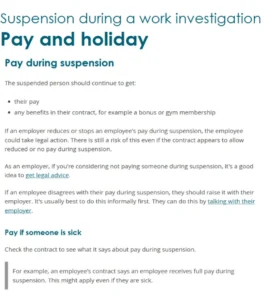
Official Acas guidance explaining pay, contractual benefits, sickness and holiday during investigatory suspension.
Can Your Employer Suspend You Without Evidence?
An employer does not have to prove misconduct before suspending an employee.
The investigation exists to establish what happened.
However, employers should have reasonable grounds for deciding that suspension is an appropriate precaution.
A completely unsupported allegation should not automatically result in removal from work.
An employer may also have an implied contractual power to suspend an employee even where the contract contains no express suspension clause, provided the decision is reasonable and lawful.
The employer should consider whether temporary adjustments could address any genuine workplace risks.
Do You Have a Right to Confidentiality During Suspension?
Employees should expect their employer to handle suspension information carefully.
However, UK employment law does not provide an unlimited, standalone right to complete confidentiality during investigations.
Employers may need to disclose relevant information to investigators, HR staff, witnesses or professional regulators.
Unnecessary disclosure could potentially breach data protection requirements or damage contractual trust and confidence.
For example, announcing unproven fraud allegations to the entire workforce could create reputational and legal concerns.
False statements causing serious reputational harm may also raise defamation issues, depending on the circumstances.
Employees concerned about future employment should understand how gross misconduct information may remain on employment records.
Can You Bring Someone to an Investigation Meeting?
There is generally no statutory right to be accompanied during an ordinary disciplinary investigation meeting.
However, Acas considers allowing an employee to bring a workplace colleague or trade union representative good practice.
The position changes at a qualifying formal disciplinary hearing where a warning or other disciplinary action may result.
In those circumstances, employees generally have a statutory right to be accompanied by an eligible colleague or trade union representative.
Employees with disabilities may also require reasonable adjustments to meeting arrangements.
Employers should distinguish between gathering evidence and conducting a formal disciplinary hearing.
How Long Can You Be Suspended Pending Investigation?
There is no fixed statutory maximum period for ordinary investigatory suspension in the UK.
However, employers should keep suspension as short as reasonably possible and regularly assess whether it remains necessary.
How Long Does Suspension Last in Practice?
| Illustrative Duration | Possible Circumstances |
| Several working days | Straightforward allegations with readily available evidence. |
| 1–3 weeks | Multiple interviews or internal document reviews. |
| 4–8 weeks | More complex investigations involving several allegations. |
| Several months | Particularly complicated matters involving external investigators or regulators. |
These periods are examples, not official averages or legal deadlines.
A suspension lasting several months is not automatically unlawful, but the employer should be able to explain the delay and justify continued suspension.
A useful management practice is to schedule an initial suspension review after approximately 10 working days.
This is an operational recommendation rather than a legal requirement.
Can You Challenge an Unfair Suspension?
Yes. Employees can challenge a suspension they believe is unreasonable, disproportionate or improperly handled.
Step 1: Raise the Issue Informally
Contact your manager or HR department and explain your concerns.
Step 2: Request a Review
Ask why continued suspension is necessary and whether alternative working arrangements could be considered.
Step 3: Provide Relevant Information
If appropriate, explain factual inaccuracies, contractual concerns or reasons the suspension is causing disproportionate harm.
Step 4: Submit a Formal Grievance
If informal discussions fail, use the employer’s formal grievance procedure.
Step 5: Obtain Independent Advice
Consider legal advice where suspension involves discrimination, unpaid wages or a potentially serious contractual breach.
Submitting a grievance does not automatically end suspension. The employer may decide it remains justified.
Sample Email to Challenge a Suspension
Subject: Request for Review of Suspension
Dear [Manager’s Name],
I am writing regarding my suspension from work on [date].
I understand that an investigation is ongoing and remain willing to cooperate fully.
However, I would appreciate clarification of the specific concerns, why suspension was considered appropriate and whether alternative working arrangements have been assessed.
Please also confirm my pay arrangements, the expected investigation process and the next suspension review date.
I would welcome an opportunity to discuss these concerns.
Kind regards,
[Employee Name]
Can You Resign While Suspended?
Yes. Employees can resign during suspension, subject to their contractual notice obligations.
However, resignation does not necessarily stop an investigation.
Employers may continue investigating serious allegations, particularly where safeguarding, criminal or regulatory matters are involved.
Resignation can also affect notice arrangements, income, references and potential legal claims.
Employees considering resignation because of alleged employer misconduct should obtain advice about constructive dismissal, which is legally complex.
Can You Take Holiday or Sick Leave While Suspended?
Employees may take annual leave during suspension with employer agreement.
Employers can refuse or cancel holiday requests, provided they follow applicable legal notice rules and contractual requirements.
Suspension itself does not automatically count as annual leave.
If an employee becomes unwell, normal sickness notification procedures generally apply.
Sick pay during suspension depends on the employment contract and circumstances. Where the contract guarantees full suspension pay, that entitlement may continue even during sickness.
Employees should request written clarification before assuming their payment arrangements will change.
Can You Work Elsewhere During Suspension?
Suspension does not automatically give employees unrestricted permission to undertake additional employment.
Contractual restrictions may still apply.
Working elsewhere could create problems if it:
- Breaches an enforceable employment restriction.
- Creates a conflict of interest.
- Prevents attendance at investigation meetings.
- Involves disclosure of confidential information.
- Conflicts with reasonable suspension conditions.
An employee already working an authorised second job may be in a different position from someone starting another job after suspension.
Where uncertain, request written clarification.
What Happens During the Investigation?
Employers should gather relevant evidence fairly and investigate without unreasonable delay.
Evidence may include witness accounts, workplace messages, CCTV, financial records, customer complaints and internal reports.
Employees should be given a meaningful opportunity to explain their position.
The investigator should consider evidence supporting and contradicting the allegations.
Possible outcomes include no further action, informal resolution, additional training, a disciplinary hearing, a warning or dismissal.
Where serious misconduct is established, dismissal is not necessarily automatic.
In fact, gross misconduct does not always lead to dismissal, because employers must consider the evidence, circumstances and proportionality of the disciplinary decision.
Suspension can also end before the investigation is complete.
Can Suspension Affect Your Mental Health?
Being excluded from work can create uncertainty, isolation and reputational concerns.
Acas advises employers to consider employee wellbeing before and throughout suspension.
Good practice includes regular communication, explaining investigation progress, offering appropriate support and avoiding unnecessary delays.
Where disability-related needs arise, employers may also have duties under the Equality Act 2010 to make reasonable adjustments.
These might include accessible meeting arrangements, additional preparation time or appropriate communication support.
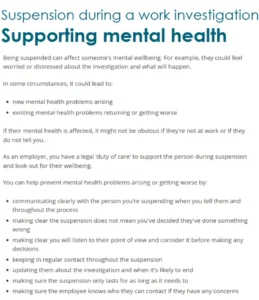
Acas guidance covering employee mental health, communication and wellbeing support during suspension.
What Employment Law Changes Affect Suspension in 2026–27?
Several important legal developments affect employees facing investigations and employers considering disciplinary action.
Employment Tribunal Deadlines Increased in October 2026
From 1 October 2026, the usual deadline for most employment tribunal claims increased from three months to six months.
This includes most ordinary unfair-dismissal and employment discrimination claims.
Generally, the new limits apply where the relevant workplace event occurred on or after 1 October 2026. Events wholly before that date remain subject to the previous rules.
For employment-contract claims in Scotland, the six-month change is scheduled to begin on 9 November 2026.
Employees should check the specific deadline for their claim rather than assuming every workplace dispute follows identical rules.
The official employment tribunal time-limit guidance explains these changes.
Since 1 December 2025, the maximum Acas early conciliation period has also increased from six to twelve weeks.
However, internal grievances do not automatically stop tribunal deadlines, and early conciliation affects time calculations under specific legal rules.
Unfair Dismissal Protection Changes in January 2027
From 1 January 2027, the ordinary unfair-dismissal qualifying period is scheduled to fall from two years to six months.
The statutory cap on compensatory awards for ordinary unfair dismissal will also be removed.
Tribunal compensation will nevertheless remain subject to legal principles governing actual losses and other relevant factors.
For small employers, these changes make fair investigations and properly documented disciplinary decisions particularly important.
Acas Is Updating Its Disciplinary Code
Acas consulted on changes to its disciplinary and grievance Code between 30 July and 23 September 2026.
The revised Code is expected to take effect in 2027, subject to the required approval process.
David Taylor, Acas’s Head of Workplace Policy for Individual Rights, Discipline and Grievance, has explained in published Acas commentary that the revisions aim to encourage earlier dispute resolution and better handling of workplace concerns.
The proposals also clarify the limited circumstances where suspension should be used and emphasise reducing its negative impact.
These are draft proposals, not final legal requirements.
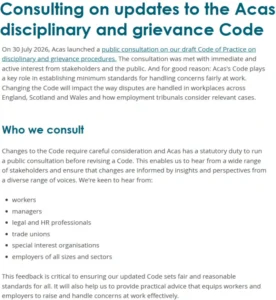
Official Acas announcement about proposed disciplinary Code changes, including guidance on suspension.
Guidance for Small-Business Employers: How to Suspend Someone Fairly
Small-business employers should treat suspension as a risk-management decision rather than an automatic disciplinary step.
The first task is identifying the actual risk.
For example, a business investigating suspected misuse of customer information could temporarily restrict database access instead of suspending the employee completely.
Employers should consider:
- What allegations are being investigated?
- What initial evidence is available?
- What risks arise if the employee continues working?
- Could temporary alternative duties address those risks?
- Would restricted system access be sufficient?
- How will suspension affect employee wellbeing?
- Who will conduct the investigation?
- When will suspension be reviewed?
Where employees are being separated following a complaint, employers should not normally move the complainant simply because they raised concerns.
The circumstances and any employee preferences should be assessed carefully.
External police or regulatory investigations also do not automatically require workplace suspension.
What Should an Employee Suspension Letter Include?
Employers should usually confirm suspension in writing, even though there is no general statutory requirement to issue a suspension letter.
A good letter should identify:
- The reason for suspension.
- The suspension start date.
- Confirmation that no disciplinary finding has been made.
- Why suspension was considered appropriate.
- Applicable salary and benefits.
- Restrictions on workplace access or communication.
- The employee’s expected availability.
- The investigator or designated contact.
- The proposed review date.
- The agreed frequency of updates.
- Available wellbeing support.
Where possible, the employer should communicate the decision sensitively in person before providing written confirmation.
Sample Employer Suspension Letter
Subject: Temporary Suspension Pending Investigation
Dear [Employee Name],
Following our discussion on [date], this letter confirms your temporary suspension from normal duties while we investigate [brief description of concerns].
This suspension is a precautionary measure and does not represent a finding of misconduct.
We have considered alternative arrangements but believe suspension is appropriate because [specific reasons].
Your normal salary and contractual benefits will continue during the suspension, subject to applicable employment terms.
Please remain reasonably available during your normal working hours.
We will review the suspension by [date], or sooner if circumstances change.
[Contact Name] will provide updates and answer procedural questions.
You will have an opportunity to respond to the allegations before any disciplinary decision is made.
Yours sincerely,
[Manager Name]
[Job Title]
Are Suspension Rules Different for NHS Staff, Teachers and Regulated Professionals?
Some industries have additional obligations.
NHS organisations may need to consider patient safety, clinical responsibilities and professional registration requirements.
Teachers and educational employers must consider relevant safeguarding policies and regulatory guidance.
Financial services employers may have additional confidentiality, conduct and reporting duties.
Where nurses, doctors or other regulated professionals are involved, the Nursing and Midwifery Council, General Medical Council or another regulator may have a separate role.
A workplace suspension does not automatically mean that a professional regulator has suspended someone’s registration.
Medical and Maternity Suspension
Medical and maternity suspensions are different from disciplinary investigations.
Under relevant provisions of the Employment Rights Act 1996, employees suspended on specified medical or maternity grounds may have statutory remuneration protections, subject to eligibility conditions.
Medical suspension remuneration can apply for up to 26 weeks in qualifying circumstances.
Pregnancy-related workplace risks may require an employer to offer suitable alternative work or, where the statutory conditions apply, suspend the employee on maternity grounds with appropriate pay.
These arrangements should not be confused with investigatory suspension following misconduct allegations.
Frequently Asked Questions
Can I Be Suspended Without a Hearing?
Yes. Employers may suspend employees before holding a disciplinary hearing, provided suspension is reasonable and appropriately justified.
Can I Be Suspended for a Social Media Post?
Potentially. Serious online misconduct involving harassment, confidential information or workplace-related risks may justify an investigation and, where appropriate, suspension.
Can My Employer End My Suspension Immediately?
Yes. An employer can end investigatory suspension whenever it is no longer justified. Employees should therefore remain reasonably available to return to work.
Does Suspension Mean I Will Lose My Job?
No. An investigation may end without disciplinary action. Dismissal requires separate consideration of the evidence and applicable legal requirements.
Is Suspension the Same as Garden Leave?
No. Garden leave commonly applies during an employment notice period, while investigatory suspension temporarily removes an employee from duties during an investigation. Their purposes and contractual implications differ.
Can I Claim Compensation for Unfair Suspension?
Potentially, where the circumstances support a recognised legal claim, such as breach of contract, discrimination or unlawful deductions from wages. Suspension alone does not automatically create entitlement to compensation.

Jennifer contributes business-focused articles covering modern business trends, digital growth, entrepreneurship, and practical insights designed to support startups and SMEs.

Does Gross Misconduct Always Lead to Dismissal?
No. Gross misconduct does not always lead to dismissal. It can be serious enough to justify dismissal without notice, including for a first offence, but dismissal is not…

Andy Burnham Whitehall Job Cuts: What Is Changing In 2026?
The Andy Burnham Whitehall job cuts story has become part of a much wider debate about how the UK Government should operate and where political power, public money…
Insights for the Modern
UK Small Business.
Join 15,000+ owners receiving tactical analysis on finance, marketing, and technology. No clutter.
Zero spam. Unsubscribe in one click.