How to Pay Yourself From a Limited Company in the UK?: Salary, Dividends and Tax-Efficient Methods


Paying yourself from a limited company in the UK involves more than transferring money from your business bank account to your personal account.
As a company director, you must understand how salaries, dividends, National Insurance, Corporation Tax and directors’ loans affect your earnings.
For the 2026/27 tax year, one of the most tax-efficient approaches for many small business owners is to take a director’s salary and supplement it with dividends from available company profits.
However, the best combination depends on your company’s profitability, other income, National Insurance position and eligibility for tax relief.
From 6 April 2026, the basic dividend tax rate increased from 8.75% to 10.75%, while the higher rate increased from 33.75% to 35.75%.
These changes make it particularly important for company directors to review how they withdraw money.
This guide explains how to pay yourself from a limited company, how much salary to take, the latest 2026/27 tax thresholds, and how different payment methods affect your take-home income.
It also covers worked calculations, dividend paperwork, directors’ loans and common mistakes.
What Are the Different Ways to Pay Yourself From a Limited Company?
A limited company is legally separate from its directors and shareholders. Therefore, the money held in its bank account belongs to the company, even if you are its sole owner.
Unlike sole traders, who can generally withdraw their business profits as drawings, company directors must use recognised methods to receive money from their businesses.
There are five main ways to receive money or value from your limited company.
| Payment method | How it works | Tax implications |
| Director’s salary | Regular payment through PAYE payroll | Income Tax and potentially employee and employer National Insurance |
| Dividends | Distribution of company profits to shareholders | Dividend tax above available allowances; no National Insurance |
| Director’s loan | Money borrowed from the company | Potential loan-related tax liabilities |
| Expense reimbursement | Repayment of legitimate business expenses | Generally tax-free when qualifying conditions are met |
| Employer pension contributions | Company pays directly into a registered pension | Potential Corporation Tax relief, subject to conditions and pension allowances |
For most owner-managed companies, a combination of salary and dividends provides flexibility while allowing the business to retain money for future expenses and investment.
However, salary and dividends serve different purposes. Salary compensates you for working as a director or employee, whereas dividends reward you for owning shares.
The official GOV.UK guidance on taking money out of a limited company explains the requirements for salary payments, dividends and directors’ loans.
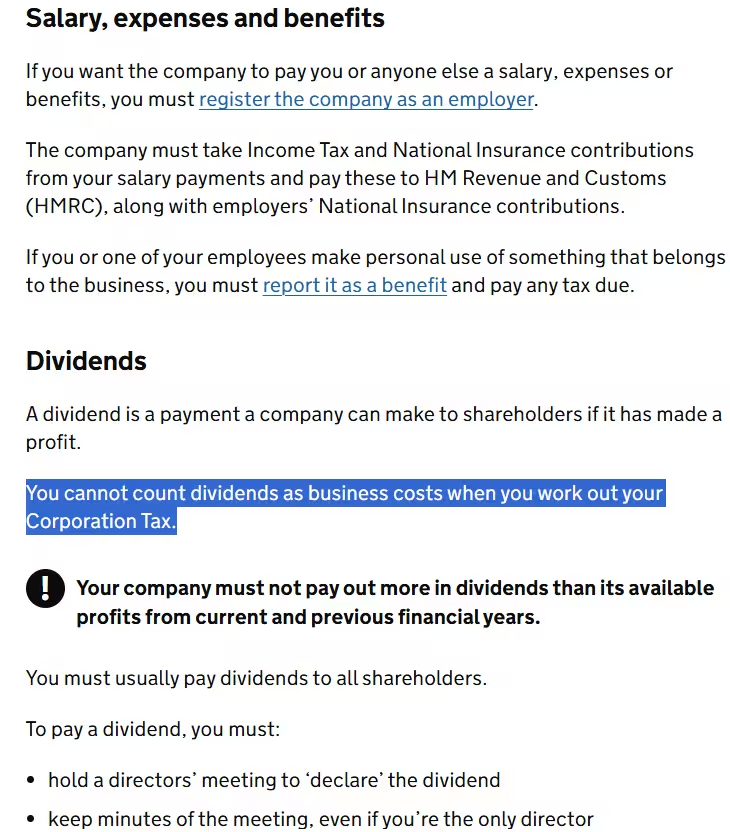
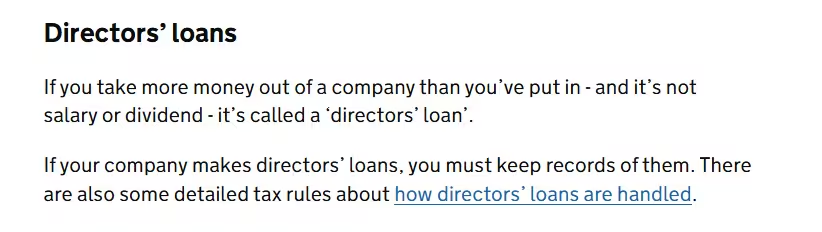
Official GOV.UK guidance explaining the different ways directors can withdraw money from a limited company.
How Much Salary Should You Pay Yourself From a Limited Company in 2026/27?
Determining the right director’s salary is one of the most important decisions when planning how much money to withdraw.
For the tax year running from 6 April 2026 to 5 April 2027, the standard Personal Allowance remains £12,570.
This means that someone with no other taxable income and their full allowance available can generally receive a salary of up to £12,570 without paying Income Tax.
However, employer National Insurance starts at a significantly lower earnings threshold.
Director’s Salary and National Insurance Thresholds for 2026/27
| Tax threshold | Annual amount | What it means |
| Personal Allowance | £12,570 | Standard tax-free personal income |
| Lower Earnings Limit | £6,708 | Relevant threshold for building a qualifying National Insurance record |
| Employer NI secondary threshold | £5,000 | Employer National Insurance generally becomes payable above this amount |
| Employee NI primary threshold | £12,570 | Employee National Insurance generally starts above this amount |
| Employee NI main rate | 8% | Generally applies to earnings between £12,570 and £50,270 |
| Employer NI rate | 15% | Generally applies to earnings above £5,000 |
| Employment Allowance | £10,500 | Maximum annual employer NI relief for eligible businesses |
These figures are based on HMRC’s published 2026/27 payroll thresholds.
One important distinction is that the company pays employer National Insurance separately from any employee National Insurance deducted from the director’s salary.
For example, a sole director receiving an annual salary of £12,570 would generally pay no employee National Insurance on that salary, but the company could have an employer National Insurance liability of:
[ (£12,570-£5,000)\times15\%=£1,135.50 ]
This £1,135.50 liability applies before any available Employment Allowance.
Which Salary Level Is Most Tax-Efficient?
Three salary levels are commonly considered.
| Annual salary | Monthly equivalent | Employer NI before relief | Main consideration |
| £5,000 | £416.67 | £0 | Avoids employer NI but normally does not produce an NI qualifying year |
| £6,708 | £559 | £256.20 | Reaches the Lower Earnings Limit |
| £12,570 | £1,047.50 | £1,135.50 | Uses the standard Personal Allowance where available |
For a company director with no other taxable income, £12,570 can produce a better overall tax result than £5,000 because the extra salary and associated employer NI generally reduce taxable company profits.
Nevertheless, the highest salary is not automatically the best solution for every company.
Other employment income, pension arrangements, low profits and administrative costs can change the calculation.
Should You Pay Yourself Through Salary or Dividends?
For many limited company directors, the most effective arrangement is to receive a relatively modest salary through PAYE and withdraw additional profits through dividends.
However, comparing the two methods requires examining both company-level tax and the tax payable by the individual.
| Feature | Salary | Dividends |
| Who receives it? | Directors or employees | Shareholders |
| Corporation Tax deduction | Generally deductible | Not deductible |
| Personal Income Tax | Standard employment income rates | Dividend tax rates |
| Employee National Insurance | Potentially payable | Not payable |
| Employer National Insurance | Potentially payable | Not payable |
| Requires company profits? | Not necessarily | Yes, sufficient distributable profits |
| Payment frequency | Usually monthly | Whenever legally declared |
| State Pension qualifying record | Can contribute | Does not contribute |
| PAYE required | Yes, where payroll reporting applies | No |
| Documentation | Payroll records and payslips | Dividend vouchers and meeting minutes |
The main advantage of salary is its treatment as a potentially deductible business expense.
For example, paying a £10,000 qualifying salary generally reduces the company’s taxable profits by £10,000, before considering associated employer National Insurance.
By contrast, dividends are distributed from profits remaining after Corporation Tax.
Consequently, comparing only the personal tax rates on salaries and dividends can be misleading.
A proper calculation includes Corporation Tax, employer National Insurance and personal dividend tax.
Why Does Employment Allowance Matter?
The Employment Allowance can substantially change the optimum salary.
Eligible businesses can reduce their annual employer National Insurance bill by up to £10,500 in 2026/27.
However, a company cannot normally claim Employment Allowance if its sole director is the only employee creating an employer Class 1 National Insurance liability.
Where another employee or director also earns above the relevant secondary threshold, the company may qualify, subject to the wider eligibility conditions.
This distinction means two limited companies generating identical profits can have different tax-efficient salary arrangements.
Luke Baldwin, an AAT Licensed Accountant, makes a similar point in his September 2026 guidance on director remuneration.
His analysis identifies other income, Employment Allowance eligibility, National Insurance history and company profitability as factors that determine the appropriate salary.
His assessment reinforces why a salary figure that works for one owner-managed company should not automatically be copied by another.
How Do You Pay Yourself a Salary From a Limited Company?
Paying yourself a salary requires your company to operate payroll and meet the relevant HMRC reporting requirements.
The process is similar to paying another employee, although directors have particular National Insurance calculation rules.
Step 1: Register Your Company as an Employer
Register for PAYE with HMRC before operating payroll, allowing sufficient time to receive the required employer references.
New business owners should also understand when to register their business with HMRC, because Corporation Tax registration and employer PAYE registration are separate obligations.
Step 2: Decide Your Annual Salary
Choose a salary based on your available Personal Allowance, other earnings, National Insurance position and company affordability.
For example, £12,570 annually represents £1,047.50 per month.
Step 3: Set Up Payroll Software
Use HMRC-recognised payroll software to record the director’s personal details, tax code and salary.
Ensure the payroll correctly identifies the employee as a company director.
Step 4: Calculate Income Tax and National Insurance
Your payroll software should calculate any PAYE Income Tax, employee National Insurance and employer National Insurance.
Unlike most employees, directors generally have National Insurance calculated using an annual earnings period, although an alternative method can be used during the year with reconciliation.
Step 5: Submit Payroll Information
Submit the required Full Payment Submission (FPS) to HMRC on or before the applicable payday, subject to the reporting exceptions.
Step 6: Transfer Your Salary
Transfer the net salary from the company’s bank account to your personal account.
Record it as a payroll payment and retain the payroll information.
Step 7: Pay HMRC
Pay any outstanding PAYE and National Insurance liabilities by the applicable deadlines.
The company should also maintain records showing its gross salary costs, employer National Insurance and payments made.
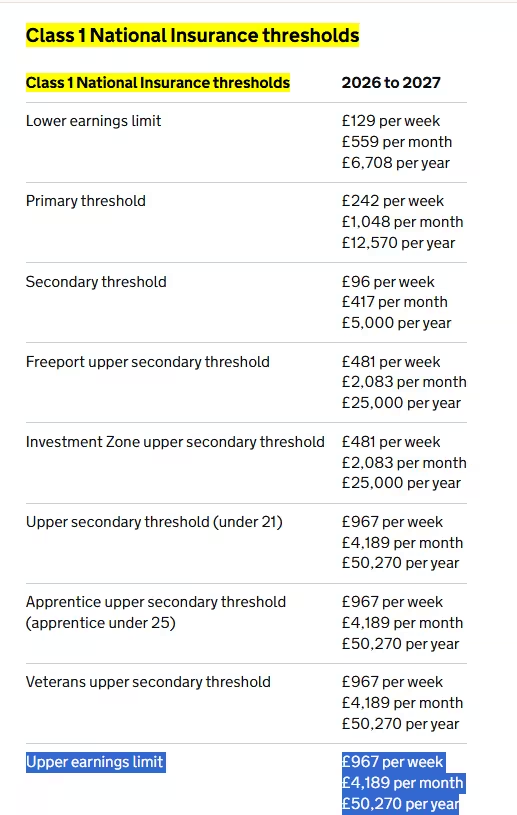
HMRC’s 2026/27 employer payroll thresholds, including director salary and National Insurance limits..
How Do Dividends Work When Paying Yourself From a Limited Company?
Dividends are payments made to shareholders using profits that are legally available for distribution.
A director who is also a shareholder may receive both salary and dividends.
However, someone who is solely a director and holds no dividend-entitled shares cannot receive dividends simply because they manage the business.
Dividends are generally paid according to share rights.
For example, where two shareholders each own 50% of the same class of ordinary shares, a £10,000 dividend distribution would ordinarily result in £5,000 for each shareholder.
Different share classes can have different rights, but payments must follow the company’s articles and applicable company law.
How Much Dividend Tax Do You Pay in 2026/27?
The Dividend Allowance remains £500 for 2026/27.
Dividend income falling within any unused Personal Allowance may also be tax-free.
Once those allowances are accounted for, the following dividend tax rates apply.
| Dividend tax band | 2025/26 | 2026/27 | Change |
| Basic rate | 8.75% | 10.75% | +2 percentage points |
| Higher rate | 33.75% | 35.75% | +2 percentage points |
| Additional rate | 39.35% | 39.35% | No change |
| Dividend Allowance | £500 | £500 | No change |
These rates apply across the UK, including Scotland, although Scottish rates for employment income differ.
For illustration, assume a director receives a £12,570 annual salary and £20,000 in dividends, with no other income.
The full salary is covered by their Personal Allowance. Of the £20,000 dividend, £500 falls within the Dividend Allowance, leaving £19,500 taxable at the basic dividend rate.
Their dividend tax calculation would be:
[ £19,500\times10.75\%=£2,096.25]
Therefore, the director receives £20,000 in dividends but has a personal dividend tax liability of £2,096.25.
The remaining dividend income after that tax is £17,903.75.
Unlike PAYE salary, personal dividend tax is not normally deducted by the company when the dividend is paid. The shareholder must account for any tax due.
For official tax rates, refer to GOV.UK’s tax on dividends guidance.
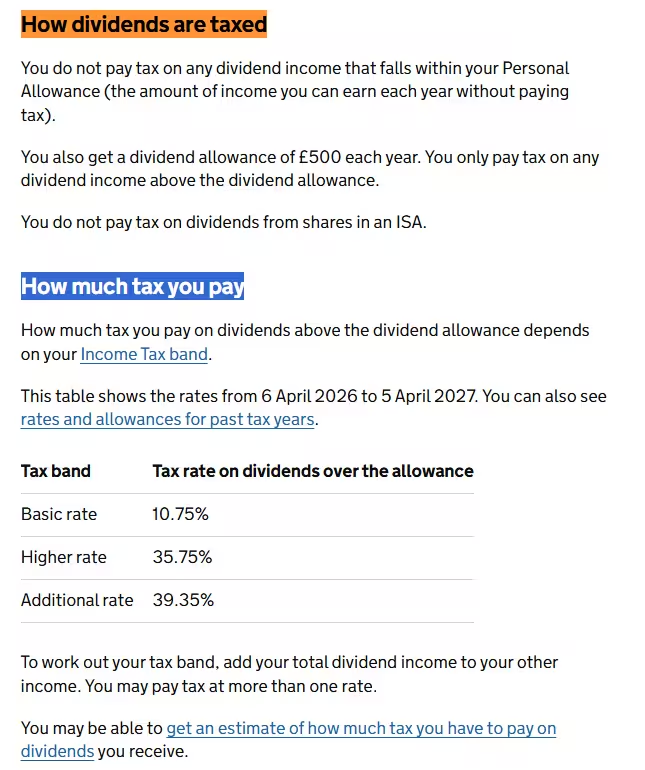
HMRC dividend tax rates for 2026/27, showing the 10.75%, 35.75% and 39.35% bands.
How Do You Legally Pay Yourself a Dividend?
Paying a dividend requires more than making a transfer from the company bank account.
The company must have sufficient distributable profits and complete the appropriate documentation.
A typical process involves:
- Check the company’s accumulated profits, allowing for losses, tax provisions and previous distributions.
- Review the accounting records to establish the amount legally available.
- Decide how much dividend to declare.
- Record the directors’ decision in meeting minutes, even where there is only one director.
- Prepare a dividend voucher showing the date, company name, shareholders and amounts.
- Pay the dividend in accordance with the relevant share rights.
- Retain the accounting and dividend documents.
Accountant Luke Baldwin specifically highlights the distinction between cash and distributable profits. A company can have substantial money in its bank account without having an equivalent amount legally available for dividends.
For example, a limited company may have £30,000 in the bank but also owe Corporation Tax, VAT, supplier invoices and other liabilities.
The bank balance alone does not establish whether the company can declare a £30,000 dividend.
A further consideration is accumulated losses. A profitable current month does not necessarily mean the company can distribute those profits if losses from earlier periods have not been covered.
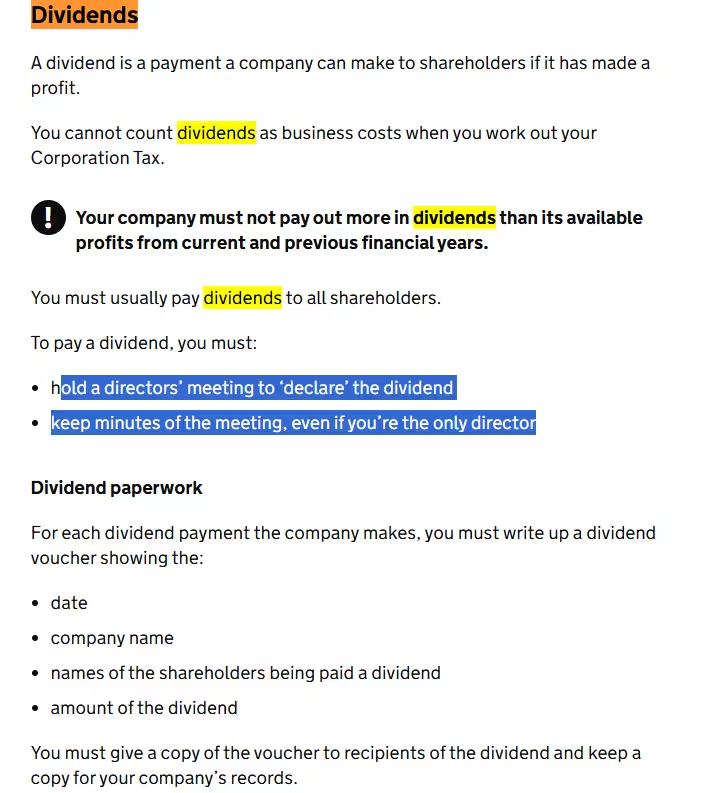
GOV.UK rules explaining the directors’ meeting minutes and dividend vouchers required when distributing company profits.
How Much Can You Take Home From a Limited Company Making £60,000 Profit?
A worked example provides a clearer understanding of how director remuneration affects the company and its owner.
Assume the following circumstances:
- The company earns £60,000 in annual profit before director salary and employer National Insurance, after other allowable expenses.
- One director owns 100% of the ordinary shares.
- The director has no other taxable income and their full Personal Allowance is available.
- The company does not qualify for Employment Allowance.
- The company has no associated companies, qualifying distributions are possible, and its tax accounting period is 12 months.
- The director takes the remaining distributable profit as dividends.
- No pension contributions, other reliefs or complicating adjustments apply.
Example: Taking £12,570 Salary and Dividends
| Calculation | Amount |
| Company profit before director remuneration | £60,000.00 |
| Director’s salary | −£12,570.00 |
| Employer National Insurance | −£1,135.50 |
| Profit before Corporation Tax | £46,294.50 |
| Corporation Tax at 19% | −£8,795.96 |
| Profit available for dividends | £37,498.54 |
| Personal dividend tax | −£3,977.34 |
| Net salary | £12,570.00 |
| Total take-home income | £46,091.20 |
In this illustration, the director receives approximately £46,091 after company Corporation Tax, employer National Insurance and personal dividend tax.
The calculation assumes the remaining taxable company profit qualifies for the 19% small profits Corporation Tax rate.
What Happens If You Choose a Lower Salary?
The following comparison uses the same £60,000 starting profit and assumptions.
| Annual salary | Employer NI | Corporation Tax | Dividend tax | Total take-home |
| £5,000 | £0 | £10,825.00 | £3,881.29 | £45,293.71 |
| £6,708 | £256.20 | £10,304.49 | £3,909.70 | £45,529.61 |
| £12,570 | £1,135.50 | £8,795.96 | £3,977.34 | £46,091.20 |
In this specific example, taking a £12,570 salary generates approximately £797 more annual take-home income than taking £5,000.
It also reaches the relevant earnings level for a National Insurance qualifying year, subject to the individual’s circumstances.
The difference occurs partly because the lower salary options leave more taxable profits inside the company. In those scenarios, the company’s profits enter the Corporation Tax marginal relief range.
These figures are illustrative calculations, not a universal recommendation. Associated companies, other income and changes to allowances can materially alter the result.
How Does Corporation Tax Affect the Money You Can Withdraw?
Corporation Tax is one of the biggest factors affecting the amount available for dividends.
For the financial year beginning 1 April 2026, standard Corporation Tax rates for qualifying companies are:
| Taxable company profits | Corporation Tax treatment |
| £50,000 or less | 19% small profits rate |
| Between £50,000 and £250,000 | Main rate with Marginal Relief, where eligible |
| Above £250,000 | 25% main rate |
The £50,000 and £250,000 limits can be reduced where a company has associated companies or a short accounting period.
This matters because the effective marginal Corporation Tax rate within the marginal relief band can reach 26.5% for qualifying companies.
A director’s salary generally reduces company profits when it meets the normal deductibility conditions. Dividends do not.
For instance, a company with £80,000 in profit before director remuneration does not necessarily have £80,000 available for dividends.
The business must first calculate deductible remuneration and other expenses, establish its Corporation Tax liability, and account for any brought-forward losses or previous distributions.
Directors who are establishing a new business should also ensure they understand their limited company registration and HMRC obligations before deciding how to distribute profits.
Can You Pay Yourself Monthly Dividends From a Limited Company?
Yes. A limited company can pay dividends monthly, quarterly, annually or at other appropriate intervals.
There is no general requirement to limit dividends to one annual payment.
However, each dividend must be properly supported by sufficient distributable profits and the required company documentation.
For example, a freelance consultant may choose to receive a fixed monthly salary of £1,047.50 and additional quarterly dividends based on business performance.
This can be more manageable than declaring a fixed monthly dividend without checking available profits.
Quarterly distributions can give the director time to review income, operating costs, tax provisions and cash reserves.
Nevertheless, a business with reliable management accounts may be able to support more frequent dividend declarations.
A consistent payment pattern does not remove the legal requirement to establish distributable profits at the time of each declaration.
Can You Pay Yourself Through a Director’s Loan?
A director’s loan occurs when you borrow money from your limited company, rather than receiving it as salary, dividends or repayment of money already owed to you.
For example, suppose you transfer £4,000 from your company’s account to your personal account.
If that payment is not an appropriately authorised dividend, salary, expense reimbursement or repayment of a credit balance, it may be recorded as money owed by you to the company.
The transaction must be recorded in a director’s loan account.
What Are the Tax Rules for Director’s Loans?
A company may face additional tax where a loan to a shareholder-director remains outstanding beyond the relevant period.
For loans within the Section 455 regime made on or after 6 April 2026, the applicable rate is 35.75%.
For example, an outstanding qualifying £10,000 loan could produce a £3,575 Section 455 tax charge if it remains unpaid beyond the relevant deadline.
HMRC generally requires the company to pay this tax nine months and one day after the end of the relevant accounting period, subject to the detailed rules.
The tax may subsequently be recoverable after a qualifying repayment, but there can be a delay.
Separate benefit-in-kind rules can also apply to beneficial loans where the relevant outstanding balance exceeds £10,000.
The 35.75% rate for loans made from 6 April 2026 is confirmed in HMRC’s Company Taxation Manual.
Ania Prochon, FMAAT, writing in 360 Accounts’ October 2026 director remuneration guidance, also emphasises that owner-directors need to keep company and personal finances separate and record loan-account transactions accurately.
Her guidance connects this record keeping directly with tax planning and avoiding unnecessary liabilities.
360 Accounts
A director’s loan should therefore not be treated as an unrestricted alternative to salary or dividends.
Can Your Limited Company Pay Into Your Pension Instead of Paying More Salary?
Yes. Employer pension contributions can be an important part of a director’s wider remuneration strategy.
Instead of paying every available pound as salary or dividends, a company may contribute directly into a registered pension scheme for its director.
Qualifying employer contributions can generally reduce the company’s taxable trading profits and do not normally attract employee or employer National Insurance.
The standard pension annual allowance for 2026/27 is £60,000, although this may be reduced in certain circumstances, including high income or previous flexible access to pension benefits.
For example, a qualifying £10,000 employer pension contribution could reduce Corporation Tax by £1,900 where the company receives full relief at 19%.
However, pension contributions are not immediately spendable personal income.
Money inside a pension is usually subject to minimum pension access-age rules. The normal minimum pension age is scheduled to increase from 55 to 57 on 6 April 2028 for most individuals.
This is particularly important for directors who are considering withdrawing a private pension before 55 to fund business expenditure.
Employer pension contributions may support long-term tax efficiency, but they should not compromise short-term business cash flow.
Can You Claim Business Expenses Instead of Paying Yourself More?
A limited company can reimburse a director for qualifying business expenses they have personally paid, subject to the applicable tax rules.
For example, you might use your personal money to pay for business software, eligible work-related travel or essential office supplies.
Where the expense is genuinely incurred for company purposes and satisfies the relevant conditions, the company can normally reimburse you without treating the repayment as salary or dividends.
The expense should be recorded with supporting evidence, such as invoices and receipts.
However, not every personal purchase becomes a legitimate business expense simply because the company pays for it.
Private expenditure, personal holidays and other non-qualifying costs can trigger tax consequences.
Separating transactions is therefore an essential part of small business financial management.
A dedicated company bank account can help directors distinguish operating expenses, reimbursements, salary and dividends.
Where additional business purchasing flexibility is necessary, it may also be useful to understand how to get a small business credit card while ensuring personal spending does not become mixed with company expenditure.
Expense reimbursement should repay legitimate costs rather than operate as a substitute for taxable remuneration.
Do You Need to Complete Self Assessment When Paying Yourself From a Limited Company?
Not every company director automatically needs to complete a Self Assessment tax return.
The obligation depends on the director’s personal circumstances, sources of income and applicable reporting requirements.
For dividends, HMRC’s current guidance distinguishes between taxable dividend income up to £10,000 and dividend income exceeding £10,000.
Where taxable dividend income is up to £10,000, someone who does not otherwise file Self Assessment may be able to report it directly to HMRC through the available reporting methods.
Where total dividend income exceeds £10,000, a Self Assessment return is generally required. Anyone already completing Self Assessment should include their dividends in the return.
Important Tax Deadlines for Directors
| Requirement | Typical deadline |
| Personal tax year ends | 5 April |
| Notify HMRC of a new Self Assessment obligation | 5 October following the relevant tax year |
| Online Self Assessment tax return | 31 January following the tax year |
| Balancing payment for Self Assessment | 31 January following the tax year |
| Second Self Assessment payment on account, where applicable | 31 July |
| Corporation Tax payment for most small companies | Nine months and one day after the accounting period ends |
| Company Tax Return | 12 months after the accounting period ends |
For example, the online Self Assessment deadline for income received during the 2026/27 tax year is normally 31 January 2028.
Directors should also budget for payments on account where applicable. These can result in a higher initial January payment than expected because part of the following year’s estimated tax is collected in advance.
What Happens If Your Limited Company Has No Profit?
A limited company that has insufficient accumulated distributable profits cannot legally declare dividends merely because the director needs personal income.
A company may still pay a commercially justifiable salary, subject to its financial position, legal obligations and ability to meet debts.
For example, a newly established consulting company could pay its director a modest salary while operating at a loss.
However, the business must consider whether it can afford that salary.
Directors should also be cautious about loans when the business is experiencing financial difficulties.
Borrowing from the company to cover personal living expenses may increase financial risk without creating sufficient resources to repay the loan.
Where a company is insolvent or approaching insolvency, directors’ duties towards creditors become particularly important.
A director should seek professional advice before extracting substantial funds from a financially distressed company.
What Are the Most Common Mistakes When Paying Yourself From a Limited Company?
Even experienced business owners can make errors when managing director remuneration.
| Common mistake | Potential consequence | Better approach |
| Taking dividends without sufficient profits | Unlawful distributions and potential repayment obligations | Check distributable profits before declaration |
| Assuming the bank balance equals profit | Cash shortages and excess distributions | Review accounts and tax provisions |
| Ignoring employer National Insurance | Unexpected payroll costs | Model salary costs before payment |
| Treating personal purchases as business expenses | Tax liabilities and accounting corrections | Keep transactions clearly separated |
| Failing to prepare dividend vouchers | Incomplete company records | Document each declaration |
| Ignoring the director’s loan account | Section 455 or benefit-in-kind liabilities | Reconcile the account regularly |
| Not reserving dividend tax | Unexpected Self Assessment payments | Maintain a separate personal tax reserve |
| Repeating an outdated salary strategy | Potentially higher combined tax | Review rates every tax year |
One particularly important mistake is continuing to use the same salary and dividend calculation after tax rules change.
The rise in employer National Insurance costs from April 2025 and the dividend tax increases introduced in April 2026 have altered the calculations for many owner-managed companies.
Consequently, older articles based on the 2024/25 or 2025/26 tax year may no longer provide an accurate answer for 2026/27.
How Can You Make Your Limited Company Payments More Tax-Efficient?
A good director remuneration strategy should consider the company’s tax position alongside the individual’s financial requirements.
The practical starting point is to calculate the company’s real profit after operating costs, assess available distributable reserves and determine how much cash the business must retain.
From there, directors can compare several possible remuneration arrangements.
For example, a business generating £80,000 in annual profit may want to model a salary of £5,000, £6,708 and £12,570, alongside various dividend and pension contribution levels.
The best result will depend on the full calculation rather than simply identifying the lowest tax rate.
Directors should also evaluate whether withdrawing all available profits is necessary.
Retaining money inside the company can help fund expansion, equipment, recruitment and periods of reduced revenue.
For businesses with fluctuating income, retaining sufficient working capital may be more valuable than maximising immediate dividend payments.
A sensible remuneration plan should also account for future obligations, including Corporation Tax, VAT where applicable, employer payroll liabilities and personal tax.
Where the director has another job, receives pension income, owns shares in multiple companies or has substantial additional taxable income, professional advice becomes especially valuable.
Frequently Asked Questions
Can I pay myself £1,000 a month from my limited company?
Yes. A limited company can pay its director £1,000 monthly through payroll, provided the company can afford it and the payment is properly recorded.
An annual salary of £12,000 generally falls below the standard Personal Allowance and employee NI primary threshold, but employer National Insurance may still apply.
Is it better to take salary or dividends from a limited company?
For many owner-directors, combining salary and dividends is more tax-efficient than relying entirely on one method.
However, company profitability, other income, pension arrangements and Employment Allowance eligibility can change the result.
Can I take all the money out of my limited company?
Not necessarily. You can withdraw funds through legitimate payment methods, but dividends must be supported by distributable profits. You also need to protect money required for tax, creditors and business obligations.
Do limited company directors pay National Insurance on dividends?
No. Dividends are not subject to employee or employer National Insurance. However, they may attract personal dividend tax once relevant allowances have been used.
Can I pay myself from my limited company without PAYE?
You can receive properly declared dividends as a shareholder without putting those dividends through payroll. However, salary payments generally require the relevant PAYE arrangements and reporting.
What is the maximum tax-free dividend in 2026/27?
The Dividend Allowance is £500. However, dividends covered by any unused Personal Allowance may also be received without Income Tax. The amount therefore depends on your

Jennifer contributes business-focused articles covering modern business trends, digital growth, entrepreneurship, and practical insights designed to support startups and SMEs.

UK Budget Savings Tax Changes 2026: New Rates, ISA Rules and How Much More Savers Could Pay?
The UK Budget savings tax changes announced on 28 October 2026 have introduced significant financial implications for millions of savers, pensioners and small business owners. From 6 April…

DWP Energy Bill Letters Dispatched: Six Million Households Could Get £150 Discount
Millions of UK households are being urged to watch their post as the Department for Work and Pensions (DWP) prepares to distribute letters concerning a £150 reduction in…
Insights for the Modern
UK Small Business.
Join 15,000+ owners receiving tactical analysis on finance, marketing, and technology. No clutter.
Zero spam. Unsubscribe in one click.