When Do I Need to Register My Business With HMRC? | UK Rules, Deadlines and Costs for 2026/27


You generally need to register with HMRC as a sole trader if your gross trading income exceeds £1,000 in a tax year.
The registration deadline is usually 5 October following the end of that tax year. If you start trading in 2026/27, your deadline will normally be 5 October 2027.
Limited companies have different obligations. They must register with Companies House and notify HMRC within three months of becoming active for Corporation Tax purposes.
Depending on your activities, you may also need separate registrations for VAT, PAYE or the Construction Industry Scheme (CIS).
When Do Different Types of Businesses Need to Register With HMRC?
| Business type | Registration requirement | Main deadline |
| Sole trader | Self Assessment when required, generally above £1,000 gross trading income | 5 October after the relevant tax year |
| Ordinary business partnership | Register the partnership and individual partners | Normally 5 October after the relevant tax year |
| Limited company | Companies House incorporation and Corporation Tax registration | Within three months of becoming active for Corporation Tax |
| Limited Liability Partnership (LLP) | Companies House, partnership tax registration and partner Self Assessment | Depends on incorporation and tax circumstances |
| VAT-liable business | VAT registration | When the applicable £90,000 threshold is exceeded or expected to be exceeded |
| Business employing staff | PAYE employer registration | Before the first payday |
| Construction contractor or subcontractor | CIS registration, where applicable | Before operating under the relevant CIS requirements |
These registrations serve different purposes. Completing one does not automatically mean that your business has satisfied every other obligation.
What Does Registering a Business With HMRC Actually Mean?
Registering your business with HM Revenue & Customs means providing the information necessary for HMRC to administer the taxes that apply to your business activities.
The registration process depends on how your business operates.
For example, a self-employed graphic designer generally registers through Self Assessment, while a limited company uses a separate Corporation Tax registration.
An employer must also consider PAYE, and businesses making taxable supplies must monitor their VAT position.
HMRC registration should not be confused with Companies House incorporation.
Companies House establishes and maintains records of companies and LLPs. HMRC administers taxes, National Insurance and related reporting obligations.
A sole trader does not normally need to incorporate a company. Instead, the individual operates the business personally and reports taxable business income as required.
A limited company is a separate legal entity. It usually has its own Corporation Tax obligations, even where the owner is its only director and shareholder.
HMRC also issues Unique Taxpayer Reference (UTR) numbers. An individual Self Assessment UTR is different from a limited company’s Corporation Tax UTR. Both usually contain ten digits, but they belong to different taxpayers.
From a practical accounting perspective, identifying the correct legal structure before registering matters because the structure determines which tax returns, records and payment obligations apply.
When Do You Need to Register as a Sole Trader With HMRC?

You generally need to register as a sole trader when your total gross self-employment income exceeds £1,000 during a tax year.
The UK tax year runs from 6 April to the following 5 April.
This rule can apply to:
- Freelancers and independent consultants
- Self-employed builders and tradespeople
- Online sellers operating a business
- Private tutors and content creators
- Delivery drivers and gig-economy workers
- People operating a side business alongside employment
- Individuals providing paid services through online platforms
The important distinction is between gross income and profit.
Gross trading income is the money your business receives before deducting expenses. Profit is the amount remaining after allowable business expenses have been deducted.
For example, imagine a self-employed photographer receives £1,500 from customers but spends £900 on allowable business expenses.
The photographer’s gross trading income is £1,500, although the resulting profit is only £600.
Because gross trading income exceeds £1,000, the person would normally need to consider Self Assessment registration even though their profit is relatively small.
However, exceeding £1,000 does not automatically mean Income Tax will be payable. The eventual liability depends on taxable profits, other income, reliefs and allowances.
Can You Start Trading Before Registering?
Yes. Sole traders can usually begin trading before completing their HMRC registration, provided they meet the relevant notification deadline.
For instance, an individual who starts freelance work in September 2026 can begin supplying services and receiving payments without first obtaining a UTR.
If registration becomes necessary for the 2026/27 tax year, the normal deadline is 5 October 2027.
However, business records should be maintained from the beginning.
Waiting until the registration deadline to organise invoices, bank transactions and expenses can make the first tax return unnecessarily difficult.
What Counts as Starting to Trade?
Starting to trade is not always identical to registering a business name, creating a website or opening a bank account.
HMRC considers the nature of the commercial activities being undertaken.
Relevant activities can include providing services, selling goods, accepting customer orders and beginning commercial operations.
Preparatory activities, such as purchasing equipment or advertising, may also be relevant, particularly when determining when a limited company becomes active.
However, these actions do not automatically establish the same trading start date in every situation.
Someone who buys a laptop and creates a website in June but does not start providing paid services until September should examine the actual facts rather than assume that the laptop purchase alone started their taxable trade.
Keeping dated records of business preparation, first contracts, invoices and payments makes the position easier to establish.
What Is the HMRC Registration Deadline for 2026/27?
For sole traders who need to notify HMRC about a new Self Assessment liability, the usual deadline is 5 October after the tax year in which that liability arose.
| Tax year | Period covered | Registration deadline | Online tax return deadline |
| 2025/26 | 6 April 2025–5 April 2026 | 5 October 2026 | 31 January 2027 |
| 2026/27 | 6 April 2026–5 April 2027 | 5 October 2027 | 31 January 2028 |
| 2027/28 | 6 April 2027–5 April 2028 | 5 October 2028 | 31 January 2029 |
Anyone who needed to register for that tax year but has not done so should act promptly rather than wait for the next registration cycle.
The normal online filing and payment deadline for the 2025/26 Self Assessment tax year remains 31 January 2027.
Those registering late may receive a different deadline for submitting their tax return, but that does not automatically extend the tax payment deadline.
What Happens If You Miss the 5 October HMRC Registration Deadline?
Missing the registration deadline does not automatically result in a fixed £100 fine.
HMRC distinguishes between failing to notify it of a tax liability, submitting a tax return late and paying tax late.
These are separate compliance issues.
What Is a Failure-to-Notify Penalty?
If you register for Self Assessment after 5 October and fail to pay the full tax liability by the following 31 January, HMRC may charge a failure-to-notify penalty.
The penalty is linked to the amount of tax remaining unpaid and depends on the circumstances, including whether the failure was careless, deliberate or otherwise subject to penalty rules.
For example, imagine somebody starts trading in August 2025 but fails to register by 5 October 2026.
They subsequently discover that they have an unpaid Income Tax liability for 2025/26.
If the liability remains unpaid after 31 January 2027, a failure-to-notify penalty may arise.
By contrast, where no tax is owed, the tax-geared failure-to-notify penalty is normally nil.
That does not mean a person can ignore a tax return that HMRC has formally required them to submit.
Is the £100 Late-Filing Penalty Different?
Yes.
The standard Self Assessment late-filing penalty is an initial £100 when a required tax return is not submitted by the applicable deadline.
Additional penalties can arise if the return remains outstanding for three, six or twelve months.
This is not the same as a failure-to-notify penalty.
For somebody registered late, HMRC may specify a later tax return filing deadline, usually three months from the date of its notification.
The person must follow the deadline actually issued by HMRC.
What About Late Payment Penalties and Interest?
Late payment can produce separate penalties and interest.
For Self Assessment liabilities outside the new Making Tax Digital penalty regime, late payment penalties can apply to amounts remaining unpaid at specified intervals after the payment deadline.
Interest is also charged on overdue tax.
Individuals within Making Tax Digital for Income Tax may instead be subject to the new late-payment penalty arrangements for the years to which those rules apply.
The most important practical distinction is that late filing, late payment and failure to notify should not be treated as interchangeable offences.
What Should You Do If You Have Already Missed the Deadline?
Take the following steps:
- Register for Self Assessment as soon as possible.
- Identify the tax years in which you had a reporting obligation.
- Reconstruct your trading income and allowable expenses using available records.
- Check whether HMRC has issued a specific tax return deadline.
- Calculate the tax owed and arrange payment as soon as possible.
- Contact HMRC if you cannot pay the full amount.
- Consider professional advice if several years are outstanding or undeclared tax is substantial.
If earlier tax years were omitted, simply registering for the current year may not resolve historic liabilities.
Depending on the circumstances, a voluntary disclosure and correction of past tax affairs may be necessary.
The professional approach is to distinguish the registration failure from the tax calculation itself. That helps a taxpayer address the correct problem and avoids assuming that paying a £100 penalty resolves everything.
Do You Need to Register With HMRC If You Earn Less Than £1,000?
Usually not, where your total eligible gross trading income is £1,000 or less for the tax year and no other reporting requirement applies.
However, some individuals may still need or choose to register.
HMRC identifies circumstances including:
- Needing proof of self-employment, such as for Tax-Free Childcare
- Making voluntary Class 2 National Insurance contributions
- Registering as a subcontractor under CIS
- Registering as a share fisher
- Having another reason to complete a Self Assessment tax return
An individual already registered for Self Assessment because of another source of income may still need to register their new self-employed activity separately with HMRC.
For example, someone who previously filed Self Assessment because they had rental income should not assume HMRC automatically knows that they have started working as a sole trader.
Does the £1,000 Allowance Apply to Each Side Hustle Separately?
No.
The trading allowance generally applies to the combined eligible gross trading income of the individual, rather than providing a separate £1,000 exemption for each activity or platform.
Consider an individual who earns:
| Income source | Annual gross income |
| Freelance design | £650 |
| Online tutoring | £450 |
| Total | £1,100 |
The combined income is £1,100.
The individual has therefore exceeded the £1,000 trading threshold, even though neither activity individually generated more than £1,000.
How Does the £1,000 Trading Allowance Work?
The trading allowance offers two important forms of relief.
Full relief: Where eligible gross trading income does not exceed £1,000, it can generally be exempt from Income Tax without a tax return being required solely for that income.
Partial relief: Where gross income exceeds £1,000, qualifying individuals may elect to deduct the £1,000 allowance instead of their actual business expenses.
You cannot normally deduct the £1,000 trading allowance and your actual expenses against the same trading income.
Trading Allowance Versus Actual Expenses
Imagine two self-employed people each generate £5,000 of gross income.
| Calculation | Business A | Business B |
| Gross trading income | £5,000 | £5,000 |
| Actual allowable expenses | £700 | £2,200 |
| Profit using actual expenses | £4,300 | £2,800 |
| Profit using £1,000 allowance | £4,000 | £4,000 |
| Lower taxable profit method | Trading allowance | Actual expenses |
Business A benefits from claiming the £1,000 allowance because its actual expenses are lower.
Business B benefits from claiming actual expenses because they exceed £1,000.
The calculation should be reviewed before submitting the tax return, rather than automatically assuming the allowance produces the greatest tax saving.
When Is the Trading Allowance Not Available?
Important restrictions apply.
The trading allowance does not generally cover an individual’s share of partnership trading income.
It also does not replace Rent a Room relief, and income from certain connected parties, including an employer or a company in which the individual has a relevant interest, may be excluded.
Limited companies cannot claim an individual’s £1,000 trading allowance against their Corporation Tax profits.
Is the Property Allowance Separate?
Yes.
Individuals may also have a separate £1,000 property income allowance for eligible property receipts.
For example, a person could have £900 of eligible freelance income and £800 of eligible property income.
The trading and property allowances are separate, subject to their respective conditions.
However, landlords must examine whether property income reporting, Rent a Room relief, mortgage-related rules or other tax obligations change the position.
Do Sole Traders Have to Pay National Insurance in 2026/27?
Registering as self-employed also affects National Insurance records and potential Class 2 or Class 4 contributions.
The rules are based primarily on profits, rather than the £1,000 gross trading income threshold.
Class 2 National Insurance
For the 2026/27 tax year:
- Profits of £7,105 or more: Class 2 contributions are generally treated as paid for qualifying-benefit purposes without an actual Class 2 payment.
- Profits below £7,105: Eligible people may choose to pay voluntary Class 2 contributions.
- Voluntary Class 2 rate: £3.65 per week.
Voluntary contributions can be important for individuals seeking to protect their National Insurance record and potential State Pension entitlement.
However, paying voluntary contributions is not automatically necessary for everyone. The value depends on the person’s existing record and eligibility.
Class 4 National Insurance
For 2026/27, Class 4 contributions generally apply to self-employed profits as follows:
| Annual profit band | Class 4 rate |
| Up to £12,570 | 0% |
| Above £12,570 up to £50,270 | 6% |
| Above £50,270 | 2% |
An individual can therefore exceed the £1,000 trading income threshold and need Self Assessment registration without necessarily owing Class 4 National Insurance.
This is another reason why registration thresholds, taxable profits and National Insurance thresholds should be considered separately.
When Must a Limited Company Register for Corporation Tax?
A limited company must be incorporated through Companies House before it can operate as that legal entity.
However, incorporation and becoming active for Corporation Tax are not necessarily the same event.
A company that has been incorporated but remains dormant may not immediately need to report active trading to HMRC.
Once the company becomes active and falls within the charge to Corporation Tax, it must normally notify HMRC within three months of the start of its relevant tax accounting period.
What Counts as a Company Becoming Active?
Potential activities include:
- Selling goods or providing services
- Beginning a commercial trade
- Employing staff
- Buying and selling stock commercially
- Managing business investments or receiving relevant income
- Undertaking other activities that bring the company within Corporation Tax
The date should be determined from the facts of the company’s activities.
For instance, a company incorporated in June 2026 that remains genuinely dormant until September 2026 would not automatically start its Corporation Tax notification period on the June incorporation date.
The applicable deadline would need to be calculated from when it became active for Corporation Tax purposes.
What Does HMRC Send After Incorporation?
Following incorporation, HMRC normally sends a company UTR to the registered office address.
This reference is needed to access the company’s Corporation Tax services and communicate with HMRC.
If the company UTR has not arrived within approximately 15 working days, the director can request it using HMRC’s online service.
Receiving the UTR does not mean every Corporation Tax registration task is complete.
Directors still need to ensure HMRC has been notified of the company’s active status where required.
Once active, a company must also manage its Corporation Tax payment deadlines, company tax returns, statutory accounts and Companies House filings.
Do Directors Need Personal Self Assessment Registration?
Not automatically.
Being a limited company director does not, by itself, mean every director must file a personal Self Assessment tax return.
However, directors may need Self Assessment because of untaxed income, dividends, separate self-employment or other circumstances.
A director’s personal tax position should be assessed independently of the company’s Corporation Tax obligations.
Do Company Directors Need Companies House Identity Verification in 2026?
Yes. Mandatory identity verification began on 18 November 2025 for new directors and people with significant control (PSCs), with a phased transition for people already in those roles.
Existing directors generally need to provide their Companies House personal code when their company files its next confirmation statement during the transition period.
Existing PSCs have separate requirements and applicable 14-day periods depending on their circumstances.
The initial 12-month transition runs from 18 November 2025 into November 2026.
Business owners should not assume everyone has one identical November 2026 deadline. The applicable date can depend on the company’s confirmation statement and the person’s position.
How Do You Verify Your Identity?
Verification can be completed through:
- GOV.UK One Login
- An Authorised Corporate Service Provider (ACSP), such as an eligible registered professional firm
Once verification has been completed, Companies House issues a personal code.
That code can be used to connect a verified identity with relevant company appointments.
Identity verification is generally required only once, although the individual may need to provide the code for multiple company roles.
Failure to meet the requirements can lead to filing problems, restrictions on appointments, enforcement action and financial penalties.
Directors should also check whether the identity-verification information recorded for PSC roles has been submitted correctly.
Identity verification does not replace Corporation Tax registration. It is a separate legal compliance requirement.
Do Partnerships and LLPs Need to Register With HMRC?
Yes, where the relevant tax-registration conditions are met.
An ordinary business partnership generally needs to register with HMRC, while each partner registers individually for Self Assessment.
A nominated partner is responsible for managing the partnership’s reporting obligations, including the partnership tax return.
Partnership profits are generally allocated between the partners according to the applicable arrangements, and individual partners report their shares on their own tax returns.
LLPs have additional requirements because they are registered legal entities at Companies House.
Most trading LLPs are taxed transparently as partnerships, although particular circumstances can produce different tax treatment.
An LLP’s Companies House registration does not automatically satisfy all HMRC requirements.
Partnership owners should agree profit-sharing arrangements, record-keeping responsibilities and reporting duties from the beginning.
When Do You Need to Register for VAT?
VAT registration becomes mandatory when a business’s taxable turnover exceeds £90,000 over a rolling 12-month period, subject to the applicable rules.
The calculation is not limited to a calendar year or the tax year ending in April.
Businesses must monitor taxable turnover on an ongoing basis.
What Is the Rolling 12-Month Rule?
Imagine that a business reviews its taxable sales at the end of October 2026.
If its total taxable turnover for the previous 12 months has exceeded £90,000 for the first time, it will usually have to register for VAT.
For the historic turnover test, a business generally has 30 days from the end of the month in which it crossed the threshold to notify HMRC.
The effective date of registration is normally the first day of the second month after the threshold was exceeded.
This means the business should not wait until its next annual accounts are completed.
What Is the Forward-Looking 30-Day VAT Rule?
VAT registration may also be required when a business expects its taxable turnover to exceed £90,000 in the next 30 days alone.
Suppose a business agrees to supply goods worth £110,000 under a single contract to be fulfilled within the next month.
Even if its previous 12-month turnover was relatively small, the forward-looking rule could trigger registration.
When this rule applies, the business normally has until the end of the relevant 30-day period to register, with the effective registration date generally being the date on which it first formed the expectation.
What Is the VAT Deregistration Threshold?
The VAT deregistration threshold is £88,000.
A VAT-registered business may be able to apply to cancel registration if its expected taxable turnover over the coming 12 months is below £88,000 and the other conditions are met.
The lower deregistration threshold should not be confused with the £90,000 mandatory registration threshold.
Can a Business Register for VAT Voluntarily?
Yes.
Businesses below the mandatory threshold can apply voluntarily.
Potential advantages include reclaiming qualifying input VAT and being able to issue VAT invoices to VAT-registered customers.
However, voluntary registration can also increase administration and affect pricing for customers who cannot recover VAT.
A VAT decision should therefore consider the business’s customer base, purchasing costs, pricing structure and cash flow.
Do Overseas Businesses Have a Different VAT Threshold?
Some businesses established outside the UK have to register for VAT from their first relevant taxable supply in the UK, without benefiting from the standard £90,000 threshold.
The exact treatment depends on where the business is established, the type of supply, its place of supply and any marketplace rules.
Non-UK sellers should not assume that the ordinary UK small-business VAT threshold applies automatically.
When Must You Register as an Employer for PAYE?
Businesses that employ staff must normally register as an employer with HMRC before paying employees through PAYE.
This requirement is separate from Self Assessment, Corporation Tax and VAT registration.
PAYE may also apply where a limited company pays its director a salary.
Employers must register before their first payday but cannot register more than two months before they begin paying people.
After registration, HMRC issues an employer PAYE reference and an Accounts Office reference.
The business then uses payroll software to calculate relevant deductions and submit payroll information.
What If Your PAYE Reference Has Not Arrived?
If the first payday arrives before the employer PAYE reference has been received, HMRC instructs businesses to:
- Run payroll and calculate the payment and deductions.
- Store the Full Payment Submission (FPS).
- Submit the FPS once the PAYE reference arrives, selecting the appropriate late-reporting reason.
Employers should not ignore the payment or assume that payroll reporting is unnecessary simply because the reference has been delayed.
Separate rules also apply to employers using construction subcontractors, including CIS obligations.
Do Construction Businesses Need CIS Registration?
The Construction Industry Scheme applies to certain payments made by contractors to subcontractors for construction work.
A business operating as a CIS contractor must register appropriately before paying subcontractors under the scheme.
Subcontractors should also consider CIS registration because their registration status can affect the deduction rate applied to payments.
CIS registration is not a substitute for registering a sole trade, partnership or company for its ordinary tax obligations.
A self-employed subcontractor may need both Self Assessment and CIS registration.
Similarly, a building company paying subcontractors can have Corporation Tax, PAYE, VAT and CIS responsibilities simultaneously.
Is Making Tax Digital Mandatory in 2026?
Yes. Making Tax Digital for Income Tax became mandatory on 6 April 2026 for qualifying sole traders and landlords.
It is no longer an entirely future programme.
The rollout is based on an individual’s qualifying gross income from self-employment and property.
| Income assessed in tax year | Qualifying income | MTD start date |
| 2024/25 | Over £50,000 | 6 April 2026 |
| 2025/26 | Over £30,000 | 6 April 2027 |
| 2026/27 | Over £20,000 | 6 April 2028 |
These thresholds apply to qualifying gross income before deducting business expenses, not taxable profit.
For example, a self-employed consultant with £42,000 of gross trading income and £16,000 of gross rental income could have £58,000 of combined qualifying income.
That could put them within the applicable MTD threshold even though their combined taxable profit is substantially lower.
Other income, such as PAYE employment earnings, is not normally added to qualifying self-employment and property receipts for this particular threshold test.
Readers can check their position using HMRC’s Making Tax Digital eligibility guidance.
What Do Businesses Have to Do Under MTD?
People required to use MTD for Income Tax must generally:
- Keep appropriate digital income and expense records
- Use compatible software
- Send quarterly updates to HMRC
- Complete the required annual Income Tax return
- Pay Income Tax and National Insurance by the applicable deadlines
Quarterly updates summarise business and property income and expenses. They are not four separate final tax returns.
There is also no general requirement to pay Income Tax every quarter merely because quarterly digital updates are submitted.
Kirsty St John, of Kirsty’s Counting Service, described the importance of accurate bookkeeping in HMRC’s published 2025/26 annual report, stating, “The bookkeeping is going to be key to this.”
Her observation reflects a practical benefit of keeping records current: discrepancies can be identified closer to the transaction date instead of being reconstructed long after the financial year has ended.
For small-business owners, this also means that bookkeeping software should be assessed for suitability before choosing a product based solely on price.
What Are the MTD Quarterly Reporting Deadlines?
For individuals who entered MTD in April 2026, the standard quarterly deadlines are:
| Quarterly update | Deadline |
| First quarterly update | 7 August 2026 |
| Second quarterly update | 7 November 2026 |
| Third quarterly update | 7 February 2027 |
| Fourth quarterly update | 7 May 2027 |
| Annual 2026/27 tax return | 31 January 2028 |
As of now, the first quarterly deadline has passed.
The next scheduled quarterly update deadline is 7 November 2026.
HMRC permits standard tax-year or calendar update periods according to the relevant arrangements, but the submission deadline dates above are the same.
Are There MTD Penalties in the First Year?
HMRC is not applying penalty points for late quarterly updates relating to the 2026/27 tax year.
This transitional treatment does not remove the requirement to maintain digital records and submit the updates.
The new late-submission penalty rules can still apply to relevant annual tax returns, and late-payment penalties and interest remain important.
From the 2027/28 tax year, quarterly updates that are submitted late can attract penalty points.
Under the normal quarterly submission regime, reaching four penalty points results in a £200 penalty, with further £200 penalties possible for subsequent missed deadlines while the threshold remains reached.
Is HMRC Automatically Registering Eligible Businesses for MTD?
From September 2026, HMRC began a phased process of signing up some eligible taxpayers who had not enrolled themselves.
HMRC contacts affected individuals after they have been signed up.
However, automatic enrolment should not be treated as a guarantee that every eligible person has completed all their MTD preparations.
They still need to confirm their status, arrange compatible software and understand their reporting responsibilities.
How Much Does It Cost to Register a Business in the UK?
Registering directly for Self Assessment with HMRC is free.
HMRC also does not normally charge a registration fee for its standard Corporation Tax, PAYE and VAT registration services.
Companies House incorporation involves a separate statutory fee.
The current standard Companies House fees changed on 1 February 2026.
| Registration or filing | Standard fee |
| Sole trader Self Assessment registration | Free |
| Corporation Tax registration with HMRC | Free |
| VAT registration with HMRC | Free |
| PAYE employer registration with HMRC | Free |
| Standard digital limited company incorporation | £100 |
| Standard paper limited company incorporation | £124 |
| Same-day digital incorporation through eligible software | £156 |
| Digital confirmation statement | £50 |
The £100 online incorporation fee replaced the earlier £50 figure.
The £50 confirmation statement fee is a separate filing fee, not the standard company incorporation fee.
Fees paid to accountants, formation agents, registered office providers or bookkeeping software companies are additional commercial charges rather than ordinary HMRC registration fees.
Which Business Address Should You Use When Registering?
Address requirements depend on the type of business and the registration being completed.
Sole Trader Address
A sole trader generally provides relevant personal and business contact information to HMRC.
Many sole traders operate from their residential address.
Although sole traders do not normally have a Companies House public registered office, they should still consider the privacy implications of displaying addresses on websites, invoices and other business materials.
Limited Company Registered Office
Limited companies must provide an appropriate registered office address in the UK, in the country where the company is registered.
The address must be capable of receiving official communications, and documents delivered there must be capable of reaching someone acting for the company.
A Royal Mail PO Box cannot be used as the registered office.
A suitable accountant’s address or authorised registered office provider may be used if the requirements are satisfied.
Is Your Home Address Public?
A limited company’s registered office address is publicly available on Companies House.
A director’s service address is also public.
However, the director’s usual residential address is generally protected from ordinary public access when provided separately to Companies House, subject to statutory disclosure rules.
If a director uses their home as the registered office or public service address, that address may become publicly visible.
Therefore, owners concerned about privacy should arrange an appropriate alternative address before incorporation.
Companies must also provide a registered email address to Companies House, but that email address is not displayed publicly.
What Records Must You Keep After Registering With HMRC?
Accurate business records are essential for tax returns, VAT calculations, expense claims and responding to HMRC enquiries.
Depending on the nature of the business, records may include:
- Sales invoices and payment confirmations
- Purchase receipts and supplier invoices
- Business bank statements
- Cash sales and expenditure records
- Mileage and business travel records
- Payroll and employee payment information
- VAT invoices and VAT returns
- Contracts and other relevant financial documents
- Details supporting income and expense calculations
How Long Must Sole Traders Keep Records?
Self-employed individuals normally need to retain records for at least five years after the 31 January Self Assessment filing deadline for the relevant tax year.
For example, records supporting the 2025/26 tax return, normally due on 31 January 2027, should generally be kept until at least 31 January 2032.
Longer periods may apply where returns are submitted very late or an HMRC enquiry remains unresolved.
How Long Must Limited Companies Keep Records?
For Corporation Tax purposes, companies generally need to retain relevant records for at least six years from the end of the relevant accounting period, subject to circumstances requiring longer retention.
VAT records generally also need to be retained for at least six years, unless a different period applies.
Digital copies can be useful, but the business must ensure that records remain accurate, accessible and securely stored.
Do Online Sellers, Influencers and Landlords Need HMRC Registration?
Different income-generating activities can create different tax obligations.
Vinted, eBay and Etsy Sellers
Selling personal possessions occasionally is not automatically the same as operating a trade.
For example, someone who sells their old clothes on Vinted is not necessarily running a business.
However, regularly buying products with the intention of reselling them for profit can constitute trading.
If the gross receipts from an individual’s eligible trading activities exceed £1,000 in a tax year, Self Assessment registration may be required.
Online marketplaces may report information about sellers to tax authorities, but platform reporting does not itself introduce a new tax or automatically make every seller taxable.
The nature of the transactions remains important.
Freelancers, Gig Workers and Delivery Drivers
Self-employed freelancers and gig workers should combine their relevant gross trading receipts when checking the £1,000 threshold.
For example, a rider who receives £750 through one delivery platform and £500 through another would have £1,250 in combined gross delivery income.
The business expenses may reduce taxable profit, but they do not normally reduce gross receipts for the initial trading allowance threshold.
Delivery drivers should also account for vehicle costs, insurance, fuel and equipment.
A more detailed breakdown of Deliveroo driver earnings and self-employment tax obligations illustrates why platform payments should not be confused with take-home profit.
Influencers and Content Creators
Creators can generate taxable income through advertising, sponsorships, affiliate commissions, subscriptions and commercial services.
Some non-cash benefits, including products received in return for promotional work, may also require tax consideration depending on the arrangements.
Influencers should record income across platforms rather than assess each revenue stream in isolation.
Landlords
Rental income is not automatically treated as ordinary sole-trader income.
Landlords normally consider property income rules and the separate property allowance.
Those with significant qualifying rental income must also assess their position under Making Tax Digital for Income Tax.
Non-UK Residents
Living outside the UK does not necessarily remove UK tax obligations.
Individuals receiving UK rental income, carrying out relevant UK business activities or operating UK companies may still have tax-registration requirements.
Non-resident landlords must also consider the Non-resident Landlord Scheme.
VAT registration can be particularly important for overseas businesses supplying goods or services in the UK.
International taxpayers should assess UK residence rules, business establishment, double-taxation agreements and the precise nature of UK-source income before selecting a registration route.
How Do You Register Your Business With HMRC Step by Step?
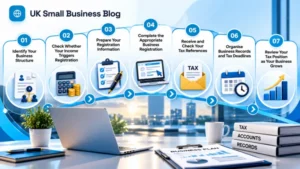
The registration process depends on your business structure, but most small businesses can complete their initial HMRC registration online.
Step 1: Identify Your Business Structure
Decide whether you are operating as a sole trader, ordinary partnership, LLP or limited company.
This determines which registrations are required.
Step 2: Check Whether Your Income Triggers Registration
Sole traders should calculate gross trading income for the relevant tax year.
Limited companies should determine whether they are active for Corporation Tax purposes.
All businesses should consider VAT, payroll and industry-specific obligations separately.
Step 3: Prepare Your Information
You may need:
- National Insurance number, where applicable
- Personal identification and contact details
- Trading name or registered company name
- Business commencement date
- Business address
- Description of business activities
- Government Gateway sign-in details
- Company number and UTR, where relevant
Different registration services request different information.
Step 4: Complete the Appropriate Registration
Sole traders can use HMRC’s official register as a sole trader service.
Limited companies should ensure the company has been incorporated and complete the relevant Corporation Tax registration requirements.
Partnerships should register the partnership and ensure the relevant partners complete their individual registrations.
Step 5: Receive and Check Your Tax References
HMRC normally issues a UTR after registration.
The reference may be sent by post or be available through the relevant online tax account, depending on the circumstances.
HMRC says an individual UTR will usually arrive around 15 days after registration, although international delivery and other circumstances can take longer.
Businesses should verify that the correct registrations have been completed instead of assuming that receipt of one reference covers all taxes.
Step 6: Organise Records and Calendar Deadlines
Create a system for tracking income, expenses, VAT, payroll and tax returns.
For businesses within Making Tax Digital, compatible digital record-keeping arrangements are required.
Step 7: Review Your Tax Position as the Business Grows
Growth can create new registration obligations.
For example, a sole trader may eventually need VAT registration, PAYE registration when hiring employees, or additional compliance work when changing to a limited company.
Business registration should therefore be reviewed when circumstances change, not treated as a once-only administrative exercise.
Can You Switch From a Sole Trader to a Limited Company?
Yes. Many UK businesses begin as sole traders and later incorporate.
However, changing to a limited company involves creating a separate legal entity rather than simply converting the existing Self Assessment registration into Corporation Tax registration.
The usual process includes:
- Incorporating a limited company through Companies House.
- Completing the required director identity verification.
- Opening appropriate company banking and accounting arrangements.
- Establishing the company’s active date for Corporation Tax.
- Transferring relevant business activities and assets where appropriate.
- Considering VAT registration or transfer arrangements.
- Reviewing PAYE if the company will pay salaries.
- Notifying HMRC if the previous sole-trader activity has ended.
- Completing any outstanding personal Self Assessment obligations.
The transfer of business assets, stock, goodwill or property may have tax implications.
Incorporating can offer limited liability and different remuneration arrangements, but it also creates additional administration, reporting costs and director responsibilities.
The decision should therefore consider actual business risks, expected profits and operating requirements rather than assuming that limited-company status always produces a lower tax bill.
Which HMRC Registrations Does Your Business Need?
The following table helps identify common registrations.
| Your situation | Registration to consider | Important distinction |
| Self-employed with more than £1,000 eligible gross trading income | Self Assessment | Registration threshold uses gross income |
| Starting a limited company | Companies House | Incorporation is separate from tax registration |
| Limited company begins relevant business activities | Corporation Tax | Normally notify HMRC within three months |
| Trading partnership | Partnership and partner Self Assessment | Partnership and individuals have separate obligations |
| Taxable turnover exceeds £90,000 | VAT | Rolling 12-month and forward-looking tests apply |
| Employing staff or paying a director through PAYE | Employer PAYE | Register before first payday |
| Operating as a construction contractor | CIS | Additional construction-industry rules |
| Working as a construction subcontractor | CIS | Registration can affect tax deductions |
| Sole trader or landlord exceeds the applicable MTD threshold | Making Tax Digital for Income Tax | Requires compatible software and quarterly updates |
Some businesses need several of these registrations at the same time.
For example, an established building company could be incorporated with Companies House, registered for Corporation Tax, VAT and PAYE, and operating under CIS.
The registrations are complementary rather than alternatives.
What Are the Important HMRC Dates for Small Businesses in 2026 and 2027?
| Date | Requirement or event |
| 5 October 2026 | Self Assessment registration deadline for relevant 2025/26 liabilities — now passed |
| 31 October 2026 | Normal deadline for 2025/26 paper Self Assessment returns |
| 7 November 2026 | Second MTD quarterly update deadline |
| November 2026 | End of the initial Companies House identity-verification transition; check individual deadlines |
| 31 January 2027 | Normal online Self Assessment filing and payment deadline for 2025/26 |
| 7 February 2027 | Third MTD quarterly update deadline |
| 6 April 2027 | MTD expansion to qualifying income over £30,000 |
| 7 May 2027 | Fourth MTD quarterly update deadline for 2026/27 |
| 5 October 2027 | Self Assessment registration deadline for relevant 2026/27 liabilities |
| 31 January 2028 | Normal online Self Assessment filing and payment deadline for 2026/27 |
| 6 April 2028 | MTD expansion to qualifying income over £20,000 |
These are general dates. Company accounting periods, VAT dates, PAYE payment dates and any individually notified filing deadlines may differ.
Frequently Asked Questions
Can I Register My Business With HMRC Before Earning Money?
Yes. You can generally register a sole trade before generating significant income, although the requirement to register depends on your circumstances. You should identify an accurate business start date.
Is HMRC Registration Free for Sole Traders?
Yes. Registering directly for Self Assessment is free. Accountants and registration agents may charge for their services.
Can I Work Full-Time and Also Register as Self-Employed?
Yes. You can operate a side business alongside employment. You may need Self Assessment for the separate trading income even though PAYE is already deducted from your salary.
Do I Need to Register If My Business Makes a Loss?
Possibly. The usual £1,000 trading threshold is measured using eligible gross income before expenses. A business can exceed the threshold while making little or no profit.
What Happens If I Register With HMRC After 5 October?
You may face a failure-to-notify penalty if relevant tax remains unpaid after 31 January. HMRC may give late registrants a different tax return deadline, but the payment deadline normally remains unchanged.
Do I Need a Business Bank Account Before HMRC Registration?
Not normally for sole traders. However, keeping business transactions separate is helpful. Limited companies should maintain appropriate banking arrangements because the company is a separate legal entity.
Do I Need to Register a Small Online Shop With HMRC?
If you are trading and your eligible gross trading receipts exceed £1,000 in the tax year, you will normally need to consider Self Assessment registration. Selling personal possessions does not automatically constitute trading.
Does Registering With Companies House Automatically Register My Business for Corporation Tax?
No. Incorporation and active Corporation Tax notification are separate matters, although HMRC generally receives company incorporation information and issues a company UTR.
Is Making Tax Digital Mandatory for Everyone Who Is Self-Employed?
No. It is being introduced in stages, based on qualifying self-employment and property income, with exemptions and other eligibility conditions.
Can I Use My Home Address to Register a Limited Company?
Yes, if it satisfies the registered office requirements. However, a company’s registered office address is public, so an appropriate alternative address may offer greater privacy.

Jennifer contributes business-focused articles covering modern business trends, digital growth, entrepreneurship, and practical insights designed to support startups and SMEs.

How to Start Digital Marketing From Home in the UK: Complete Beginner’s Guide
Starting digital marketing from home in the UK is possible without a marketing degree, expensive equipment or previous agency experience. However, building a successful freelance business or remote…
Insights for the Modern
UK Small Business.
Join 15,000+ owners receiving tactical analysis on finance, marketing, and technology. No clutter.
Zero spam. Unsubscribe in one click.