John Healey £100 Energy Support: Who Qualifies and When Will Payments Arrive?

John Healey’s £100 energy support payment will provide one-off financial assistance to eligible households in England from January 2027.
Announced in the Autumn Budget on 28 October 2026, the Household Energy Payment is expected to benefit up to 20 million households living in properties within council tax bands A to D.
The government has allocated approximately £2.6 billion to the wider payment programme, alongside an additional £100 million discretionary fund for English councils to assist vulnerable households that fall outside the main eligibility criteria.
However, with energy bills forecast to increase significantly in January 2027, concerns are growing over whether the payment will provide sufficient financial protection throughout the winter.
Households need to understand how the payment works, whether they qualify automatically and what additional assistance they could receive.
What Is John Healey’s £100 Energy Support Payment?
The Household Energy Payment is a temporary financial support measure introduced to help households manage rising gas and electricity costs during the 2026/27 winter.
Unlike an energy supplier discount, the £100 payment is being administered through the council tax system, with eligible residents expected to receive the money directly.
The scheme forms part of a wider government strategy to reduce immediate living costs while introducing longer-term reforms to the UK’s energy market.
| Payment details | Confirmed information |
| Official scheme name | Household Energy Payment |
| Payment amount | £100 |
| Announcement date | 28 October 2026 |
| Payment start date | January 2027 |
| Eligible council tax bands | A, B, C and D |
| Estimated beneficiaries | Up to 20 million households |
| Payment frequency | One-off |
| Main scheme location | England |
| Wider programme funding | Approximately £2.6 billion |
| Discretionary council funding | £100 million |
| Payment administrator | Local authorities |
The payment is not a new Universal Credit benefit, pension increase or recurring monthly energy allowance.
It is designed to provide temporary financial relief during a period of elevated household expenditure.
Who Is Eligible for the £100 Energy Support Payment?
Eligibility primarily depends on the council tax classification of a household’s main residence rather than its annual income or employment status.
Under the government’s announced criteria, households must generally occupy their main home in England, fall within council tax bands A to D and be responsible for council tax, subject to provisions for exempt households.
Eligibility by Council Tax Band
| Council tax band | Standard £100 payment eligibility |
| Band A | Eligible, subject to scheme conditions |
| Band B | Eligible, subject to scheme conditions |
| Band C | Eligible, subject to scheme conditions |
| Band D | Eligible, subject to scheme conditions |
| Band E | Discretionary support may be available |
| Band F | Discretionary support may be available |
| Band G | Discretionary support may be available |
| Band H | Discretionary support may be available |
A household does not necessarily need to receive means-tested benefits to qualify.
This means working families, pensioners, self-employed individuals and households with relatively higher incomes could all receive the payment if they satisfy the property-related conditions.
Properties Excluded From the Main Scheme
The main eligibility rules exclude second homes, unoccupied properties and households where residents are not responsible for council tax, subject to the final scheme guidance.
Most council tax-exempt households are expected to be included, although detailed arrangements are still being finalised.
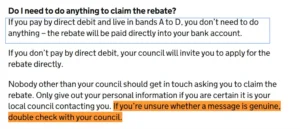
Government eligibility guidance confirming the £100 Household Energy Payment for qualifying properties in council tax bands A to D.
When Will the £100 Energy Payment Be Paid?
The government has confirmed that local authorities are expected to begin distributing payments from January 2027.
The timing has been selected to coincide with the colder winter months, when household heating demand is generally at its highest.
| Period | Expected development |
| 28 October 2026 | Payment announced in the Autumn Budget |
| November–December 2026 | Councils prepare payment systems and administrative arrangements |
| January 2027 | Payments expected to begin |
| Early 2027 | Remaining applications and discretionary support arrangements |
There is currently no single nationwide payment date on which every qualifying household is guaranteed to receive £100.
Processing times could vary between councils, particularly where bank account details need to be verified or residents are required to complete an application.
Households should monitor their local authority’s website for payment announcements rather than assume the money will arrive on 1 January.
How Can Households Claim the £100 Energy Support?
The application process will depend largely on how residents currently pay their council tax.
Households Paying by Direct Debit
Eligible residents who already pay their council tax through Direct Debit are expected to receive the payment automatically into their bank accounts.
Using existing council tax records should reduce administrative delays and remove the need for many households to submit separate applications.
Households Using Other Payment Methods
Residents who pay council tax manually, through bank transfers or other payment arrangements are expected to receive instructions from their local authority.
They may need to provide information that allows the council to establish eligibility and issue the payment.
Households can prepare by:
- Checking their council tax band.
- Confirming that their council tax account information is correct.
- Updating outdated contact information with their council.
- Monitoring official council announcements.
- Retaining their latest council tax statement.
- Responding to genuine requests for payment information.
Further information about the administration of the scheme is contained in the official Household Energy Payment 2027 council tax guidance.
Can Pensioners, Tenants and Benefit Claimants Receive the £100 Payment?
The payment is designed to reach a broader proportion of the population than traditional means-tested financial support programmes.
Receiving a benefit is not a general requirement, and owning a property is not necessary.
| Household circumstances | Potential eligibility |
| State Pension recipients | Yes, if eligible |
| Pension Credit recipients | Yes, if eligible |
| Universal Credit claimants | Yes, if eligible |
| Full-time employees | Yes, if eligible |
| Self-employed workers | Yes, if eligible |
| Private tenants | Yes, if eligible |
| Council and housing association tenants | Yes, if eligible |
| Council tax-exempt households | Most expected to qualify |
| Residents of second homes | No |
| Tenants whose landlord is liable for council tax | Generally excluded from the main scheme |
For tenants, the important distinction is whether they are responsible for council tax at their main residence.
People living in shared accommodation where the landlord is liable for council tax may not qualify directly and should investigate discretionary assistance.
The payment is also separate from the support outlined in the recent DWP energy bill letters, which concern the £150 Warm Home Discount.
What Support Is Available for Households in Council Tax Bands E to H?
One of the biggest concerns surrounding the £100 energy support scheme is that council tax bands do not necessarily reflect a household’s current financial circumstances.
A pensioner living alone in a larger property, for example, may have a limited income despite occupying a home in band E or F.
To address this issue, the government has announced an additional £100 million discretionary fund for local authorities in England.
Councils will establish their own eligibility requirements, potentially prioritising households experiencing severe financial hardship, high energy consumption due to medical needs or difficulty meeting essential living expenses.
Unlike the standard Household Energy Payment, discretionary assistance may vary depending on local funding arrangements and individual circumstances.
Treasury estimates suggest that the main payment will reach:
| Household category | Estimated coverage |
| All households in England | 80% |
| Households experiencing fuel-related financial stress | 83% |
| Households in the lowest three income deciles | 88% |
| Fuel-stressed households outside the main scheme | 17% |
These figures demonstrate that although the scheme has extensive coverage, a significant proportion of financially vulnerable households could still miss out on automatic support.
Will the £100 Energy Support Be Enough to Cover Rising Energy Bills?
Although £100 provides some immediate financial assistance, recent energy market forecasts suggest that households could face substantially higher costs throughout 2027.
The current annualised energy price cap for a typical dual-fuel household paying by Direct Debit is £1,723.
Energy market forecasts published in November suggest this could increase to approximately £2,166 from January 2027.
| Energy cost comparison | Amount |
| October–December 2026 annualised price cap | £1,723 |
| Forecast January–March 2027 annualised price cap | £2,166 |
| Potential annualised increase | £443 |
| Estimated percentage increase | 25.7% |
| Household Energy Payment | £100 |
| Proportion of projected annualised increase covered | 22.6% |
These figures illustrate that the payment would offset less than a quarter of the projected annualised increase.
However, the price cap is reviewed quarterly, meaning the January rate will not necessarily remain in place throughout the year.
Why the £100 Payment Could Last Just 11 Days?
Analysis published by the Resolution Foundation on 21 November 2026 estimates that a typical household could spend approximately £62 a week on energy during January.
Jonathan Marshall, Principal Economist at the Resolution Foundation, said:
A typical family will burn through the Government’s £100 Household Energy Payment in just 11 days this January.
The organisation also forecasts that a typical household could spend around £275 on energy during January alone.
Based on this projection, the £100 payment would cover approximately 36.4% of that month’s energy expenditure.
How Much of January’s Energy Bill Could £100 Cover?
Based on the Resolution Foundation’s projected energy expenditure, a typical household could spend approximately £275 on gas and electricity in January 2027 alone.
The government’s £100 energy support payment would cover 36.4% of this estimated monthly expenditure, leaving households responsible for the remaining 63.6%.
| Energy expenditure breakdown | Amount | Percentage |
| Projected January energy bill | £275 | 100% |
| Government energy support | £100 | 36.4% |
| Remaining household expenditure | £175 | 63.6% |
Although the payment will provide some immediate financial relief, a typical household could still need to find an additional £175 to cover January’s energy costs.
This highlights the limitations of a one-off payment in addressing rising energy prices, particularly for low-income families, pensioners and vulnerable households with higher heating requirements.
Can Households Receive Both the £100 Payment and the £150 Warm Home Discount?
Yes. The Household Energy Payment and the Warm Home Discount are separate government support schemes.
Households meeting the eligibility criteria for both could receive £250 in combined financial assistance during the winter period.
| Support scheme | Amount | Payment method |
| Household Energy Payment | £100 | Direct payment |
| Warm Home Discount | £150 | Electricity bill discount |
| Combined support | £250 | Two separate arrangements |
The Warm Home Discount is expected to benefit approximately six million households across Great Britain during winter 2026/27.
Unlike the Household Energy Payment, the Warm Home Discount primarily supports qualifying low-income households.
Eligible residents should check any correspondence they receive about the scheme, particularly if additional information is required to confirm their entitlement.
Receiving one payment does not automatically establish eligibility for the other.
What Other Energy Bill Changes Has John Healey Announced?
The £100 payment represents only one part of the government’s broader energy affordability strategy.
Several additional measures aim to reduce household expenditure, address historic energy debt and reform how energy charges are calculated.
Extension of the Electricity VAT Cut
The government has extended the temporary removal of VAT on qualifying domestic electricity supplies in Great Britain until 1 July 2027.
The Treasury estimates that the measure will reduce the annualised energy price cap by approximately £50 in April 2027 compared with what it otherwise would have been.
The change applies to qualifying electricity supplies rather than all household gas and electricity expenditure. Gas continues to attract VAT at 5%.
Unlike the £100 payment, households will not generally need to submit an application to benefit from the electricity VAT reduction.
Removal of Gas Standing Charges
The government has asked Ofgem to remove standing charges from domestic gas bills by the end of 2027 or as soon as possible afterwards.
Standing charges are fixed daily costs that households pay regardless of their gas consumption.
However, removing these charges does not eliminate the underlying costs. Energy suppliers are expected to recover them through gas unit prices instead.
Consequently, households with lower gas consumption could benefit, while those with particularly high heating requirements may experience smaller savings or potentially higher costs.
Energy Debt Relief Scheme
A targeted Energy Debt Relief Scheme is scheduled to launch in spring 2027.
It is intended to assist vulnerable households that accumulated substantial energy arrears during the 2022–2024 energy crisis and have limited ability to repay them.
Ofgem reported that household gas and electricity debt and arrears reached approximately £5 billion during the second quarter of 2026.
The new scheme will focus on eligible households experiencing genuine financial hardship, subject to final eligibility and repayment engagement requirements.
Will Scotland, Wales and Northern Ireland Receive the £100 Energy Support?
The main Household Energy Payment applies specifically to England.
However, the government has confirmed that devolved administrations will receive additional funding to enable them to provide comparable assistance according to their own priorities.
| UK nation | Energy payment arrangements |
| England | £100 Household Energy Payment for eligible households |
| Scotland | Additional funding for devolved support arrangements |
| Wales | Additional funding for devolved support arrangements |
| Northern Ireland | Additional funding for devolved support arrangements |
Residents outside England should not assume that they will automatically receive an identical £100 payment under the English council tax eligibility rules.
Each devolved administration may introduce different payment mechanisms, eligibility requirements or financial assistance programmes.
This is particularly important in Northern Ireland, where domestic rates operate instead of council tax.
Why Has the Government’s £100 Energy Payment Been Criticised?
Despite the government’s intention to provide financial relief to millions of households, the scheme has attracted criticism from economists and organisations campaigning against fuel poverty.
The End Fuel Poverty Coalition has warned that relying on council tax bands may exclude households experiencing significant financial hardship.
The organisation argues that property valuations are not always reliable indicators of disposable income, energy requirements or an individual’s ability to afford heating.
A household living in a higher council tax band may face considerable financial pressure due to retirement, unemployment, disability, rising mortgage costs or reduced earnings.
The government’s approach offers administrative advantages because local councils already hold substantial property and payment information.
However, this comes with a trade-off between rapid delivery and precise financial targeting.
Research from the Resolution Foundation estimates that approximately 1.6 million households in the lower half of the income distribution could miss out on the standard payment.
The £100 million discretionary fund is intended to address some of these gaps, although its effectiveness will depend on how local authorities distribute the available resources.
What Does the £100 Energy Support Mean for Small Business Owners?
Although the Household Energy Payment is primarily designed for residential properties, it could indirectly benefit many UK entrepreneurs, sole traders and self-employed workers.
Business owners who meet the residential eligibility criteria can receive the payment in their capacity as householders.
However, commercial premises such as retail shops, restaurants, warehouses and offices are not independently eligible for the £100 household payment.
Eligibility for Different Business Arrangements
| Business circumstances | Payment availability |
| Sole trader working from home | Eligible if residential conditions are met |
| Limited company director | Eligible through qualifying main residence |
| Freelancer renting a residential property | Potentially eligible |
| Retail shop paying business rates | Not eligible for the household payment |
| Commercial office premises | Not eligible |
| Business owner with multiple residential properties | Main residence only, subject to eligibility |
For self-employed workers operating from home, higher domestic heating and electricity costs can increase the overall cost of maintaining their business activities.
The payment could therefore provide some short-term relief, particularly during periods when seasonal expenditure increases.
Small business owners should also consider the wider UK Budget savings tax changes, which could affect their personal financial planning alongside rising household costs.
Separate Energy Support for Commercial Businesses
The Autumn Budget also confirmed funding for the British Industrial Competitiveness Scheme.
From April 2027, the programme is expected to reduce electricity costs by up to 25% for more than 10,000 eligible energy-intensive businesses.
However, this is a targeted industrial measure rather than a universal discount for all small businesses.
Business owners should continue to review their commercial energy contracts, operating expenditure and cash flow forecasts independently of the Household Energy Payment.
How Can Households Avoid £100 Energy Payment Scams?
Government financial support announcements frequently attract fraudulent messages designed to obtain personal information and banking details.
As the January 2027 payment period approaches, households should remain cautious about unexpected emails, text messages and telephone calls claiming to offer early access to the £100 rebate.
Common warning signs include:
- Requests for an upfront payment or administration fee.
- Messages promising immediate access to the £100.
- Unofficial websites requesting banking information.
- Requests for online banking passwords or security codes.
- Messages threatening to cancel eligibility unless residents respond immediately.
- Telephone calls requesting remote access to a computer or mobile device.
Local authorities are responsible for administering the Household Energy Payment.
If a message appears suspicious, residents should visit their council’s website independently and contact the council using its published telephone number.
A legitimate payment does not require residents to disclose their online banking passwords or pay a processing fee.
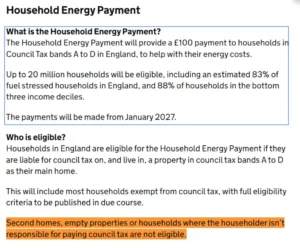
Official government guidance explaining automatic £100 payments, application arrangements and precautions against fraudulent messages.
What Should You Do If Your £100 Energy Payment Does Not Arrive?
Eligible households that have not received the payment should first establish whether their local authority has started processing payments.
As the scheme is administered locally, payment schedules may differ between areas.
Residents should check their council tax account, review their council’s payment announcements and confirm that any required application has been completed.
| Potential issue | Recommended action |
| Payment has not arrived in January | Check the council’s published payment schedule |
| Bank account details have changed | Contact the local authority |
| Council tax is not paid by Direct Debit | Check application instructions |
| Recently moved house | Ask the council which eligibility rules apply |
| Property is in band E or above | Enquire about discretionary assistance |
| Council tax exemption applies | Check the council’s final eligibility guidance |
| Payment application has been rejected | Request clarification and available review options |
Households experiencing immediate financial hardship should not wait until the £100 payment arrives before contacting their energy supplier.
Suppliers may be able to arrange affordable repayment plans, emergency credit or other forms of assistance depending on individual circumstances.
Conclusion
John Healey’s £100 energy support payment represents an important short-term intervention for millions of households facing rising winter energy costs.
With payments expected to begin in January 2027, eligible residents in council tax bands A to D should check their local authority’s arrangements.
However, projected energy price increases suggest that the payment alone may not provide sufficient protection against higher bills.
Additional support, including the £150 Warm Home Discount, discretionary council funding and planned energy market reforms, could offer further financial relief.
Households should confirm their eligibility, remain alert to scams and explore every available support option before winter costs increase.
Frequently Asked Questions
Is John Healey’s £100 energy support payment confirmed?
Yes. The Household Energy Payment was officially announced in the Autumn Budget on 28 October 2026, with distribution expected to begin in January 2027.
Is the £100 energy payment made per person or per household?
The payment is provided per eligible household, not per individual. Multiple adults living at the same qualifying address will not each receive £100.
Do I need to receive Universal Credit to qualify?
No. The main scheme is based on residential council tax eligibility rather than whether a household receives Universal Credit or other means-tested benefits.
Can I receive the £100 payment if I have a fixed energy tariff?
Yes. Eligibility is not generally determined by the type of energy tariff a household uses. Residents must satisfy the applicable council tax and residency conditions.
Will the £100 payment be deducted from my council tax bill?
The announced payment is intended to be paid directly to eligible households rather than operate as a standard reduction in council tax liability.
Can households using prepayment meters receive the £100 support?
Yes. Using a prepayment energy meter does not automatically exclude a household because the payment is administered through the council tax system.
Is the £100 energy payment a monthly or annual benefit?
Neither. It is a one-off financial support payment for the 2026/27 financial year. No recurring £100 payment has been announced.

Jennifer contributes business-focused articles covering modern business trends, digital growth, entrepreneurship, and practical insights designed to support startups and SMEs.

How to Pay Yourself From a Limited Company in the UK?: Salary, Dividends and Tax-Efficient Methods
Paying yourself from a limited company in the UK involves more than transferring money from your business bank account to your personal account. As a company director, you…

UK Budget Savings Tax Changes 2026: New Rates, ISA Rules and How Much More Savers Could Pay?
The UK Budget savings tax changes announced on 28 October 2026 have introduced significant financial implications for millions of savers, pensioners and small business owners. From 6 April…
Insights for the Modern
UK Small Business.
Join 15,000+ owners receiving tactical analysis on finance, marketing, and technology. No clutter.
Zero spam. Unsubscribe in one click.