Pension Shortfall for Over-40s: How Much Do You Need to Retire Comfortably in the UK?


Millions of UK adults over 40 face a potential pension shortfall as rising retirement costs, gaps in private savings and changes to the State Pension system create fresh financial challenges.
The Pensions Commission’s May 2026 interim report estimated that 15 million people are undersaving for retirement, with self-employed workers, lower earners and women among those facing particularly significant risks.
The Government’s October 2026 Budget has added another consideration. An adjusted State Pension triple lock is scheduled to take effect from April 2030, changing how future annual increases are calculated.
However, a pension shortfall does not automatically mean someone must abandon their retirement plans. Understanding existing savings, projected income and future expenses can reveal practical opportunities to improve financial security.
We examined the latest government announcements, pension industry research and retirement-cost benchmarks to explain what people in their 40s and 50s should consider.
What Should Over-40s Check First?
Before calculating how much additional money to save, it is important to establish what retirement income is already available.
Your 30-Second Pension Checklist
- Check your State Pension forecast and expected eligibility age.
- Locate workplace and personal pensions from previous employment.
- Add together the current value of defined contribution pension pots.
- Identify any guaranteed income from defined benefit pensions.
- Compare projected income against expected retirement expenses.
- Review employer matching and available pension tax relief.
These checks help distinguish a genuine savings deficit from incomplete information about existing pensions.
A pension statement might show a relatively small balance, but it could represent only one account among several accumulated throughout a career.
Why Are So Many People Over 40 Facing a Pension Shortfall?
The retirement savings challenge is not simply caused by people failing to save.
Many individuals entered their 40s after years of mortgage repayments, childcare expenses, fluctuating employment and limited disposable income.
Automatic enrolment increased workplace pension participation, but minimum contribution rates may not provide enough income to maintain someone’s previous lifestyle.
The Pensions Commission reported in May 2026 that approximately 45% of working-age adults were not currently contributing to a pension.
It also found that roughly half of low- and middle-earning employees were saving at minimum automatic-enrolment levels.
Pensions Commissioner Baroness Jeannie Drake emphasised the need for substantial reform, stating:
“This demands a renewed national settlement on pensions.”
Her comments reflect an important distinction: expanding access to pension saving does not necessarily guarantee adequate retirement income.
For someone aged 45, a further challenge is the limited period remaining before retirement. With fewer years available for investment growth, additional contributions may need to be larger.
Nevertheless, retirement planning should reflect individual circumstances rather than an assumed national savings target.
What Has Changed for UK Pensions Since May 2026?
Several major developments have made earlier pension forecasts less reliable.
| Development | Latest Position | Why It Matters |
| Pensions Commission | Interim report published 19 May 2026 | Identified widespread retirement undersaving |
| Retirement Living Standards | Updated 3 June 2026 | Revised annual retirement-cost estimates |
| State Pension age review | Third review launched July 2025 | Future eligibility ages could change |
| Triple lock reform | Confirmed in October 2026 Budget | Changes uprating calculations from April 2030 |
| Salary sacrifice | £2,000 annual NI exemption threshold from April 2029 | Affects some employee and employer contributions |
| Pensions dashboards | Connection deadline 31 October 2026 | Supports future access to pension information |
| Pensions Commission final report | Scheduled for February 2027 | Could recommend further saving reforms |
The October Budget also announced a Pension Tax Allowance from April 2027 for eligible pensioners with relatively low incomes.
This measure is intended to prevent people whose total income is at or below the full new State Pension rate from facing small Income Tax liabilities caused by State Pension uprating.
Importantly, it does not represent an additional universal pension payment.
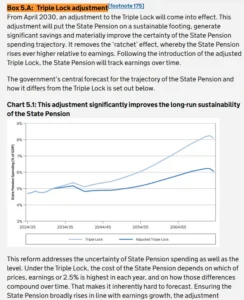
UK Budget 2026 confirms the adjusted triple lock and Pension Tax Allowance.
How Will State Pension Age Changes Affect People Over 40?
The State Pension age determines when an eligible person can begin receiving payments from the Government.
Under current legislation, it increases from 66 to 67 between April 2026 and April 2028.
A further increase to 68 is scheduled between April 2044 and April 2046.
The third State Pension age review, launched in July 2025, is examining factors including life expectancy and whether the existing timetable remains appropriate.
One possible outcome is an earlier increase to 68. However, an alternative timetable should not be described as confirmed legislation.
Could Someone Aged 45 Lose £42,700?
Research published by wealth management firm Rathbones in May 2026 suggested that someone aged 45 could receive approximately £42,700 less in State Pension payments compared with a scenario where eligibility remained at 66.
The estimate reflects particular assumptions about pension increases and the age at which payments begin.
It is not an announced Government deduction, an individual forecast or money removed from an existing pension account.
The revised triple lock planned for 2030 also means older projections should be reconsidered.
Financial Planning Director Ed Wood of Rathbones has highlighted how uncertainty around future State Pension provision increases the importance of building private retirement savings.
For over-40s, the appropriate response is to calculate how many years they may need to finance before receiving the State Pension.
Someone hoping to stop work at 65 but expecting State Pension eligibility at 68 needs a separate three-year income plan.
How Is the State Pension Triple Lock Changing?
The traditional triple lock increases the basic and full new State Pension by whichever is highest:
- Consumer price inflation.
- Average earnings growth.
- A guaranteed minimum increase of 2.5%.
The Government has committed to maintaining this arrangement through April 2029.
From April 2030, the announced adjusted triple lock will increase the State Pension by the highest of inflation, 2.5%, or the amount needed to maintain or restore its value relative to earnings.
This means pensions should remain protected against inflation while tracking average earnings over time, rather than automatically receiving the full annual earnings increase whenever that is highest.
The Government estimates that the adjustment could reduce annual State Pension expenditure by approximately £15 billion by the late 2030s.
For retirement planning, the central lesson is that future increases should not be assumed to match historical triple-lock outcomes indefinitely.
Readers interested in the differences between generations can also examine why the new State Pension is considered unfair to some existing pensioners.
How Much Money Is Needed for Retirement in 2026?
Pensions UK published updated Retirement Living Standards on 3 June 2026.
These estimates describe three lifestyles based on typical expenditure on essentials, transport, leisure and other everyday activities.
Retirement Living Standards: 2026 Figures
| Retirement Standard | Single Person | Couple |
| Minimum | £13,900 | £22,500 |
| Moderate | £32,700 | £45,400 |
| Comfortable | £45,400 | £62,700 |
Figures represent annual household spending estimates, not universal pension-pot requirements. Housing costs such as rent and mortgage payments are excluded.
The moderate standard allows greater flexibility for social activities and occasional holidays, while the comfortable standard reflects more discretionary expenditure.
Pensions UK estimates that approximately 82% of the working population may reach the minimum standard, compared with 23% reaching moderate and 9% comfortable.
Zoe Alexander, Executive Director of Policy and Advocacy at Pensions UK, has encouraged workers to investigate whether their employers can provide additional pension contributions above statutory minimum levels.
This is especially relevant to workers in their 40s, because employer contributions can substantially increase total retirement savings without requiring the entire increase to come from take-home pay.
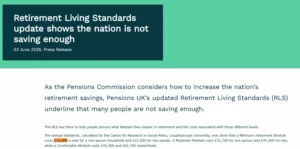
The updated 2026 Retirement Living Standards for individuals and couples.
How Large Should an Over-40s Pension Pot Be?
There is no universally correct pension balance for a 40-, 45- or 50-year-old.
A suitable target depends on existing savings, guaranteed pension income, retirement age, household composition and expected living expenses.
For example, Pensions UK’s 2026 illustrative estimates suggest that a single person pursuing a moderate retirement may need approximately £335,000–£505,000 in defined contribution savings, assuming receipt of the full State Pension and particular annuity rates.
Its comfortable retirement estimate is approximately £560,000–£845,000.
These are indicative calculations, not guaranteed requirements.
Rathbones published substantially larger figures in May 2026, including £1.68 million for a single 25-year-old planning to retire at 65.
That modelling allowed for decades of projected inflation and different retirement assumptions.
It should not be presented as the amount everyone over 40 needs today.
What Should You Have Saved by 40, 45, 50 or 55?
The following example illustrates how existing savings and future contributions interact.
Illustrative Assumptions
- Target private pension pot: £300,000 in today’s purchasing power.
- Target retirement age: 67.
- Annual investment growth: 3% above inflation, after fees.
- Contributions remain constant in inflation-adjusted terms.
- Monthly contributions include employee, employer and tax-relief amounts.
- No withdrawals, tax charges or guaranteed investment returns are assumed.
| Current Age | Pot Needed Now if Contributing £400 Monthly | Monthly Contribution Needed Starting From £0 |
| 40 | £44,800 | £602 |
| 45 | £77,900 | £804 |
| 50 | £116,400 | £1,129 |
| 55 | £161,100 | £1,733 |
These are illustrative mathematical projections, not age-specific savings recommendations.
The £300,000 target is not necessarily sufficient for a moderate retirement, and age 67 is used as a private-pension planning date rather than a prediction of State Pension eligibility.
Investment returns may be lower or negative, and inflation can change the actual money required.
How Much Extra Should Someone Save to Catch Up?
Consider someone aged 40 with £50,000 already invested in defined contribution pensions.
They want a £300,000 inflation-adjusted pot at 67.
Assuming 3% annual real investment growth, compounded monthly, they would need approximately £377 in total gross pension contributions each month.
If they postpone additional contributions until 45, the original £50,000 could grow to approximately £58,100.
They would then need about £503 monthly to achieve the same target at 67.
That delay increases the required contribution by approximately £126 per month.
For someone already contributing £200, the important figure is the difference between their current contribution level and the projected requirement.
Employees should include employer contributions and pension tax relief when making this comparison.
The calculation also illustrates why waiting for a mortgage to finish before increasing pension contributions can have a substantial long-term cost.
Can National Insurance Gaps Reduce Your State Pension?
Yes. State Pension entitlement depends partly on qualifying years in a person’s National Insurance record.
Generally, at least ten qualifying years are needed to receive any new State Pension.
People whose National Insurance records began after April 2016 generally need 35 qualifying years for the full amount.
However, people with contributions before April 2016 may be covered by transitional calculations, including adjustments related to contracting out.
Therefore, simply dividing the full State Pension by 35 does not accurately predict everyone’s entitlement.
What Is the State Pension Worth in 2026/27?
| Pension Type | Weekly Full Rate | Annualised Over 52 Weeks |
| Full new State Pension | £241.30 | £12,547.60 |
| Full basic old State Pension | £184.90 | £9,614.80 |
The old basic State Pension can be supplemented by Additional State Pension, so the headline rates do not always represent a person’s total entitlement.
For comparison, Joseph Rowntree Foundation research using 2025 conditions estimated a £17,400 gross annual income requirement for a particular single-pensioner household receiving Pension Credit.
That figure is not a universal 2026 threshold and should not be directly substituted for the newer Retirement Living Standards.
Readers concerned about missing contributions can explore whether they can receive a pension without having paid National Insurance.
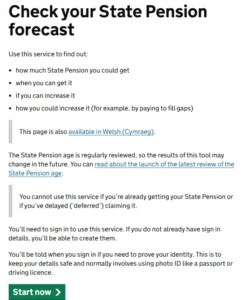
How the official State Pension forecast identifies pension age, entitlement and potential increases.
Should You Pay Voluntary National Insurance Contributions?
Voluntary contributions can sometimes improve State Pension entitlement, but paying them is not automatically beneficial.
Before making payments, check whether missing years can be covered through National Insurance credits, whether additional qualifying years would increase the forecast, and whether future employment could close the gap.
This is particularly important for people who took career breaks to raise children or provide unpaid care.
Can Lost Pension Pots Help Close the Shortfall?
Forgotten pensions can make retirement savings appear smaller than they actually are.
The Pensions Policy Institute estimated that approximately £31.1 billion was held in 3.3 million lost pension pots in 2024.
The average estimated value was around £9,500.
These figures describe pension accounts whose administrators cannot contact their owners, rather than money that has necessarily disappeared.
Someone who has worked for several employers may have multiple accounts with different providers.
How Can You Trace a Lost Pension Safely?
Begin with old employment contracts, payslips, pension statements and former employers.
The Government’s Pension Tracing Service can help identify contact information for pension schemes.
However, it cannot confirm whether someone owns a particular pension or disclose its current balance.
Pensions dashboards are intended to make this process easier.
The legal deadline for pension schemes within scope to connect their information is 31 October 2026.
That deadline does not mean the public dashboard becomes available on the same day.
The MoneyHelper Pensions Dashboard is expected in 2027/28, with a separate launch announcement required.
Until then, consumers should continue using existing official tracing methods.
Pension scam warning: Be suspicious of unsolicited calls, guaranteed investment returns, requests for substantial tracing fees or claims that pensions can easily be unlocked before the normal minimum pension age.
Always verify firms independently before supplying personal details.
Should You Consolidate Old Pension Pots?
Combining several defined contribution pensions can simplify administration and make retirement planning easier.
It may also reduce charges where a new provider offers better value.
Nevertheless, transferring pensions is not always the right decision.
| Potential Advantages | Potential Risks |
| Fewer accounts to manage | Exit fees or transfer charges |
| Simpler investment monitoring | Loss of valuable guarantees |
| Easier pension forecasting | Possible loss of protected pension access ages |
| Potentially lower ongoing fees | Different investment risks |
| More flexible retirement options | Delays during transfers |
Defined benefit pensions deserve particular attention because they usually promise an income calculated under scheme rules.
Transferring out can mean surrendering valuable guaranteed benefits.
Regulated financial advice is generally required when transferring safeguarded benefits worth more than £30,000 into flexible arrangements.
Those considering consolidation should also understand why some pension transfers experience significant delays.
A straightforward administrative arrangement should never take priority over protecting valuable pension rights.
How Does the £2,000 Salary Sacrifice Cap Affect Pension Savings?
From 6 April 2029, only the first £2,000 of annual employee pension contributions made through salary sacrifice will benefit from the existing National Insurance exemption.
Salary sacrifice allows employees to exchange part of their contractual salary for pension contributions paid by their employer.
Amounts above £2,000 can still be contributed, but employee and employer National Insurance will apply to the excess under the announced rules.
Income Tax relief on eligible pension contributions remains available, subject to the usual conditions.
Worked Example for £40,000–£60,000 Earners
| Example | £40,000 Salary | £60,000 Salary |
| Salary sacrificed | 5% | 10% |
| Annual contribution | £2,000 | £6,000 |
| Amount above NI exemption | £0 | £4,000 |
| Illustrative extra employee NI | £0 | £80 |
| Illustrative extra employer NI | £0 | £600 |
The calculations use 2026/27 standard Class 1 NI rates of 8% or 2% for employees and 15% for employers, as applicable.
Actual costs from 2029 depend on the rates, thresholds, payroll arrangements and final implementation rules at that time.
The policy does not place a £2,000 limit on pension saving.
For additional context, the planned salary sacrifice pension tax changes explain the potential implications for employers and employees.
How Can Self-Employed Workers and Business Owners Improve Their Pensions?
Self-employed people face a different retirement challenge because they are not automatically enrolled into a workplace pension through their own self-employment.
The Pensions Commission’s May 2026 report found that only around 4% of wholly self-employed workers were actively saving into a pension.
Irregular earnings, business investment needs and income uncertainty can all make consistent pension saving difficult.
A practical approach is to incorporate pension contributions into financial planning rather than treating them solely as payments made when profits are unusually high.
Should Sole Traders Consider a Personal Pension or SIPP?
Sole traders can contribute to personal pensions or self-invested personal pensions.
A SIPP offers additional investment choice, although greater flexibility also requires careful attention to fees, asset selection and risk.
Personal contributions can qualify for tax relief within applicable rules.
For example, with relief at source, an eligible basic-rate taxpayer contributing £80 personally may receive a further £20 in basic-rate tax relief into their pension.
Higher-rate taxpayers may be able to claim additional relief, depending on their circumstances.
Contributions should remain affordable alongside business taxes, emergency reserves and essential operating expenses.
Can Company Directors Make Employer Pension Contributions?
Limited company directors may be able to arrange pension contributions directly from their companies.
Employer contributions can be particularly useful because their tax treatment differs from extracting money through salary or dividends.
Qualifying employer pension contributions may be deductible for Corporation Tax where the relevant business-expense conditions are met.
However, company directors should not assume every contribution automatically qualifies for relief.
Profitability, total remuneration, contribution allowances and the company’s commercial circumstances matter.
An appropriately qualified accountant or regulated financial adviser should review substantial contributions before they are made.
Freelancers and gig workers should also account for months without contracts rather than assuming every year will produce consistent pension funding.
What Pension Tax Allowances Can Help Over-40s Catch Up?
The standard pension annual allowance remains £60,000 for 2026/27.
It generally covers the total value of pension savings made during the tax year, including relevant employer contributions.
Higher earners may have a reduced allowance.
People who have flexibly accessed taxable defined contribution pension savings may also become subject to the Money Purchase Annual Allowance, normally £10,000.
Unused annual allowance from the previous three tax years can sometimes be carried forward.
For 2026/27, these are:
- 2023/24
- 2024/25
- 2025/26
Carry forward normally requires pension scheme membership during the relevant earlier year.
It does not remove the separate restrictions on tax relief for personal contributions.
These provisions may help individuals who receive a large bonus, sell a business or have temporarily higher earnings, but large contributions require careful tax calculations.
Why Does the Sandwich Generation Face Greater Pension Pressure?
Many people in their 40s and 50s simultaneously support children and ageing parents.
They may face university costs, mortgage repayments, care-related expenses and reduced working hours.
These commitments can create pension contribution gaps precisely when retirement planning becomes more urgent.
Rather than stopping contributions indefinitely, households can assess whether smaller regular payments remain sustainable.
Maintaining enough accessible savings for emergencies is also important.
Pension investments are generally inaccessible until the normal minimum pension age, currently 55 and increasing to 57 from April 2028 for most people.
The rules and exceptions are explained in more detail under early private pension withdrawal restrictions.
Long-term pension contributions should not come at the cost of leaving a household unable to manage immediate financial emergencies.
What Pension Mistakes Should People Over 40 Avoid?
Several common decisions can increase retirement shortfalls.
The first is relying on the full State Pension without checking the actual entitlement.
Another is assuming an employer’s minimum pension contribution will automatically finance a comfortable retirement.
Other avoidable problems include overlooking charges, abandoning pension contributions after changing jobs, taking unnecessary withdrawals and transferring pensions without checking guarantees.
Some savers also rely too heavily on investment return assumptions.
A projected pension balance is not guaranteed, and higher potential returns generally involve greater investment risk.
Retirement planning should also consider the tax consequences of withdrawing large pension sums.
The strongest strategy is usually a combination of realistic spending assumptions, consistent contributions, appropriate investment decisions and periodic reviews.
What Happens if Your Pension Savings Are Too Low?
Insufficient savings may require practical adjustments to retirement plans.
Some people choose to work longer, reduce discretionary expenditure or move gradually into part-time employment.
Others may consider downsizing, using accessible non-pension savings or changing their intended retirement lifestyle.
A phased retirement can be particularly useful where an individual wants to reduce working hours before receiving the State Pension.
However, continuing employment is not always possible because of health, caring responsibilities or labour-market conditions.
Financial plans should therefore include alternatives rather than assuming that working indefinitely will solve every shortfall.
People approaching retirement on low incomes should also investigate eligibility for Pension Credit and other relevant support.
Frequently Asked Questions
Will the State Pension Age Rise to 68 Sooner?
It could. The Government is reviewing the timetable, but the currently legislated increase to 68 remains scheduled between 2044 and 2046.
How Much State Pension Will I Receive With 25 Qualifying Years?
There is no universal amount. Entitlement depends on your National Insurance history, including any pre-2016 transitional adjustments. Check your personal forecast rather than automatically calculating 25/35 of the full rate.
What Is the £2,000 Pension Salary Sacrifice Cap?
From April 2029, the National Insurance exemption on employee pension contributions made through salary sacrifice will generally apply only to the first £2,000 annually. It is not a maximum pension contribution.
Can I Use the New Pensions Dashboard Now?
The public service has not yet launched. The 31 October 2026 deadline concerns pension-provider connections, while public availability is expected separately in 2027/28.
Can Self-Employed People Get a Workplace Pension?
Self-employed individuals are not automatically enrolled through their own self-employment, but they can establish personal pensions or SIPPs. Those who also hold qualifying employment may participate in an employer’s workplace scheme.
Is It Too Late to Start a Pension at 50?
No. Saving at 50 still allows time for contributions, investment growth and potential tax relief. However, the monthly amount needed may be considerably higher than if contributions had started earlier.

Jennifer contributes business-focused articles covering modern business trends, digital growth, entrepreneurship, and practical insights designed to support startups and SMEs.

UK Budget Savings Tax Changes 2026: New Rates, ISA Rules and How Much More Savers Could Pay?
The UK Budget savings tax changes announced on 28 October 2026 have introduced significant financial implications for millions of savers, pensioners and small business owners. From 6 April…

DWP Energy Bill Letters Dispatched: Six Million Households Could Get £150 Discount
Millions of UK households are being urged to watch their post as the Department for Work and Pensions (DWP) prepares to distribute letters concerning a £150 reduction in…
Insights for the Modern
UK Small Business.
Join 15,000+ owners receiving tactical analysis on finance, marketing, and technology. No clutter.
Zero spam. Unsubscribe in one click.